
NASHCoDe: Redefining Community Detection through the Lens of Game Theory
A game theory inspired, decentralized, local information based algorithm for community detection in social graphs
This paper introduces NASHCoDe, a decentralized community detection algorithm inspired by non-cooperative game theory. It models network nodes as rational agents aiming to maximize a local utility function, achieving a Nash stable partition where no node benefits from changing its community.
TL;DR
Community detection is usually treated as a global optimization problem, but real-world social groups form through individual choices. NASHCoDe (Nash Stability based Community Detection) flips the script by treating every node as a rational agent in a game. It uses only local neighborhood data to reach a stable equilibrium, outperforming traditional centralized algorithms in both modularity and coverage without needing to know the number of communities beforehand.
The Problem: Why Global Optimization Fails Social Intuition
Most classic algorithms for community detection (like those optimizing for Modularity or Conductance) operate under a "top-down" philosophy. They assume a central observer trying to maximize a global score. However, social networks are "bottom-up" entities. In the real world, you join a community because of your friends and local connections, not because a central authority decided it improved a global modularity score.
Current SOTA methods face two major hurdles:
- Centralization: They require access to the entire graph topology simultaneously.
- Prior Knowledge: They often require the user to input the expected number of clusters (), which is rarely known in complex biological or social systems.
The Insight: Nodes as Rational Agents
The authors propose that a community is effectively a Nash Stable Partition. In this state, no individual node can improve its "happiness" (utility) by jumping to a different group.
The Utility Function: Why Local Density Matters
Instead of looking at the whole graph, a node evaluates its utility based on:
- How many neighbors it has within its current community.
- How well those neighbors are connected to each other (triangles).
The mathematical intuition is captured by the utility function: Where is the internal degree and represents triangles. This formula rewards nodes for being in "clique-ish" environments, which is exactly how tight-knit communities are structured.
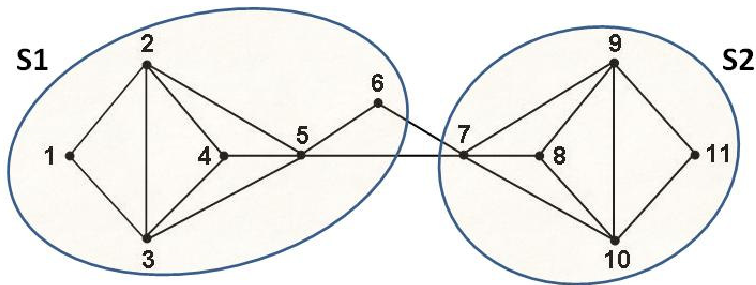 Figure 1: An illustration of how nodes evaluate their position within a partition based on local connectivity.
Methodology: The NASHCoDe Algorithm
The algorithm is elegantly simple and decentralized:
- Initialization: Start with small random clusters (e.g., groups of 3).
- Iterative Refinement: Nodes are visited in order of their degrees. Each node calculates if moving to a neighbor's community would increase its local utility.
- Convergence: If a node finds a better home, it moves. Because the authors proved that these moves increase a global "capacity" function, the algorithm is guaranteed to converge to a Nash equilibrium and never enter an infinite loop.
Experiments: Dominating the Benchmarks
The researchers tested NASHCoDe against three heavyweights: the Greedy Algorithm, the Spectral Algorithm, and the Randomized Game Theory (RGT) approach.
Key Results
The performance gain in Coverage (the fraction of edges that stay within communities) is massive. While traditional algorithms often struggle to keep edges internal, NASHCoDe achieves superior results:
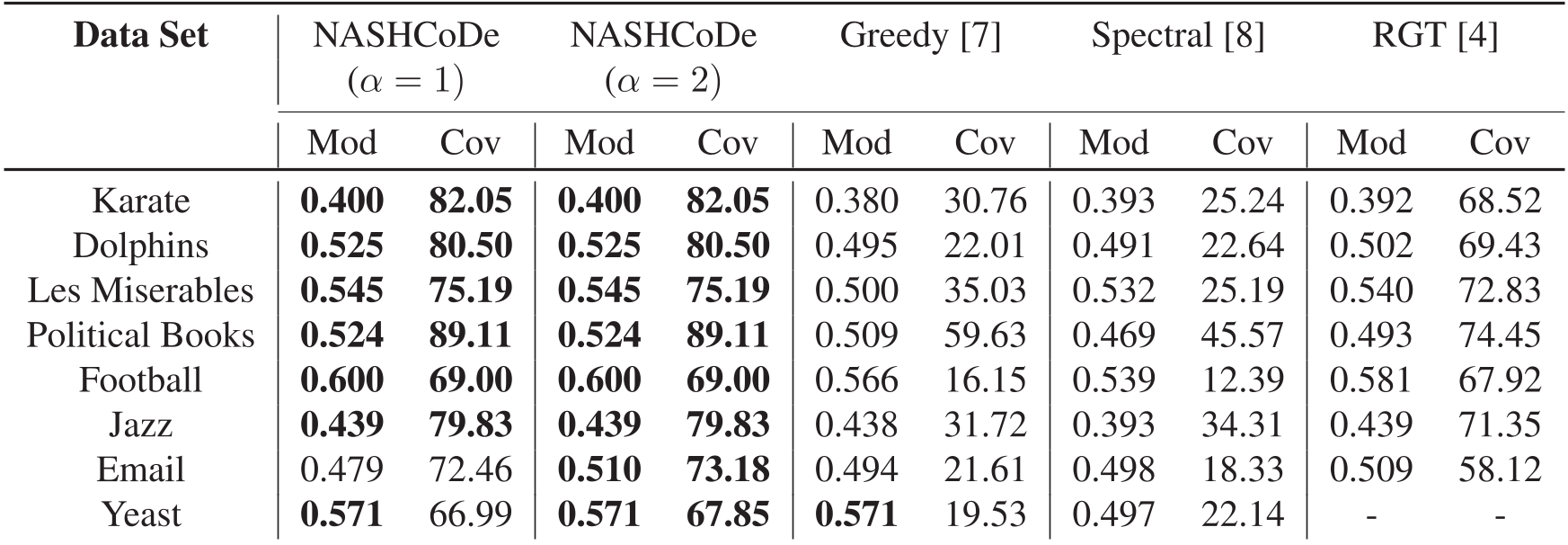
- Karate Club: NASHCoDe achieved 82.05% coverage, nearly tripling the Greedy algorithm's 30.76%.
- Modularity: Across all datasets (Dolphins, Football, Email, etc.), NASHCoDe either matched or exceeded the modularity of centralized SOTA methods.
Critical Analysis & Future Outlook
NASHCoDe succeeds because it aligns the mathematical objective with the natural behavior of social agents. Its O(n log n) complexity (in typical cases) makes it viable for large-scale graphs where global optimization becomes computationally prohibitive.
Limitations:
- The algorithm currently assumes unweighted and undirected graphs.
- The choice of the "initial partition" can still influence the speed of convergence, though not the eventual stability.
Future Work: This framework opens the door for community detection in privacy-preserving environments, where nodes might only know their neighbors but not the entire network. Applying this game-theoretic approach to directed graphs or weighted biological networks could be the next frontier in graph mining.
Conclusion
By shifting the focus from global modularity to local Nash stability, NASHCoDe provides a robust, decentralized, and intuitive way to find communities that truly matter to the nodes themselves.