
PNH: Reimagining Cognitive Training via Collaborative Gamification for Older Adults
Gamification of cognitive training: a crowdsourcing-inspired approach for older adults.
This paper introduces Preventive Neuro Health (PNH), a gamified cognitive training tool designed for older adults to prevent dementia. It utilizes a unique crowdsourcing-inspired collaborative model and personalized engagement layers to achieve superior long-term adherence compared to traditional monotonous tasks.
TL;DR
Cognitive decline is a global challenge, yet most digital "brain training" fails due to boredom. Preventive Neuro Health (PNH) shifts the paradigm from lonely, repetitive drills to a crowdsourced community effort. By replacing cutthroat competition with collaborative milestones, PNH offers a clinically-backed, personalized experience that treats cognitive health as a shared journey rather than a solitary chore.
The "Boredom Barrier" in Cognitive Healthcare
Current research confirms that cognitive training can delay dementia symptoms, but there is a catch: it only works if you actually do it. Most existing tools are "monotonous tasks" that participants drop after the initial novelty wears off.
The authors' critique of current SOTA (State of the Art) commercial solutions like Lumosity and Cognifit is sharp: these platforms often use "distracting" game elements or "direct comparisons" (leaderboards) that have been shown to induce stress in older adults, actually hindering performance.
The Crowd-Sourcing Insight: Why Work Alone?
The core "Aha!" moment of this paper is the application of Crowdsourcing principles to healthcare. Instead of a user working for their own high score, their performance contributes to a "Virtual Economy."
- The Metaphor: Think of it as a community garden. Your individual effort (training session) adds points to a global pool.
- The Reward: Once the community hits a milestone, everyone unlocks new features or content.
- The Result: This fosters Relatedness—the feeling of being part of a group—which is a much more powerful long-term motivator for users over 50 than a gold medal.
Methodology: The PNH Architecture
The PNH system isn't just a skin over old games; it's a sophisticated technical stack designed for Personalization.
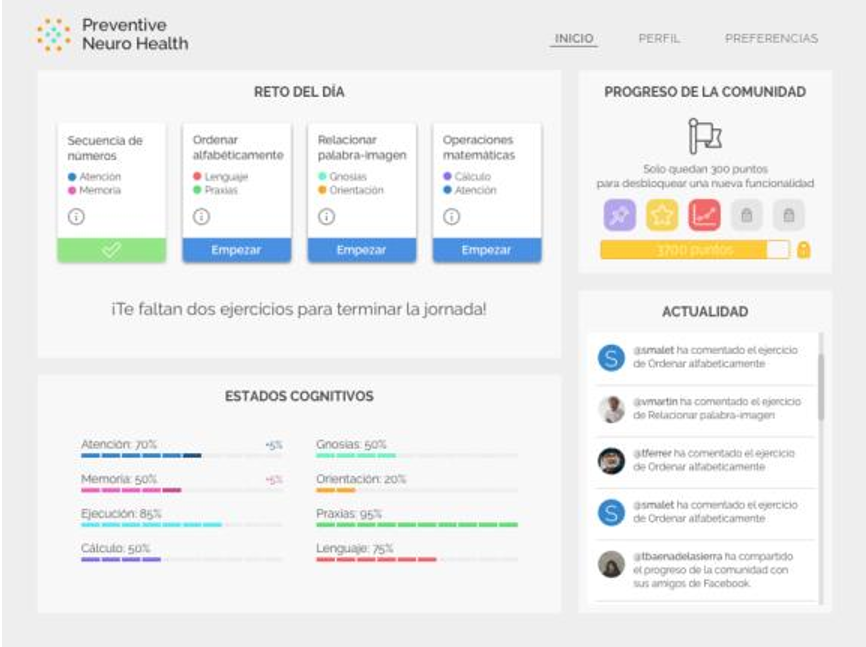 Figure: The PNH Technical Architecture, highlighting the Gamification Engine and Automatic Scheduler.
Key Technical Components:
- Automatic Scheduler: This module prevents the "Frustration vs. Boredom" trap (Flow theory). It dynamically adjusts difficulty based on historic performance and clinical goals.
- Gamification Engine: Unlike static systems, this engine processes "Contextual Information." If you haven't logged in, it sends a personalized trigger; when you finish, it shows how much you helped the entire community.
- SPARC Framework: The authors evaluate every design choice against five pillars: Sense, Purpose, Autonomy, Relatedness, and Competency.
UI/UX: Accessibility Meets Engagement
The interface (built with Django and ImpactJS) prioritizes high-contrast, large-touch targets, and a "Card-based" dashboard to reduce cognitive load.
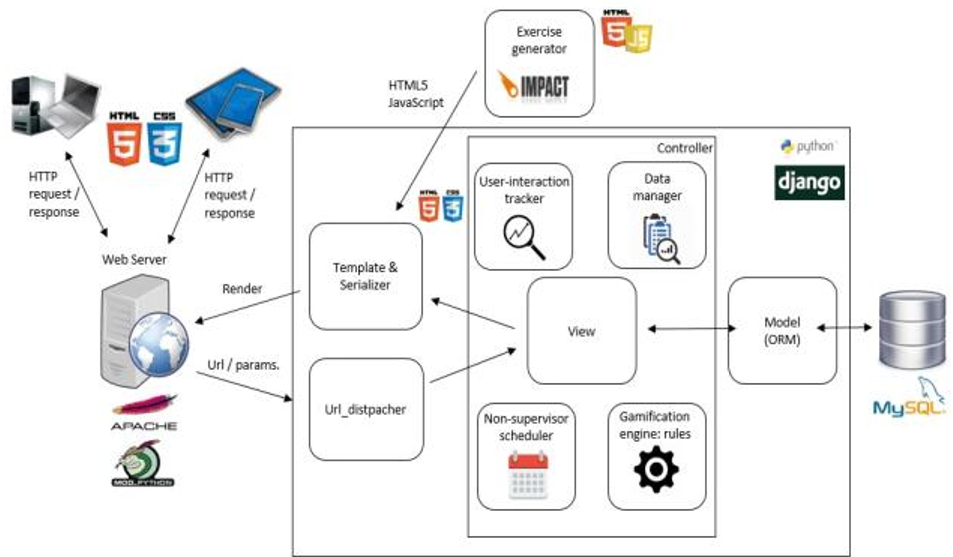 Figure: The PNH Dashboard featuring Daily Challenges and community progress bars.
Critical Analysis & Future Outlook
The PNH approach succeeds where others fail by recognizing that older adults are not just "older gamers." Their motivational profile is distinct—prioritizing social contribution and individual growth over status.
Limitations: While the design is robust, the paper primarily presents the framework and architecture. The real-world efficacy depends on the results of the planned 2017 pilot study, specifically whether the "collaborative" group maintains higher daily active usage (DAU) over 90 days compared to a control group.
The Takeaway for Devs: If you are building for the 50+ demographic, ditch the badges. Build a community where every click helps the person next to them. Social currency is the most valuable asset in the longevity economy.