
Foursquare's Score Game: Decoding the Mechanics of Social Competition
Towards understanding the gamification upon users’ scores in a location-based social network
2016-08-01
Summary
Problem
Method
Results
Takeaways
Abstract
This paper investigates the social gamification of "User Scores" in Foursquare, quantifying how leaderboard dynamics drive check-in behaviors. By applying the Granger Causality Test to longitudinal score data, the authors identify significant predictive influences between friends, establishing 20% causality rates compared to 10% in random graphs.
## TL;DR
Does seeing your friend's high score on a leaderboard actually make you go out more? This paper proves it does. By analyzing Foursquare's user score system through the lens of **Granger Causality**, the researchers uncovered a hidden "influence network" where users' check-in habits are driven by the competitive desire to climb the local leaderboard.
## The Motivation: Moving Beyond "Spatial Homophily"
In the world of Location-Based Social Networks (LBSNs), we've long known that friends tend to visit similar places—a phenomenon known as *spatial homophily*. However, the *why* has remained murky. Is it just because you live in the same neighborhood? Or is the "gamification" of the platform—badges, points, and leaderboards—actively pushing you to compete?
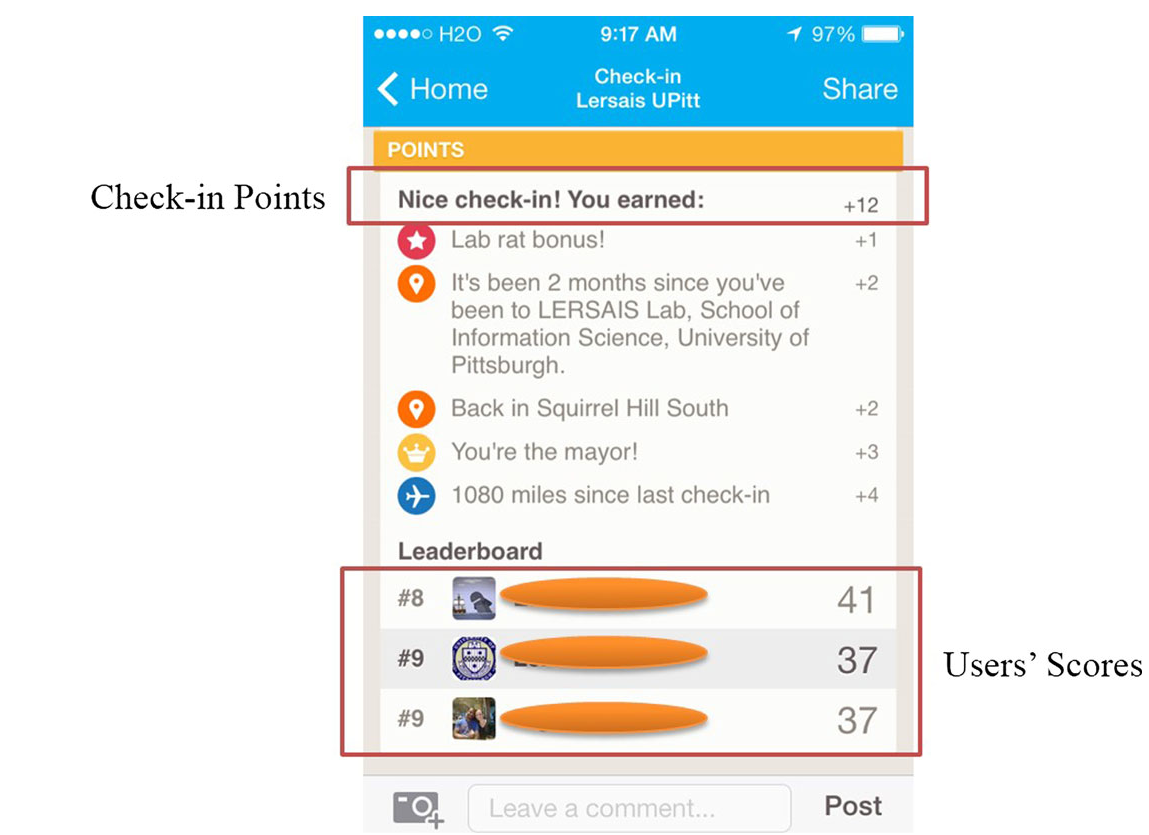
The authors argue that Foursquare's **User Scores** (a rolling 7-day accumulation of check-in points) serve as a perfect proxy for social status. If your friend spikes in points, do you follow suit?
## Methodology: The Granger Causality Network
To isolate true influence from random noise, the researchers utilized the **Granger Causality Test**.
### How it works:
If knowing User A's past scores helps predict User B's future scores better than knowing User B's history alone, we say User A "Granger-causes" User B's behavior.
The authors transformed the undirected friendship graph into a **Directed Granger Causality Network**. This new network differentiates between:
- **One-way influence**: You follow a "leader" in your group.
- **Interplay edges**: You and a friend are in an active, mutual back-and-forth competition.
- **Recursive Influence Triangles**: A influences B, B influences C, and A also influences C.
## Key Insights from the Experiments
The empirical study concentrated on a 10,254-user subset in the Pittsburgh area.
### 1. The "Gamer" Profile
"Involved users" (those participating in the score competition) are not your average users. They possess:
- **Higher Scores**: 30% of involved users had average scores > 50, compared to only 15% for others.
- **Higher Degree**: They are social butterflies with significantly more friends.
- **Higher Similarity**: Friends who compete on scores have much more similar check-in patterns.
### 2. The Power of Mutual Competition
Only ~15% of causal links were mutual (interplay). These users usually rank very closely on the leaderboard, indicating that competition is fiercest between "peers" rather than between experts and novices.
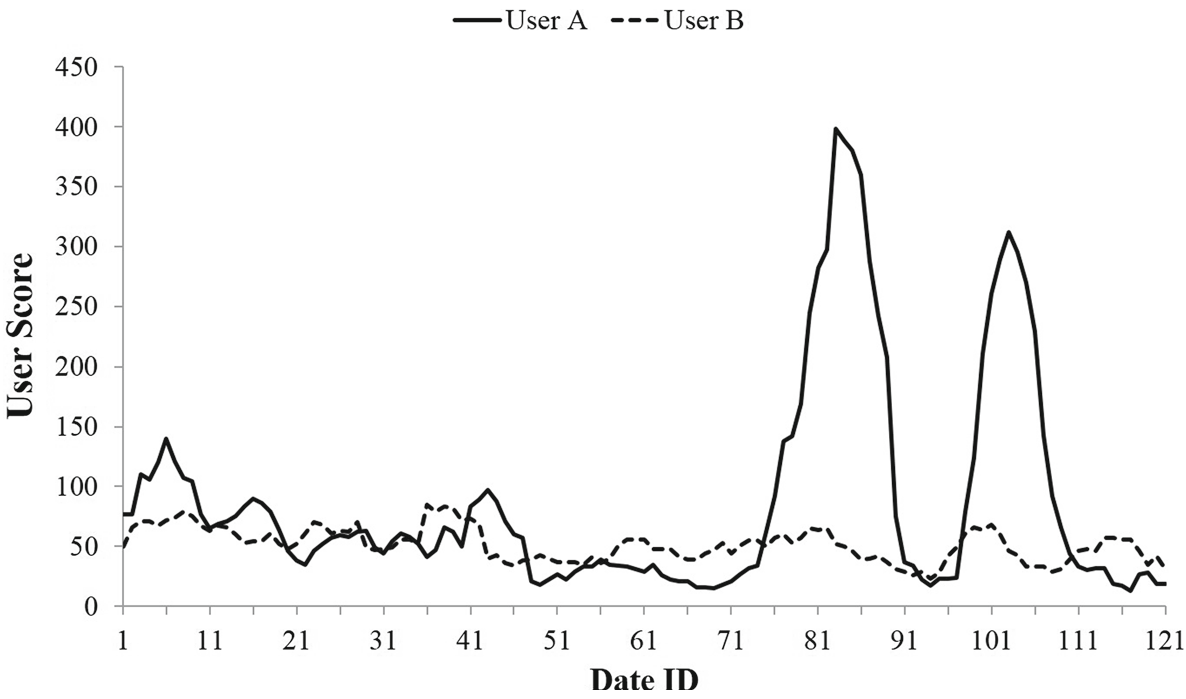
*Figure: Note how User B's score often mirrors User A's movements with a slight lag—a classic signal of influence.*
### 3. The "Status" Theorem
The research confirmed the "status theorem" in these recursive triangles: influence generally flows from high-degree users (high status) to lower-degree users.
## Critical Analysis & Future Value
This work is a pioneering step in treating gamification as a measurable social force rather than just a UI feature.
**Real-world Application**:
- **Precision Marketing**: Instead of recommending a venue to all of a user's friends, platforms should target the "competitors" identified in the causality network. They are the ones most likely to "react" to a friend's new check-in.
- **Friend Recommendation**: If User A competes with User B, and B competes with C, suggesting C as a friend to A might increase platform engagement via new competitive cycles.
**Limitations**:
A major caveat is that the study does not distinguish between *positive* influence (cheering a friend on/competing) and *negative* influence (avoiding the same places). Future models could integrate sentiment analysis or "distrust" links to refine these dynamics.
## Conclusion
The leaderboard is more than just a list; it is a behavioral regulator. By mathematically proving that our scores "Granger-cause" those of our friends, this research provides a blueprint for building more addictive and socially-aware gamified services.