
Gamifying Knowledge: Turning Routine KB Maintenance into a Playable Simulation
Knowledge Base Refinement with Gamified Crowdsourcing
The paper proposes a gamified crowdsourcing framework for Knowledge Base (KB) refinement, specifically targeting weighted Linked Data. It introduces a simulation model to evaluate "Games with a Purpose" (GWAP) rule designs, demonstrating how quiz-based interactions can correct erroneous link weights in a domain ontology.
TL;DR
Building and maintaining a high-quality Knowledge Base (KB) is notoriously labor-intensive. This paper introduces a gamified crowdsourcing approach to refine weighted Linked Data. By treating KB updates as a "Game with a Purpose" (GWAP) and using a simulation model to test game rules, the researchers demonstrate that even casual players can fix complex ontology errors—provided the system can intelligently filter out unreliable contributors.
Problem & Motivation: The Expert Bottleneck
In the era of Linked Data and RDF (Resource Description Framework), the value of a KB lies in its connections. However, machine learning often misses the nuances of domain-specific relationships (e.g., knowing that "no hot water" relates more to a "bathroom" than a "kitchen").
The authors identify two major pain points:
- Cost: Hiring domain experts for KB maintenance is unsustainable.
- Motivation & Quality: While crowdsourcing is cheaper, casual users lack the incentive to be accurate and often provide noisy or "lazy" data.
To solve this, the authors look toward Gamification—specifically seeking a way to predict if a game's rules will actually result in a cleaner KB before spending money on a live deployment.
Methodology: Dynamic Weights and Calibration
The core of the system is a weighted RDF model. Instead of a simple "A is related to B" link, each link has a weight () representing the strength of the relationship.
1. The Game Loop
The authors designed two game types:
- Collection Game: Based on "inversion-problem" GWAPs, where one player describes an image and another guesses the location, generating new keywords in the process.
- Correction Game: A quiz-based format where users identify the most relevant floor plan section for a given keyword.
2. The Weight Update Logic
When a player selects an answer, the KB doesn't just record it; it updates the underlying manifold of weights using the following logic:
- Correct answer (a):
- Other answers:
3. User Reliability (The Factor)
To handle "trolls" or low-effort users, the system injects calibration quizzes (questions with known answers). A user's performance on these hidden tests determines their reliability score , which scales their impact on the KB.
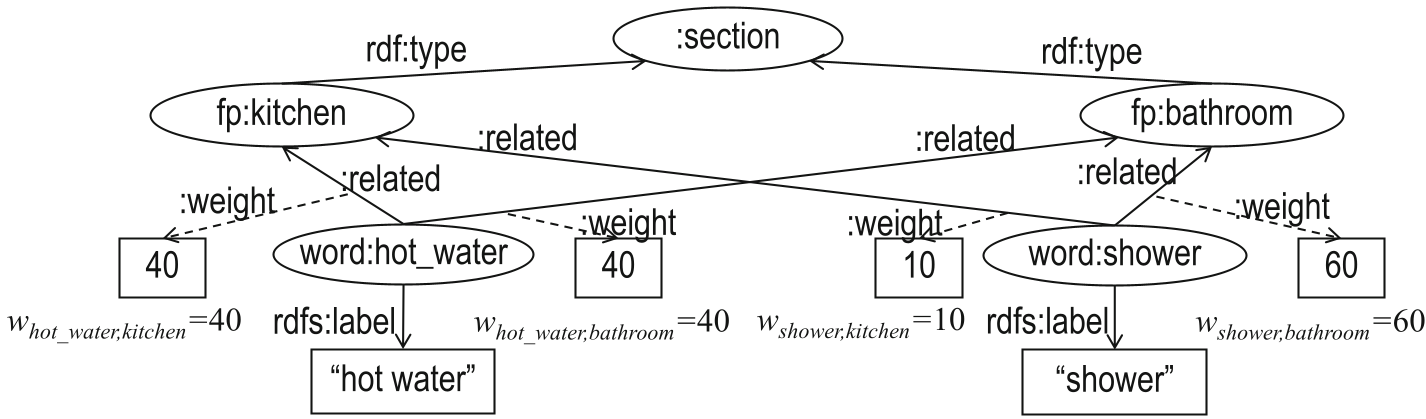 Figure 1: An example of the weighted domain ontology connecting equipment to floor plan sections.
Experiments: Proving the Simulation Works
The researchers simulated 500 game rounds with varying ratios of "reliable" vs. "non-reliable" users.
Key Findings:
- Convergent Accuracy: Even with only 20% reliable users, the system eventually corrected the KB error (the "bathroom" weight eventually overtook the "kitchen" weight).
- Calibration Efficiency: Utilizing calibration quizzes allowed the system to reach the "correct" KB state roughly 45% faster than a system that treated all users as equally reliable.
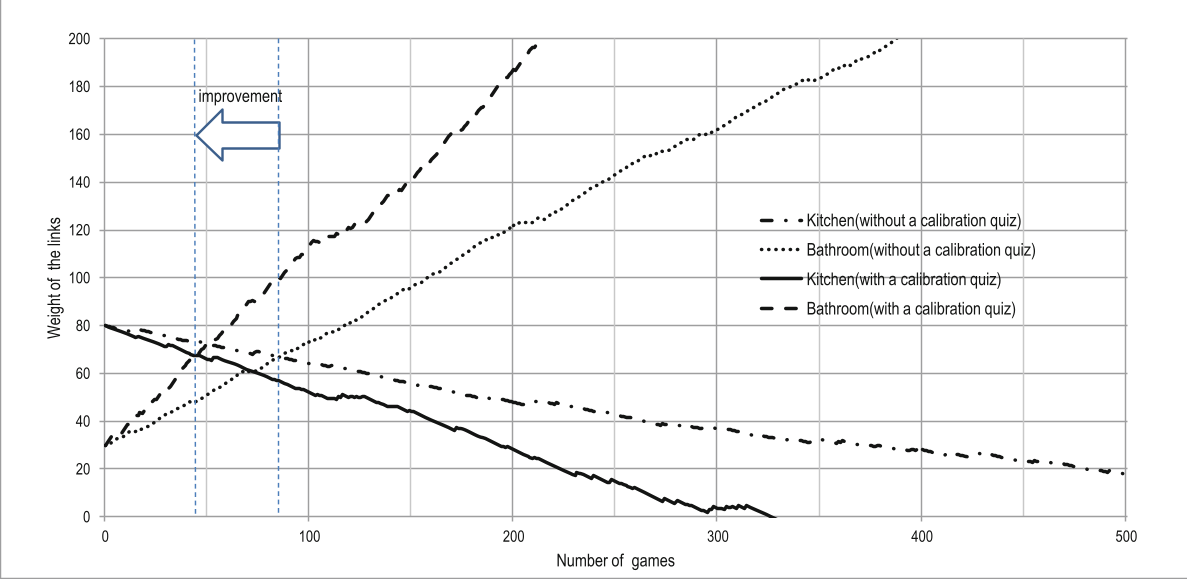 Figure 2: Simulation results showing link weights converging toward the correct relationship over 500 rounds.
Critical Insight: Why This Matters
The most significant contribution here isn't just the game itself, but the simulation model. By simulating the refinement process, developers can "stress test" their incentive structures and update coefficients () without real-world failure costs.
Limitations & Future Work
While the simulation is promising, it relies on a simplified binary model of user reliability (either 1.0 or 0.0). Real human behavior is more nuanced, involving fatigue, learning curves, and cultural bias. The authors acknowledge that the next step is validating this model against actual human players to see if the simulated "improvement rates" hold steady in the wild.
Final Takeaway
Knowledge Base Refinement doesn't have to be a chore for experts. By framing it as a weighted network that "learns" from gamified human input, we can build self-healing data ecosystems that thrive on the collective intelligence of the crowd.