
GappaGoshti™: Bridging the Rural Digital Divide via Voice-Based Social Media
GappaGoshti™: a social networking platform for information dissemination in the rural world
GappaGoshti™ is a mobile-based multimedia social networking platform designed for information dissemination and expert advice exchange among rural, semi-literate farmers in India. By utilizing an asynchronous voice-based model combined with a visual UI in local languages, it achieves high engagement in knowledge sharing for agricultural sustainability.
TL;DR
GappaGoshti™ is a social networking platform tailored for Indian farmers that replaces complex text-based internet with an asynchronous voice-and-visual mobile interface. By allowing users to record, tag, and thread short audio clips, it transforms the mobile phone into a powerful tool for peer-to-peer agricultural advice and local marketing, boasting a 90% engagement rate in pilot tests.
Problem & Motivation: The Literacy and Technology Gap
In India, over 70% of the population depends on agriculture, yet the farmers responsible for food security are often the least supported by modern information technology. The "Digital Divide" is not just about lack of hardware; it is a barrier of literacy, language, and interface complexity.
Existing solutions have significant flaws:
- PCs: Too complex, power-hungry, and non-localized.
- SMS: Requires text literacy and doesn't support local dialects well.
- IVRS (Voice Menus): Slow, sequential, and lacks a personal "social" feel.
The authors recognized that while farmers might struggle with a keyboard, they are highly comfortable with mobile phones and oral communication. The motivation was to create an "Internet-like experience" without the need for traditional internet skills.
Methodology: The "Visual-Voice" Hybrid
GappaGoshti™ treats voice as a persistent, asynchronous medium rather than a synchronous phone call. This means a user can post a question, and others (or experts) can reply hours later—creating a searchable, browsable community knowledge base.
Key Architectural Pillars:
- Short Voice Posts: Users record 20-second clips. This limit balances communicative value with the constraints of poor GPRS/network speeds.
- Visual UI (Marathi Language): Instead of complex menus, the platform uses intuitive icons and local terminology to guide the user.
- Threaded Discussions & Tagging: To solve the "discoverability" problem of audio, the system introduced tagging (categories) and threading (linking replies to questions), allowing farmers to follow specific agricultural topics.
 Figure 1: High-level visual interface showing recording, playback, and weather services.
Experiments & Results: Real-World Adoption
The platform was deployed in Raigad with a group of farm owners and agricultural workers. The results highlighted a shift from technology "fear" to "utility":
- Engagement: 90% of the pilot group were active, using the platform for commerce (marketing mangoes and rice) and advice (pest control, mango ripening).
- Social Policing: Notably, no spam was reported. The community naturally "policed" the content, keeping discussions focused on agriculture and local news.
- Activity Breakdown: Data showed that listening to posts and responding to queries were the most popular features, validating the "help-desk" nature of the social network.
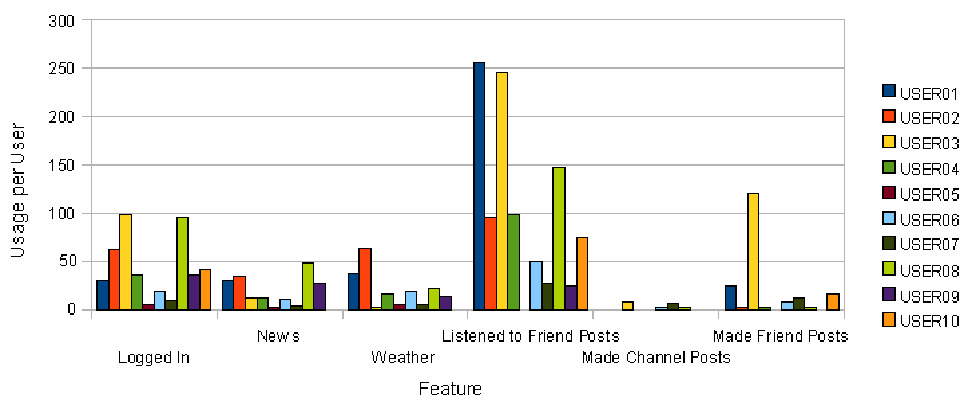 Figure 2: Statistical representation of feature usage, highlighting high engagement in listening and information retrieval.
Critical Analysis & Conclusion
The "Why" behind the Success
GappaGoshti™ succeeds because it respects the Inductive Bias of its users. Rural communication is inherently oral and communal. By mimicking a village "Chitchat" (the literal meaning of GappaGoshti) digitally, the authors reduced the cognitive load required to use a "new" technology.
Limitations & Future Work
Despite its success, the platform faced hardware challenges. Many users found it difficult to carry extra handsets provided for the study. Future versions aim to support multimedia components like photos and video, which would allow farmers to show—rather than just describe—crop diseases or soil conditions.
Final Takeaway
GappaGoshti™ proves that for ICT (Information and Communication Technology) to serve the "Global South," it must move away from text-centric paradigms. The future of the rural internet is localized, visual, and above all, spoken.