
Gated DeltaNet: Harmonizing Gating and the Delta Rule for Superior Linear RNNs
Gated Delta Networks: Improving Mamba2 with Delta Rule
The paper introduces Gated DeltaNet, a novel linear RNN architecture that unifies the data-dependent gating of Mamba2 with the targeted memory update mechanism of the Delta Rule. By optimizing training through an extended WY representation and chunkwise parallelism, it achieves SOTA performance across language modeling and long-context retrieval tasks.
TL;DR
Linear Transformers and State Space Models (SSMs) like Mamba2 have promised efficient scaling, yet they often struggle with high-precision retrieval compared to standard Transformers. Gated DeltaNet bridges this gap by merging two powerful ideas: the dynamic forgetting of gating mechanisms and the surgical precision of the Delta Rule. The result is a model that forgets what is useless and remembers what is vital, outperforming Mamba2 and DeltaNet across major benchmarks while maintaining high training throughput.
Problem & Motivation: The Memory Collision Crisis
In the world of efficient sequence modeling, we have had two main camps:
- Gated Linear RNNs (e.g., Mamba2): These use a scalar decay to control memory. If the model wants to forget something, it has to dim down the entire memory state equally. It’s like using a global dimmer switch when you only want to turn off a desk lamp.
- Delta Rule Networks (e.g., DeltaNet): These use a rank-1 update to "write over" specific old information. While precise, they lack a "clear all" button, making them struggle when the context shifts entirely (e.g., switching between different documents in a long prompt).
The authors' insight is simple: These two are complementary. Gating provides a macro-level memory clearing mechanism, while the Delta Rule provides micro-level associative precision.
Methodology: The Gated Delta Rule
The core innovation is the Gated Delta Rule update: Here, acts as the global forget gate, and acts as the selective update (the Delta Rule).
Hardware-Efficient Training
The major hurdle for Delta-rule models has always been speed. Purely recurrent updates are slow on GPUs. Gated DeltaNet overcomes this by extending the WY representation—a technique from numerical linear algebra—to work with gating. This allows the model to be trained in "chunks," leveraging Tensor Cores for massive parallelism.
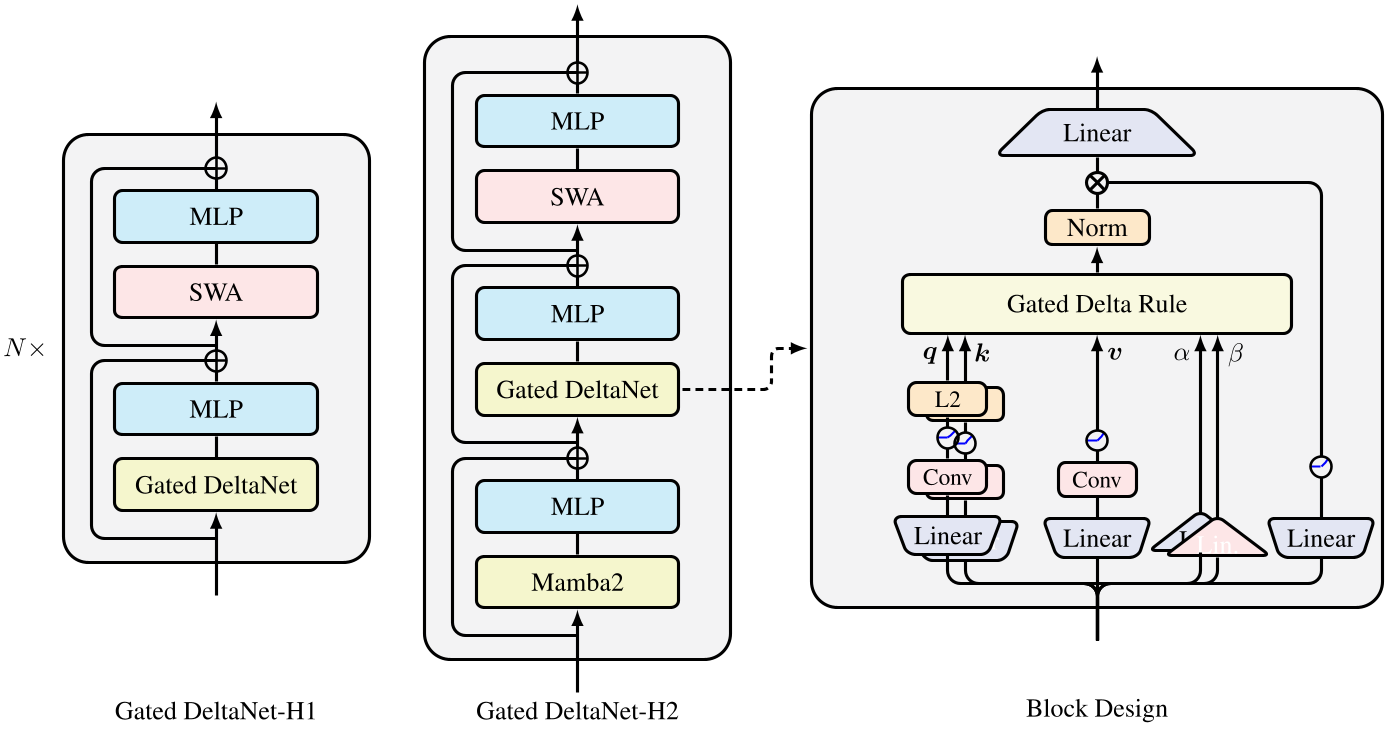 Figure 1: The architecture setup. Gated DeltaNet can serve as a standalone token mixer or be interleaved with Sliding Window Attention (SWA) to form powerful hybrid models like H1 and H2.
Experiments: Performance at Scale
The authors trained several 1.3B parameter models on 100B tokens. Gated DeltaNet consistently clawed back the performance lost by other RNNs in retrieval-heavy tasks.
The "Needle In A Haystack" (NIAH) Test
As shown in the table below, DeltaNet (pure delta) excels at simple retention but fails when "haystack" (noise) is added. Mamba2 (pure gating) fails as sequences get longer. Gated DeltaNet maintains high performance by filtering noise while retaining the "needle."

Throughput Analysis
Despite the added mathematical complexity, Gated DeltaNet is highly optimized. It achieves nearly the same throughput as the original DeltaNet and remains competitive with Mamba2, especially in hybrid configurations.
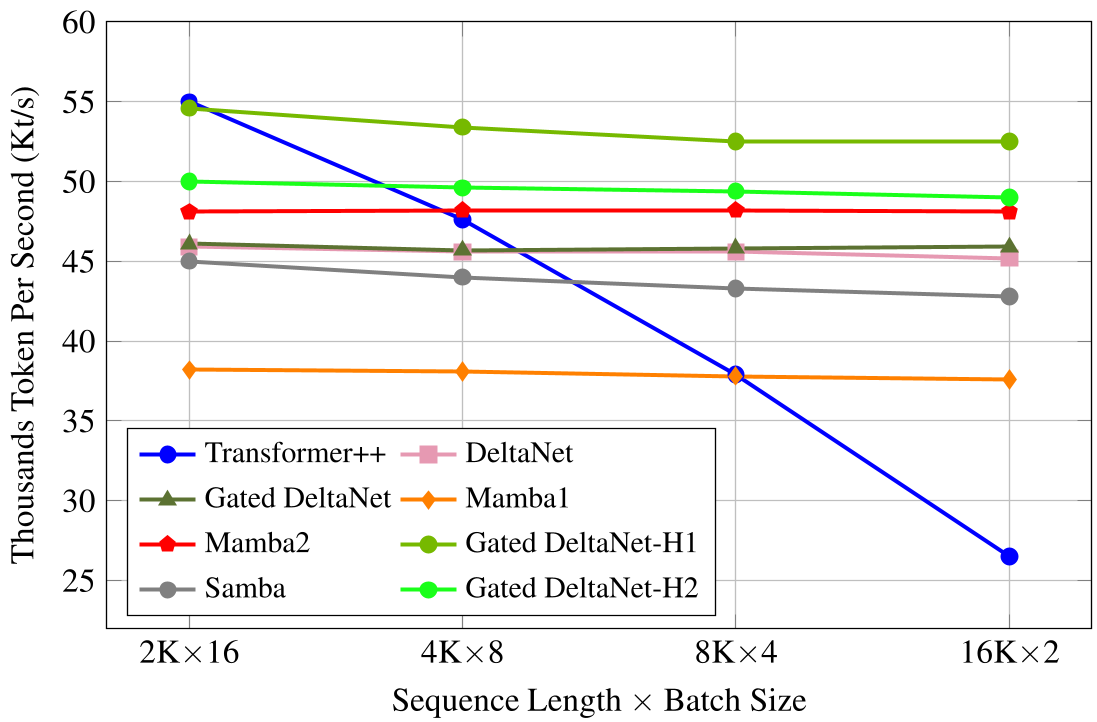 Figure 2: Throughput comparison shows that adding hybrid SWA layers actually increases speed by reducing the recurrent state overhead.
Critical Insight: Why This Matters
The "Delta Rule" is essentially a form of Online Gradient Descent. By setting up the hidden state as a fast-weight matrix that tries to minimize an online regression error (making ), Gated DeltaNet is effectively "learning" to associate keys and values at test time.
The addition of gating serves as adaptive weight decay. In deep learning, weight decay prevents the model from exploding; here, it prevents the memory state from becoming "saturated" with old, irrelevant associations.
Conclusion
Gated DeltaNet represents a significant step forward for the RNN-revival movement. By proving that complex update rules like the Delta Rule can be parallelized and gated effectively, it opens the door for sub-quadratic models that don't just "summarize" context, but actively "learn" it during the forward pass.
Takeaway: If your task involves long-context reasoning or precise retrieval (e.g., RAG, Code generation), purely gated models like Mamba may not be enough—selective, delta-based updates are likely the path forward.