
Beyond Keywords: Using Social Topology to Filter Disaster Intelligence
Gathering High Quality Information on Landslides from Twitter by Relevance Ranking of Users and Tweets
2016-11-01
Summary
Problem
Method
Results
Takeaways
Abstract
The paper presents a comprehensive disaster information system that extracts high-quality landslide data from Twitter using a social sensing approach. It introduces a dual-layer strategy involving Word2Vec-based tweet classification and a PageRank-inspired relevance ranking of users to filter noise and identify authoritative event reports.
## TL;DR
Researchers from the Georgia Institute of Technology have developed a system that filters Twitter "noise" to find real-world landslide events with over 94% accuracy. By combining **Word2Vec** semantic analysis with a **PageRank** based user influence model, the system distinguishes between a "political landslide" and a literal mudslide, prioritizing reports from authoritative "social sensors."
## Problem & Motivation: The Noise in the Machine
Social media platforms are the "eyes and ears" of the modern world during disasters. However, using them as reliable data sources is notoriously difficult. Keywords like "landslide" are highly polysemic—they are used more often to describe unexpected election victories or Fleetwood Mac songs than actual geological disasters.
The authors identify two fatal flaws in existing SOTA (State Of The Art) methods:
1. **Semantic Weakness**: Simplistic models like Bag-of-Words (BOW) fail to capture the context of words.
2. **Democratic Bias**: Current systems treat a tweet from the *US Geological Survey* (@USGS) with the same weight as a tweet from a random bot or a casual fan, leading to significant detection errors.
## Methodology: Semantics Meets Social Graphs
### 1. Semantic Classification with Word2Vec
Instead of treating words as isolated tokens, the system uses **Word2Vec** (Skip-gram model) to transform tweets into 300-dimensional vectors. By calculating the **centroid vector** of a tweet, the model captures the underlying intent. An SVM (Support Vector Machine) then classifies these vectors into "Relevant" or "Irrelevant."
### 2. The Virtual Community & PageRank
The breakthrough of this paper lies in the **Relevance Ranking** of users. The authors construct two "Virtual Communities":
* **Relevant Community**: Users who post/interact with actual disaster content.
* **Irrelevant Community**: Users focused on politics, sports, or music.
By applying the **PageRank** algorithm to the "retweet graph," the system calculates an influence score for every user within these specific domains. An authoritative source like @BBCNews gains high scores in both, while a local geologist might only rank high in the "Relevant" community.
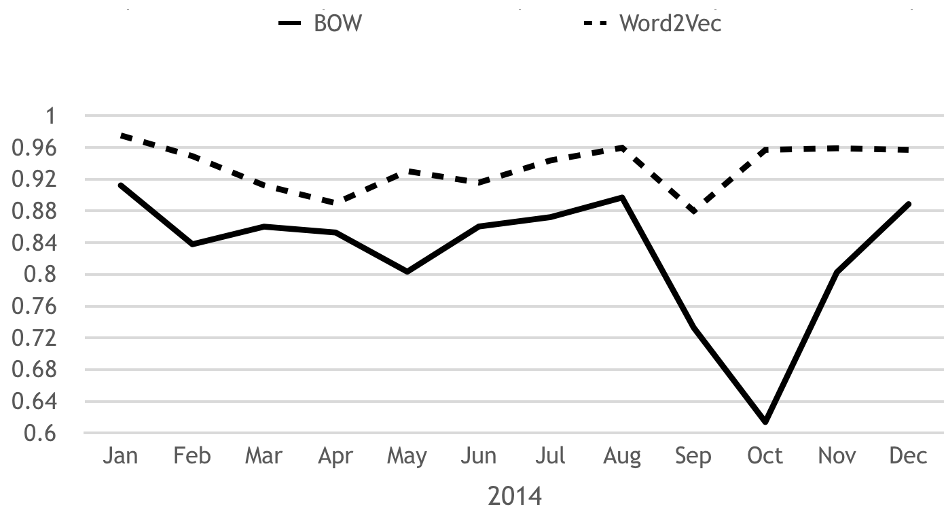
*Fig 1: Word2Vec significantly outperforms the Bag-of-Words baseline across the entire evaluation period.*
### 3. Spatiotemporal Event Ranking
The Earth is divided into a grid of 2.3-mile cells. The final "Disaster Probability" for a cell is not just a count of tweets, but a weighted sum:
$$P(\omega|x) = \sum RelRank(POS) - \sum IrrelRank(NEG)$$
This formula penalizes noisy cells and amplifies signals from high-influence, relevant users.
## Experiments & Results: Precision in Action
The system was tested on a massive 2014 dataset of landslide-related geotagged tweets.
* **Classification Performance**: The Word2Vec approach achieved an **F1-score of 0.936**, a massive jump from the 0.828 achieved by traditional BOW models.
* **Detection Accuracy**: By weighing user influence, the event detection F1-score reached **0.941**.
* **Visualizing Influence**: The research reveals how authoritative news sources (like @YahooNews) and local experts form the backbone of the "Relevant" community graph.
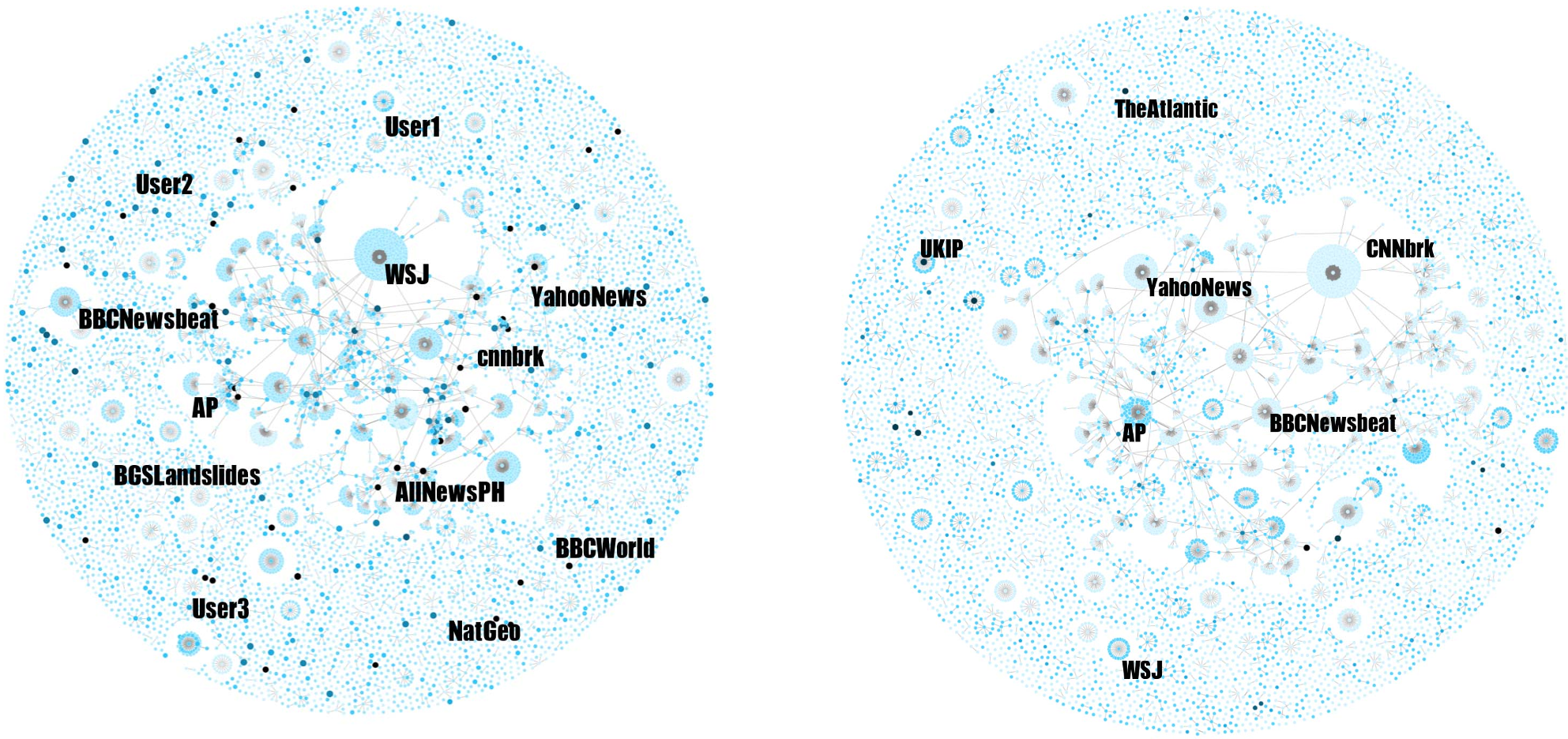
*Fig 2: Visualization of the "Irrelevant" community network, showing how clusters of non-disaster discourse are identified.*
## Critical Analysis & Conclusion
**Takeaway**: This work proves that "who says it" is just as important as "what is said." By mapping the social topology of Twitter, the system effectively transforms "social noise" into a high-fidelity sensor network.
**Limitations**: The model assumes only one disaster per cell within a 30-day window. While this prevents duplicates, it may struggle in regions hit by multiple separate incidents (e.g., a series of mudslides along a mountain range).
**Future Work**: The authors aim to expand this to multimodal data (Instagram/YouTube), as images of mudslides are often more definitive than short text descriptions. This research paves the way for a real-time, global disaster monitoring system that could potentially save lives through early warning.