
GP-MVM: Leveraging Gathering Points to Supercharge Viral Marketing in Decentralized Networks
Gathering Point-Aided Viral Marketing in Decentralized Mobile Social Networks
The paper introduces GP-MVM, a gathering point-aided viral marketing scheme for decentralized Mobile Social Networks (MSNs). It leverages "Gathering Points" (GPs) as relay nodes and social metrics to optimize seed selection and information diffusion, outperforming existing MSN diffusion methods in scale and speed.
TL;DR
Viral marketing is no longer just for Facebook or Twitter. This paper introduces GP-MVM, a framework designed for decentralized Mobile Social Networks (MSNs) where nodes (users) communicate via short-range protocols (like WiFi-Direct) without a central server. By identifying "Gathering Points" (GPs)—like malls or campuses—and using a new metric called Integrated Contact Strength (ICS), the researchers have created a way to spread information faster and more reliably than previous state-of-the-art methods.
The Problem: The Chaos of Decentralized Spread
In a standard Online Social Network (OSN), we have global knowledge of the "graph." We know who is friends with whom. In a decentralized MSN, we are "blind."
- Unreliable Diffusion: Nodes move unpredictably; an encounter is a rare, opportunistic event.
- Limited Knowledge: No single node knows the entire network structure.
- Resource Constraints: Mobile devices have limited battery and storage, meaning we can't just flood the network with copies of an ad.
The Insight: People Are Creatures of Habit
The authors noticed that while human movement seems random, we often congregate at Gathering Points (GPs). A GP can be equipped with a "throwbox"—a simple storage device. Instead of hoping two people meet in the street, we can use these GPs as "dead drops" or hubs for information.
Methodology: Integrated Contact Strength (ICS)
The secret sauce of this paper is the ICS metric. Most models only look at node-to-node contact. GP-MVM looks at:
- Node-to-Node Strength (): How often do I meet other people?
- Node-to-GP Strength (): How often do I visit specific hubs?
The ICS is defined as: This formula allows the system to prioritize nodes that are either social butterflies or frequent visitors to popular locations.
1. Distributed Seeding
The "Information Source" doesn't just pick the first person it sees. It uses Ratio Seeding or Threshold Seeding to hand off "seed" status to users with high ICS scores. This ensures the information stays in the hands of the most effective "spreaders."
2. The GP-Aided Diffusion Algorithm
Once seeds are selected, the process follows three parallel phases:
- Seed Refreshing: If a seed meets someone with a higher ICS, it "hands off" its seed status.
- Information Storing: When a seed hits a GP, it uploads the ad to the throwbox.
- Information Diffusion: Both the seeds and the GPs push the information to any non-infected node they encounter.
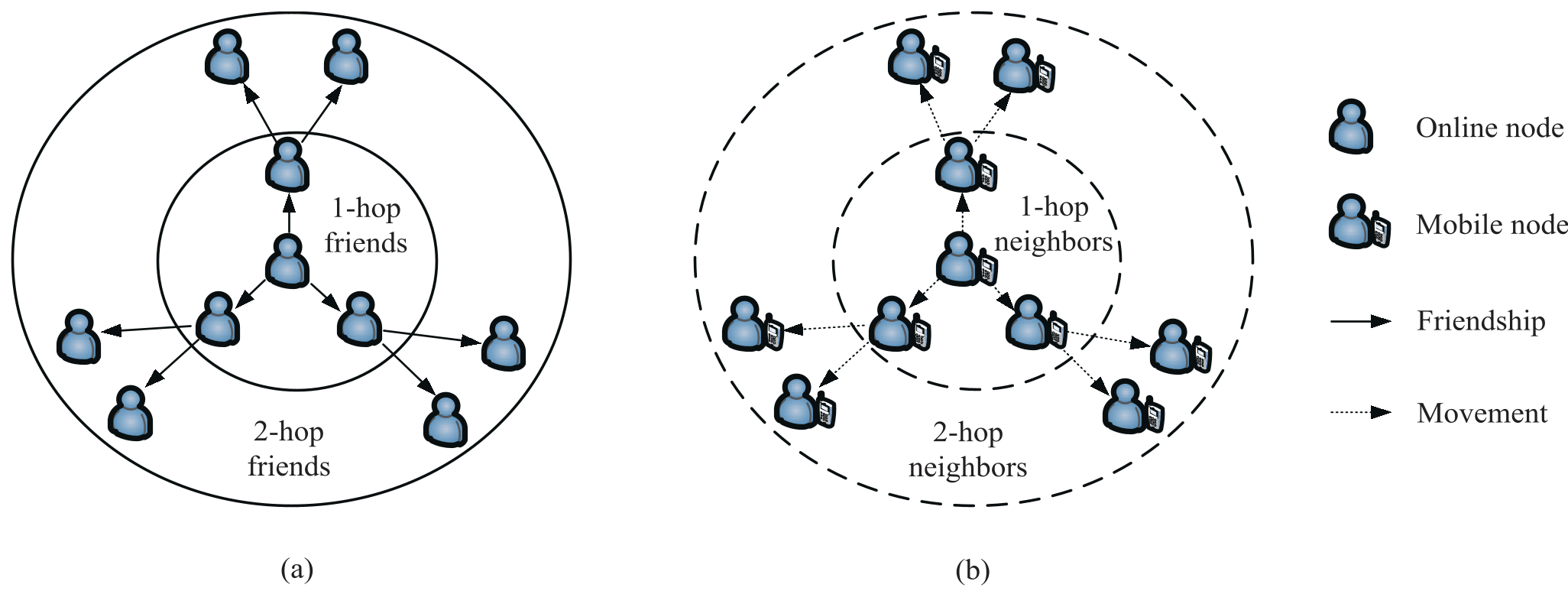 Fig 1: Illustrating the transition from Online Viral Marketing (left) to Mobile Viral Marketing (right).
Experimental Results
The authors validated their model using a Continuous-time Markov Chain and verified it with real-world mobility data from the Dartmouth College trace.
SOTA Comparison
GP-MVM was pitted against SocialCast (social-aware) and Homing Spread (location-aware but knowledge-blind).
- Higher Reach: GP-MVM consistently hit a higher percentage of the total population within the Time-to-Live (TTL) window.
- Faster Speed: Most nodes received information within the first 2-4 hours, whereas competitors lagged significantly behind.
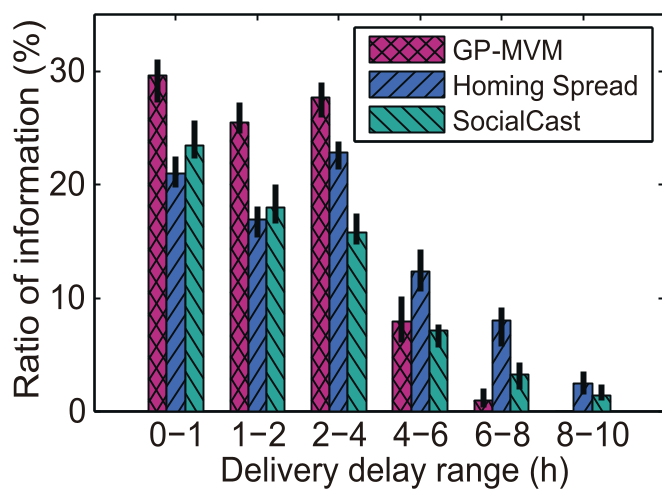 Fig 2: Diffusion proportion comparison showing GP-MVM (solid lines) outperforming SocialCast and Homing Spread.
Critical Insight: The "Omega" Trade-off
The paper highlights a fascinating trade-off via the weight .
- If you set low, you favor GPs. This results in high reliability (eventually everyone gets it) but low speed (it takes time for people to walk to the GPs).
- If you set high, you favor node-to-node contact. This is fast but less reliable, as the "word-of-mouth" might die out in isolated clusters.
Conclusion
GP-MVM proves that the most effective way to manage decentralized information spread is to marry social behavior with physical geography. By turning "Gathering Points" into active participants in the marketing chain, the network overcomes the fragility of individual mobile movements.
Future Outlook: The next step for this research will likely involve "Incentive Mechanisms"—how do we pay or reward users for being "seeds" and using their battery to spread ads?