
GMM-Based Interest Prediction: Redefining User Profiling in Social Networks
Gaussian Mixture Model Based Interest Prediction In Social Networks
This paper introduces a user interest prediction framework for social networks using a Gaussian Mixture Model (GMM) clustering approach. Tested on a massive Sina Weibo dataset containing 16 million messages, the method achieves a state-of-the-art prediction accuracy of up to 93.9%, outperforming traditional models like SVM and K-means.
TL;DR
Researchers have developed a high-precision interest prediction model using Gaussian Mixture Models (GMM). By analyzing 16 million Sina Weibo messages, the model achieves a maximum accuracy of 93.9%, significantly surpassing established baselines like SVM and K-means. The core innovation lies in its ability to handle the "fuzzy" boundaries of user interests through probabilistic clustering and effective denoising.
Context & Motivation: The "Noise" in Big Social Data
In the era of Big Data, social media platforms are gold mines for personalized recommendation and behavior analysis. However, traditional interest prediction methods often struggle with:
- Scalability: Supervised models require massive labeled datasets.
- Ambiguity: Users often belong to multiple interest groups or change their focus ("swing users").
- Complexity: Social data is high-dimensional and frequently noisy.
The authors argue that unsupervised clustering—specifically GMM—is the key to unlocking efficient, accurate, and dynamic interest prediction without the overhead of exhaustive manual labeling.
Methodology: From Raw Posts to Gaussian Components
The proposed framework follows a rigorous four-stage pipeline:
1. Feature Extraction
Using the ICTCLAS system for Chinese word segmentation and TF-IDF for frequency statistics, the authors extracted 579 key interest eigenvalues across 20 predefined categories (e.g., Finance, Technology, Entertainment).
2. The GMM Framework
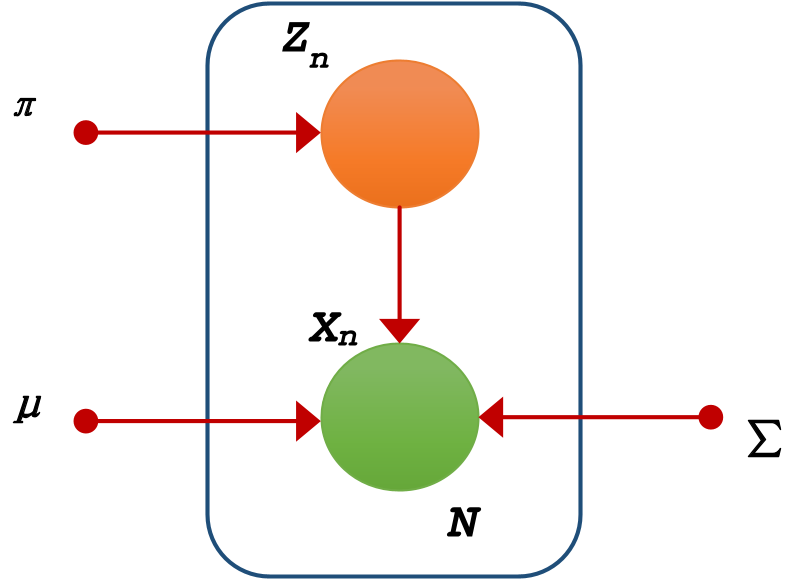
Unlike K-means, which assigns a data point to a single cluster (hard-clustering), GMM assumes the data is generated from a mixture of several Gaussian distributions. Each user is represented as a linear superposition: This allows the model to capture the probability of a user belonging to a specific interest category, providing a much-needed "soft" boundary.
3. Optimization via EM Algorithm
The parameters () are optimized using the Expectation-Maximization (EM) algorithm, iteratively maximizing the log-likelihood of the observed user behavior data.
Experiments & Breakthrough Results
The model was validated using a dataset of 4,613 Weibo users. A critical part of the process involved Denoising. Initial clustering results showed overlapping "noise points" caused by "swing users." By applying Independent Component Analysis (ICA), the authors cleared the boundaries between interests.
Performance Highlights:
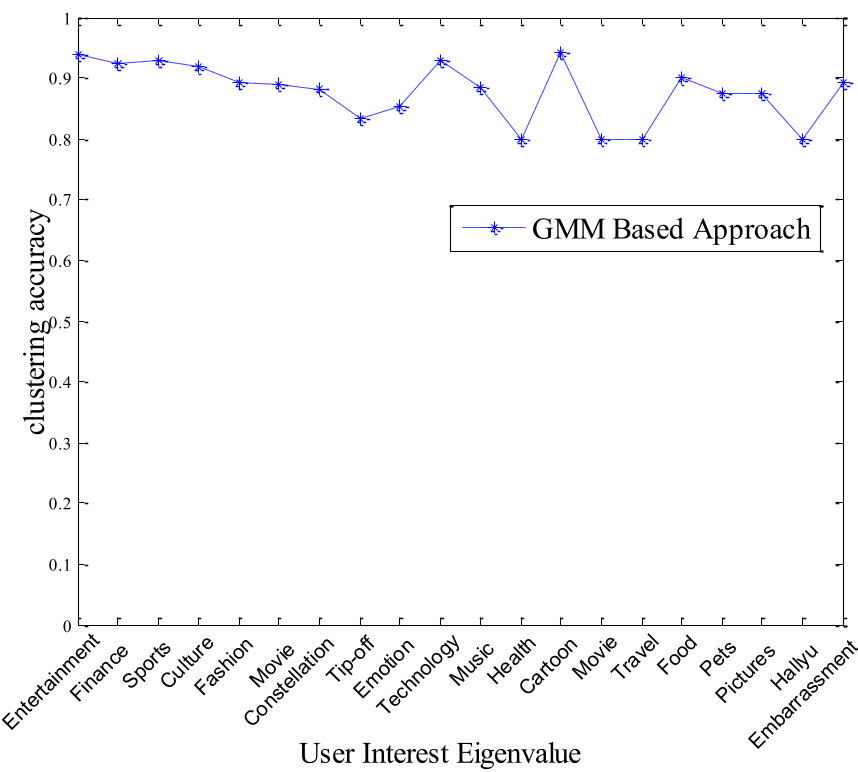
- Accuracy: Reached 93.9% for high-engagement categories.
- Stability: The prediction accuracy remained consistently above 80% across all 20 categories.
- Superiority over SVM/K-means: As shown in the comparison table, GMM's F-measure (~0.93) dominates traditional classifiers.
Comparison with Baselines
| Classifier | Precision (Pos) | Recall (Pos) | F-measure (Pos) |
|---|---|---|---|
| GMM | 0.9435 | 0.9140 | 0.9285 |
| SVM | 0.840 | 0.859 | 0.849 |
| K-means | 0.845 | 0.831 | 0.838 |
Critical Insight: Why GMM Wins
The success of GMM in this context points to a fundamental truth in social network analysis: Interest is not a point; it is a distribution. K-means fails because it ignores the variance and the covariance of features, treating every interest-cluster as a perfect sphere. GMM, by contrast, accounts for the "ellipsoidal" nature of data—recognizing that some interests (like "Technology") might correlate with others ("Finance") in complex, non-linear ways.
Conclusion & Future Look
The GMM-based approach offers a balanced solution between computational speed and prediction accuracy. While the study focused on text-based features from Weibo, the methodology is highly extensible. Future research could integrate Graph Neural Networks (GNN) with GMM to incorporate topological social relationships (friends' influences) directly into the Gaussian components, likely pushing the accuracy even closer to the theoretical limit.
Takeaway: For developers of recommendation systems, moving from hard-assignment to probabilistic modeling is a low-hanging fruit with massive SOTA potential.