
Advancing Competitiveness: The Innovation Path for GBA Service Trade Firms via the "Corpus-Metaphor-WordNet" Schema
Competitiveness Advancement Innovation Path of GBA Heterogeneous Service Trade Firms with Entrepreneurial and Innovative Spirit
2020-01-01
Summary
Problem
Method
Results
Takeaways
Abstract
This paper investigates the competitiveness of heterogeneous service trade firms in the Guangdong-Hong Kong-Macao Greater Bay Area (GBA). It proposes a "Corpus-Metaphor-WordNet" schema combined with Markov and Bayesian modeling to identify the innovation paths driven by entrepreneurial spirit.
## TL;DR
This research provides a novel methodological framework to enhance the competitiveness of heterogeneous service trade firms in the Guangdong-Hong Kong-Macao Greater Bay Area (GBA). By integrating **Markov Leap Chains**, **Bayesian principles**, and a **Corpus-Metaphor-WordNet schema**, the author identifies three critical drivers: GBA-level integration, regional agglomeration, and industrial cluster synergy, all underpinned by a "humanity-oriented" entrepreneurial spirit.
## Problem & Motivation: Beyond Traditional Economic Metrics
The service trade sector in the GBA is inherently heterogeneous, making it difficult for standard economic models to track how qualitative factors—like "entrepreneurial spirit"—translate into quantitative market leads.
Prior work in innovative entrepreneurial orientation (EO) has often treated innovation as a static firm-level trait. However, this paper argues that in a high-density urban agglomeration like the GBA, competitiveness is a **systemic emergent property**. The challenge lies in mapping the "soft" metaphor of innovation onto the "hard" reality of spatial economic data.
## Methodology: The Corpus-Metaphor-WordNet Schema
The author introduces a sophisticated spatio-temporal model system. The core innovation is the use of a **Fuzzy Association Location model** that utilizes:
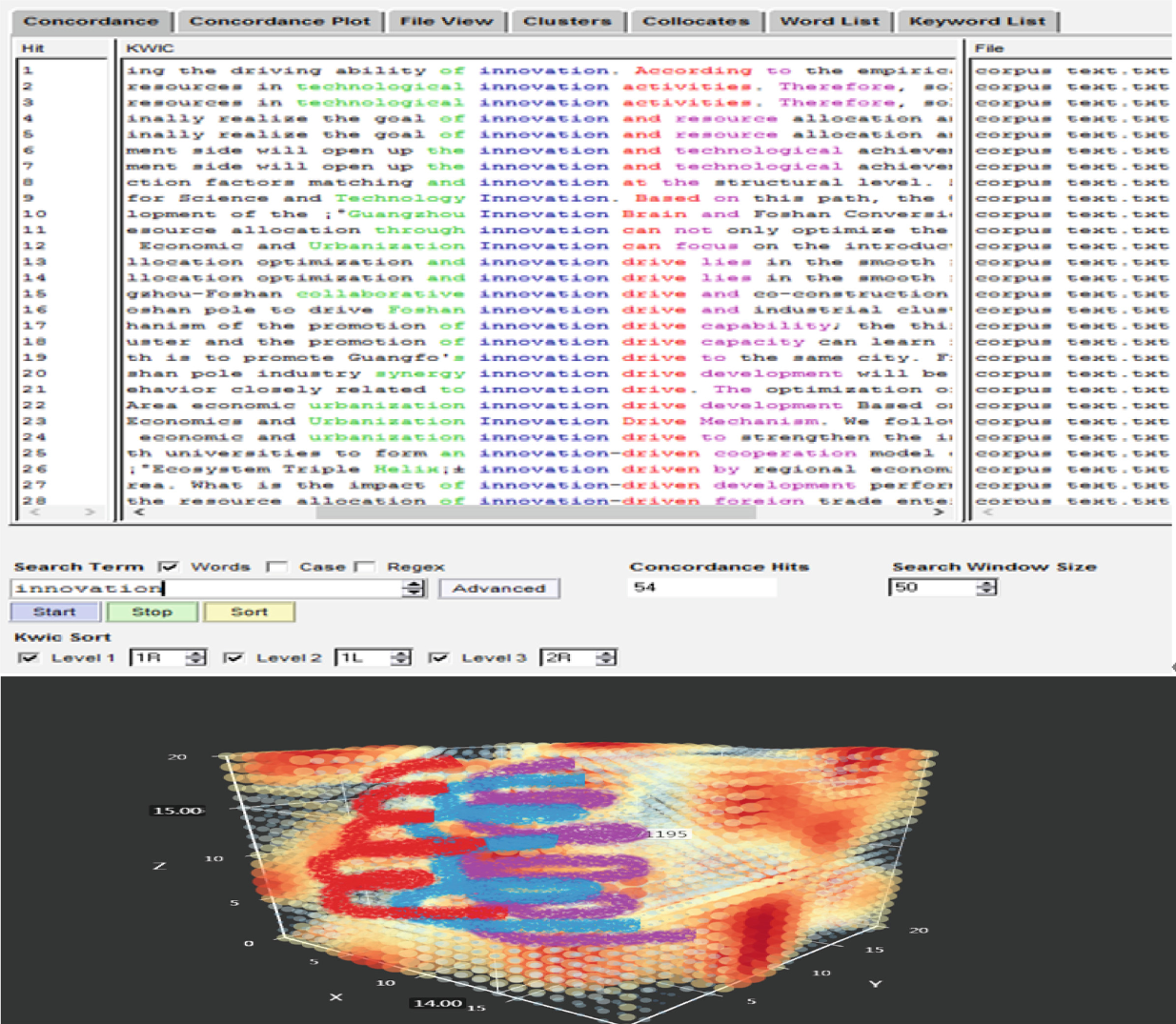
1. **Markov Leap Chains**: To link the "Concordance Hits" of linguistic data (WordNet) with localized economic events.
2. **Bayesian Equation of State**: Specifically, $ ilde{N}(t) = \dot{A}[r(t), t] n(t) + \beta[r(t), t] m(t)$, to describe system modalities and input control vectors in a probability space.
3. **Data Mining-Radar Monitoring**: To visualize the "Three-Helix" relationship between the GBA drive, regional factors, and industry clusters.
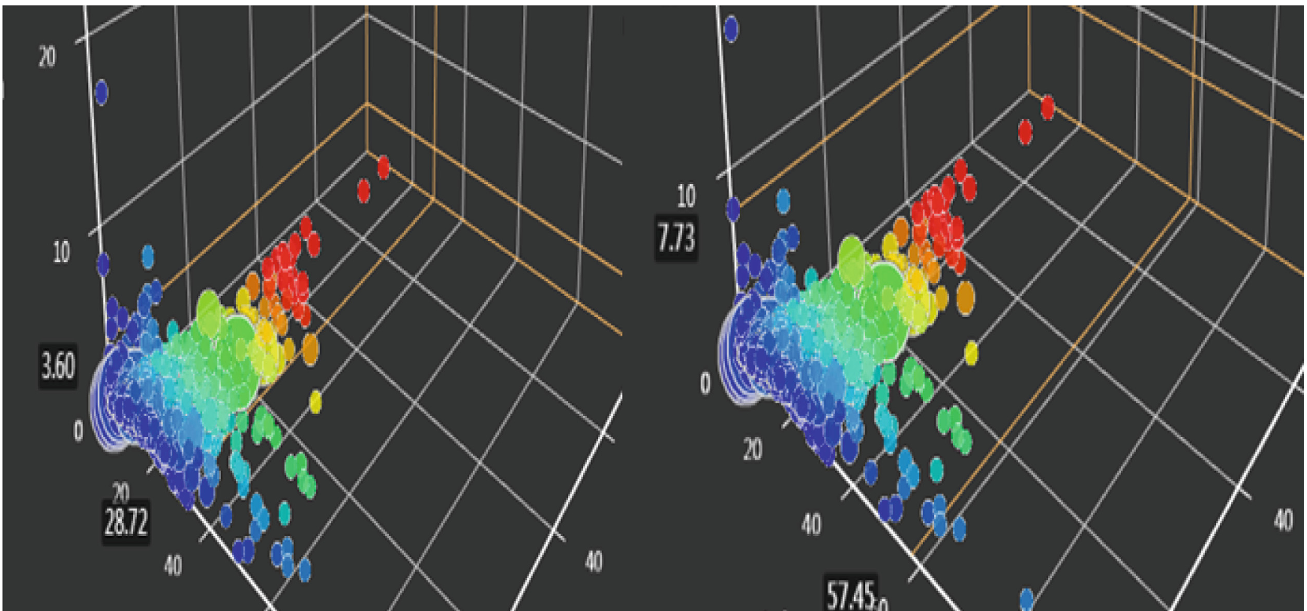
The "humanity-oriented" aspect is modeled as an "UP-DOWN" metaphor, where innovation flows from macro-regional policy (GBA) down to specific industrial chain levels.
## Experiments & Results: The Three-Helix Drive
The study employs a simulated rectangular area of the GBA to test the asymptotic efficiency of the proposed schemes. The empirical results demonstrate that:
* **Spatial Spillover**: Innovation (Y-axis) exhibits a clear spatial spillover effect, meaning that the success of one firm correlates positively with its proximity to regional "growth poles."
* **Quantitative Thresholds**: The lower and upper limits of the mapping consistency (3.60–28.72; 7.73–57.45) suggest high reliability in how the model tracks firm performance.
* **Path Confirmation**: Competitiveness is most effectively boosted when firms leverage the "financial supply-side" reforms and embed themselves into the GBA’s next-generation IT and biomedicine clusters.
## Critical Analysis & Conclusion
The value of this paper lies in its **interdisciplinary approach**, bridging linguistics (Corpus/Metaphor) with stochastic modeling (Markov/Bayesian) and regional economics. It moves the conversation from *if* entrepreneurial spirit matters to *how* it is spatially and structurally distributed across a metropolitan circle.
**Limitations**: The model relies on specific system parameters (e.g., RSSI values and coordinate settings) that may require significant recalibration when applied to non-GBA regions or different types of trade exports.
**Future Outlook**: For practitioners, the takeaway is clear: competitiveness in the 2026 GBA economy is a factor of "regional embeddedness." Success follows the path of synergistic innovation where the "humanity-oriented" spirit acts as the lubricant for trillion-level industrial clusters.