
gCrop: Redefining Smart Agriculture through the Internet of Leaf Things (IoLT)
gCrop: Internet-of-Leaf-Things (IoLT) for Monitoring of the Growth of Crops in Smart Agriculture
The paper introduces gCrop, a smart monitoring system for leafy crops based on the Internet of Leaf Things (IoLT) framework. It combines IoT hardware, OpenCV-based image processing, and polynomial regression to predict plant age and growth status with a high accuracy of approximately 98%.
TL;DR
The gCrop system represents a shift from general field monitoring to individual leaf-level diagnostics. By integrating IoT sensors with a computer vision-driven Internet of Leaf Things (IoLT) framework, the authors have developed a method to predict crop maturity and age with up to 98% accuracy, all while maintaining the low power profile required for real-world farming.
Motivation: The Intuition Gap
In the race to feed 9 billion people by 2040, agricultural efficiency is no longer optional. Currently, farmers rely on "trial and error" or manual measurement of the Leaf Plastochron Index (LPI)—a logarithmic scale used to estimate plant age based on leaf length.
However, manual LPI is tedious. On the other hand, existing high-tech "stereo vision" systems often consume too much power for field deployment. The authors identified a massive need for a system that is non-destructive, low-power, and scientifically grounded in plant physiology.
Methodology: The IoLT Architecture
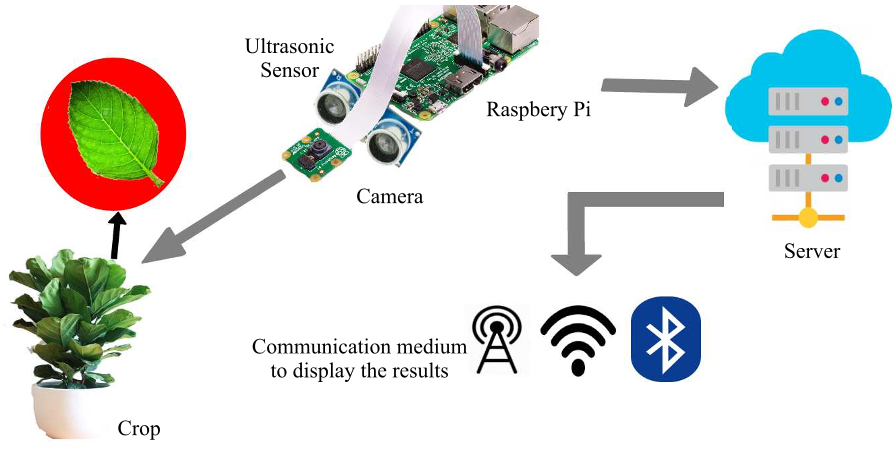
The "Internet of Leaf Things" treats the individual leaf as a primary data source. The hardware stack consists of a camera module paired with an ultrasonic sensor to provide a depth-referenced calibration for measurements.
1. Dimensional Analysis (The "How")
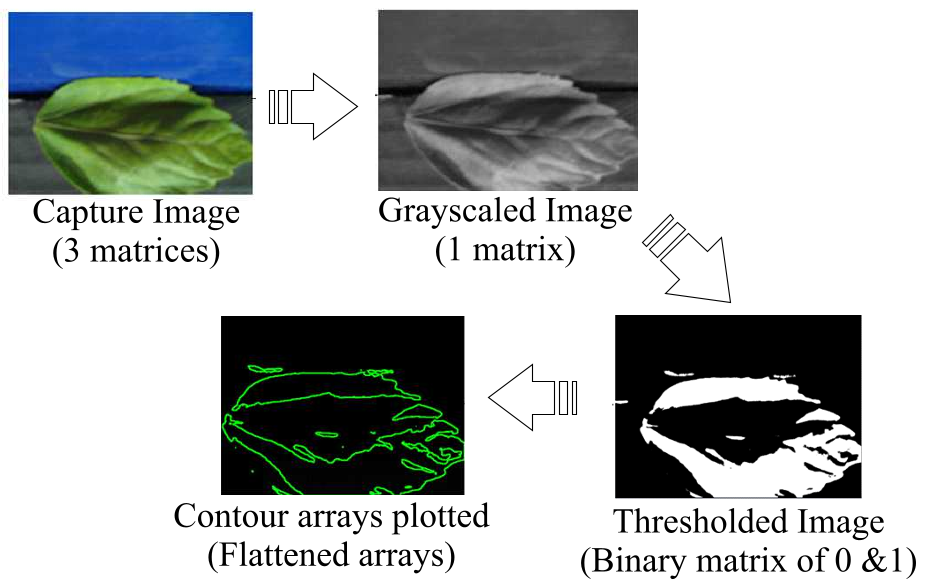
Using OpenCV, the system performs a multi-step transformation:
- Grayscaling & Blurring: Removes environmental noise.
- Thresholding: Converts the leaf image into a binary matrix for high-speed processing.
- Edge Detection: Extracts the leaf contour to calculate length and width in a "pixel per metric" format.
2. From Pixels to Age
Instead of just measuring size, gCrop applies a third-order polynomial regression based on historical LPI data. Because leaves at the bottom of the plant grow at different rates than those at the top, the authors created 9 separate datasets indexed by leaf position. This spatial awareness allows the model to map simple physical dimensions to the "Ideal Growth Conditions" of the species.
Experiments: High Precision in the Wild
The system was tested on tomato leaves (Lycopersicon Esculentum). The results proved that leaf positioning is a critical variable in accuracy:
- Bottom Leaves (Index 1-2): Showed the highest correlation with mathematical growth models, achieving 97.9% accuracy.
- Top Leaves (Index 9): The accuracy dropped slightly to 90.8%, likely because younger leaves at the plant apex exhibit more stochastic growth patterns.
Dimensional Accuracy Table
| Capture Type | Actual (cm) | Calculated (cm) | Accuracy |
|---|---|---|---|
| Leaf Sample A | 15.25 | 15.22 | 99.80% |
| Leaf Sample B | 8.60 | 8.44 | 98.17% |
The ability of gCrop to measure physical length with near-perfect precision outclasses human measurements, which are often limited by scale-tape errors and physical handling of the plant.
Critical Analysis & Conclusion
Takeaway: gCrop effectively bridges the gap between complex computer vision and the physical constraints of field agriculture. By simplifying the visual task to "edge prediction," it maintains a low computational footprint while providing high-value predictive data (age and maturity).
Limitations:
- Dataset Diversity: The current model heavily relies on tomato leaf data. Generalizing this to non-leafy crops or complex canopy structures (where leaves overlap) remains a challenge.
- Segmentation: In a dense field, the system may struggle to isolate a single leaf. The authors suggest a watershed algorithm for future image segmentation to solve this.
Future Outlook: The transition to "Internet of Leaf Things" suggests a future where sensors are so cheap and low-power that we monitor crops at the organ level rather than the field level. This precision will be the key to optimizing fertilizer, water, and harvesting schedules in the era of Smart Agriculture.