
Explorers or Specialists? Unpacking the Drivers of Research Diversification
The effects of gender, age and academic rank on research diversification 1
This study investigates the influence of gender, age, and academic rank on research diversification among 31,101 Italian professors across the sciences (2004-2008). Using OLS regression models, the authors examine three metrics—Extent of Diversification (ED), Diversification Ratio (DR), and Relatedness Ratio (RR)—finding that younger and more senior-ranked scholars exhibit a higher propensity to diversify.
TL;DR
Why do some scientists stick to one niche while others "scatter-gather" across disciplines? This large-scale study of over 31,000 Italian professors reveals that research diversification is heavily influenced by age and academic rank, but—contrary to popular belief—gender plays a minimal role once you control for total publication volume.
Backgound: The Diversification Dilemma
In the modern academic landscape, researchers face a tug-of-war. On one hand, policy-makers push for interdisciplinary solutions to complex societal problems. On the other, the "disciplinary system" of hiring and tenure often rewards those who specialize deeply in a single field. This paper explores how individual traits—specifically age, gender, and seniority—tip the scales between specialization and diversification.
Methodology: Measuring the "Scatter-Gather" Strategy
The authors define diversification along three sophisticated axes using Web of Science (WoS) data:
- Extent (ED): The raw number of different topics in a scholar’s portfolio.
- Intensity (DR): The proportion of work published outside one's "dominant" topic.
- Relatedness (RR): Whether those "outside" topics are cognitively close to the home discipline or a complete leap into the unknown.
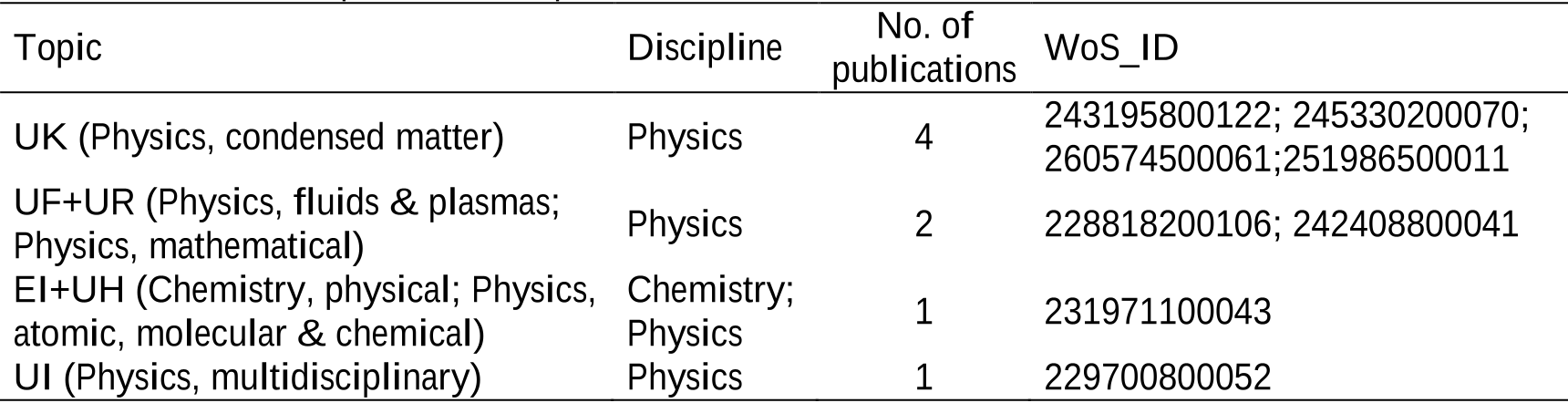 Table 2: Example of how a single professor's publications are mapped to dominant topics and disciplines.
Key Insights: Age, Rank, and the Gender Myth
1. The Paradox of the "Young Explorer" and the "Senior Manager"
The study finds a fascinating contradiction. Age is negatively correlated with diversification (younger scholars explore more), but Academic Rank is positively correlated (Full professors diversify more than assistants).
Why? The authors suggest a "Cohort Effect." Younger scientists may have a natural curiosity or are part of a new generation trained in broader environments. Meanwhile, Full Professors have the "social capital" and safety to take risks, often managing large, diverse research groups that naturally pull them into multiple fields.
2. Debunking the Gender Productivity Explanation
Previous theories suggested that women might be less productive because they "waste" time on less specialized, interdisciplinary research. This study refutes that. When the researchers controlled for total output volume (publication intensity), the differences between men and women in diversification essentially vanished.
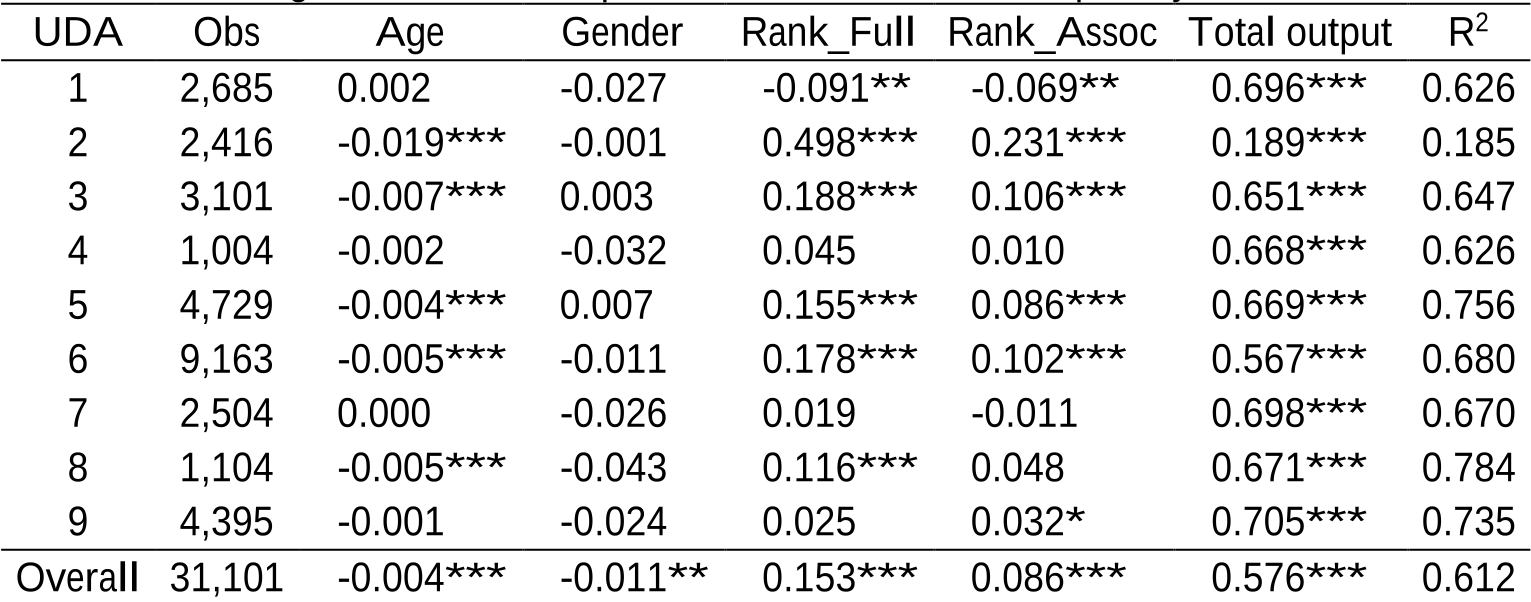 Table 5: OLS Results (Model 2) showing that once 'Total Output' is accounted for, gender (x2) significance drops across most disciplines.
3. Disciplinary Nuance: The Case of Mathematics
Mathematics consistently stands out as an "anomaly." Unlike biology or engineering, math professors show much higher specialization. In this field, assistant professors are actually more diversified than their senior counterparts, suggesting that in "pure" sciences, the drive to specialize increases as one climbs the ladder.
Critical Analysis & Takeaways
The study’s strength lies in its scale—capturing an entire national system accurately. However, it is a cross-sectional study, not longitudinal. It captures a "snapshot" in time (2004-2008).
The Takeaway:
- For Policy Makers: Promotion structures should recognize that diversification is a sign of career maturity and social leadership, rather than a lack of focus.
- For Researchers: Don't fear the "scatter-gather" strategy; it is a natural progression of a robust academic career, provided your core productivity remains stable.
Future Work: How has the rise of AI and "big data" shifted these patterns since 2008? The "cognitive relatedness" of fields is likely shrinking as computational tools bridge disparate disciplines.