
Gait-Based Biometrics: Decoding Age and Gender via AdaBoost and Wavelets
Determination of Gender and Age Based on Pattern of Human Motion Using AdaBoost Algorithms
This paper presents an automated framework for classifying human gender and age using gait patterns from video sequences. It leverages 2D Discrete Wavelet Transformation (DWT) for feature extraction from silhouette width vectors and employs Modest AdaBoost and Gentle AdaBoost algorithms, achieving up to 88.7% accuracy in age classification and 90.6% in gender classification.
TL;DR
This research tackles the challenge of identifying pedestrian attributes by analyzing how people walk. By combining image processing to extract human silhouettes, Discrete Wavelet Transforms (DWT) to capture motion dynamics, and the Modest AdaBoost algorithm, the authors successfully classified age and gender with accuracies exceeding 83%. The study positions gait analysis as a critical tool for future Intelligent Transportation Systems (ITS) and pedestrian safety.
Background and Motivation
Our walking style is as unique as a fingerprint. Psychological studies have long suggested that humans can recognize others simply by their gait. In the context of "Smart Cities" and autonomous driving, the ability for a system to automatically determine whether a pedestrian is an elderly person or an adult could be life-saving, allowing systems to adjust traffic signal timings or alert motorists accordingly.
The authors argue that previous works focused heavily on identification (who is this person?), whereas there is a significant gap in understanding "behavioral attributes" (what is the age/gender of this person?) for safety applications.
Methodology: From Video Pixels to Motion Features
1. Robust Silhouette Extraction
The first hurdle in gait analysis is noise. The authors utilize an adaptive Gaussian mixture model to separate the walking human from the background. Crucially, they operate in the HSV (Hue, Saturation, Value) color space. Unlike RGB, HSV is much better at distinguishing between actual objects and moving shadows—a common failure point in computer vision.
2. The Spatiotemporal Width Vector
Instead of analyzing the whole body, the authors simplify the human form into a "silhouette width vector." They calculate the horizontal distance between the left and right boundaries of the silhouette for every row of pixels.
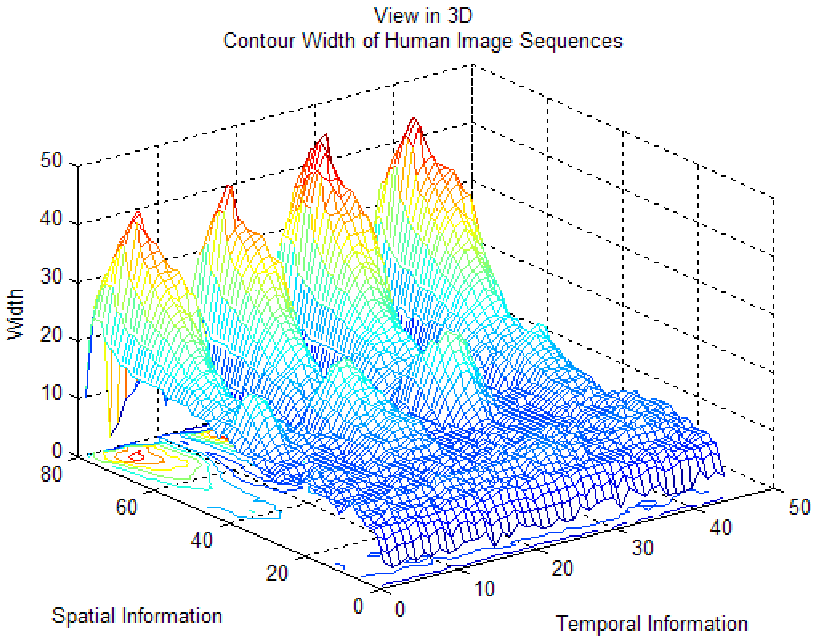 Fig 1: The width vector tracks the periodic movement of arms and legs over time.
3. Frequency Domain Transformation (Wavelets)
Human walking is periodic. While Fourier Transforms are common for signal analysis, the authors chose 2D Discrete Wavelet Transformation (DWT). Why? Because wavelets are "localized." They can capture sharp discontinuities and subtle changes in motion at different scales (the "forest and the trees"), which is perfect for the complex, non-linear movement of human limbs.
4. Boosting the Results
The high-dimensional wavelet features are filtered using a T-Test to find the most "discriminative" ones. These are then fed into AdaBoost algorithms. AdaBoost works by training many "weak" classifiers (simple rules) and combining them into a "strong" one, specifically focusing on the "hard-to-classify" examples in each round.
Experimental Insights
The study involved 53 participants (Adults vs. Elderly). The authors compared two variants of the boosting algorithm: Gentle AdaBoost and Modest AdaBoost.
| Classification Type | Modest AdaBoost (Avg) | Gentle AdaBoost (Avg) |
|---|---|---|
| Age | 83.5% | 79.2% |
| Gender | 84.9% | 75.9% |
Key Findings:
- Modest vs. Gentle: Modest AdaBoost consistently outperformed Gentle AdaBoost across nearly all tests.
- Feature Efficiency: Gender was surprisingly easy to classify; it reached 90.6% accuracy with only 10 selected features. Age classification was more complex, requiring up to 40 features to reach peak performance.
- Optimal Configuration: The highest accuracy for age classification (88.7%) was achieved by Modest AdaBoost using 40 features.
Critical Analysis & Future Outlook
This work demonstrates that silhouette-based gait analysis is a computationally efficient way to categorize pedestrians. Using width vectors and wavelets reduces the need for heavy 3D modeling or expensive sensors.
Limitations:
- Sample Size: With only 53 participants, the model's ability to generalize to a global population (with varying clothing and walking aids) remains to be tested.
- Camera Angle: The subjects were filmed at an "oblique angle." Gait features change significantly when viewed from the front versus the side.
The Takeaway: In the future, your local intersection might "know" to hold a green light for a few extra seconds because its vision system has recognized a senior citizen crossing the street—not by their face, but by the unique, wavelet-encoded rhythm of their stride.
Conclusion
By moving from raw video to the frequency domain via Wavelets, and then utilizing the iterative power of Modest AdaBoost, this study provides a robust blueprint for real-time pedestrian attribute detection.