
Gender, Ideology, and the Digital Pulse: Predicting the Spread of Anti-Abortion Policy
Gender and Ideology in the Spread of Anti-Abortion Policy
This study utilizes over 200,000 Twitter posts from 2013 to analyze the relationship between constituent ideology and the rapid spread of anti-abortion policies across U.S. states. The researchers developed a Twitter-based collaborative filtering model that predicts state-level policy enactments with higher accuracy than traditional geographic or poll-based metrics.
TL;DR
By analyzing 200,000+ tweets, researchers from MIT and Microsoft Research have demonstrated that social media discourse is a more accurate predictor of state-level abortion policy changes than traditional polls. The study uncovers a "moral tug-of-war" between values of Purity and Fairness and reveals a concerning trend: the current wave of anti-abortion legislation aligns significantly more closely with the online expressions of men than those of women.
Background: Beyond the Polling Booth
In the early 2010s, the U.S. witnessed an unprecedented surge in abortion restrictions. To understand this, researchers typically look at the "What" (the laws) or the "Who" (the politicians). This paper looks at the "Why" by tapping into the collective consciousness of Twitter. It positions itself as a bridge between computational linguistics and political science, moving beyond static polls into the dynamic world of natural language.
The Core Conflict: Ideological and Gendered Fault Lines
The authors identified several key "Latent Ideologies" that differentiate states enacting pro-abortion vs. anti-abortion policies:
- Moral Intuitions: Anti-abortion discourse is heavily rooted in Purity and Authority, while the pro-abortion side emphasizes Fairness.
- Terminology as Strategy: Anti-abortion states favor the word "baby" (emphasizing the fetus), whereas pro-abortion states focus on the "woman" (emphasizing autonomy).
- The Intensity Gap: Anti-abortion states exhibited higher emotional intensity (anger, anxiety) and greater linguistic unity, suggesting a more mobilized constituent base.
Methodology: Collaborative Filtering for Laws
The most innovative aspect of this research is treating policy adoption like a Netflix recommendation. If "State A" and "State B" talk similarly on Twitter, and "State A" passes a specific clinic regulation, the model "recommends" (predicts) that "State B" will soon do the same.
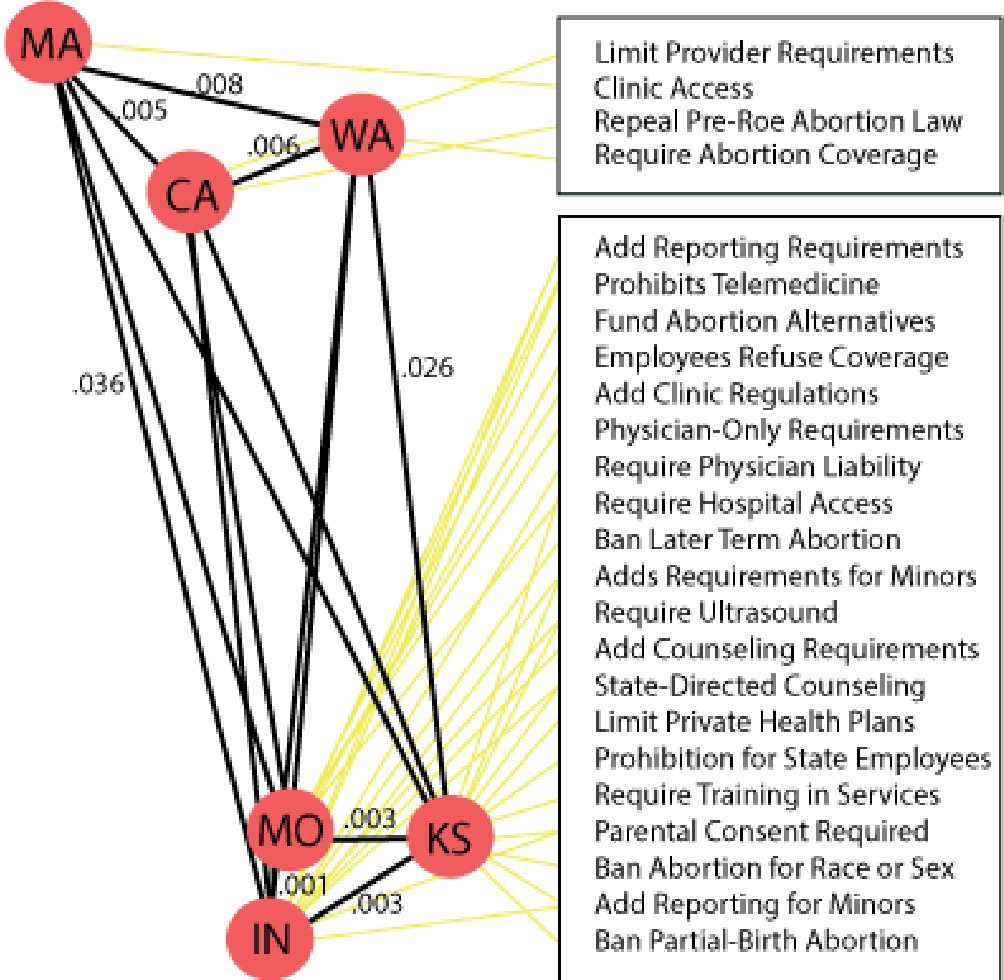 The graph visualizes connections between states based on linguistic similarity, using these edges to propagate policy "recommendations."
The Gender Disconnect: A Stark Reality
One of the paper's most provocative findings is the gender analysis. By segmenting users by inferred gender, the researchers found that:
- Men and Women are farther apart ideologically than even the most polarized states.
- The "Male" model was significantly better at predicting policy enactment than the "Female" model.
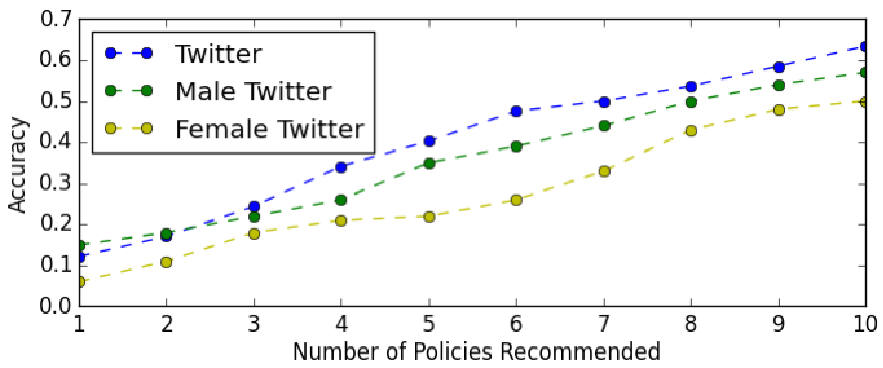 Experimental results show that similarity metrics derived from male users consistently provide a better fit for the actual spread of anti-abortion legislation.
Experimental Performance
The Twitter-based model successfully outperformed traditional metrics across the board.
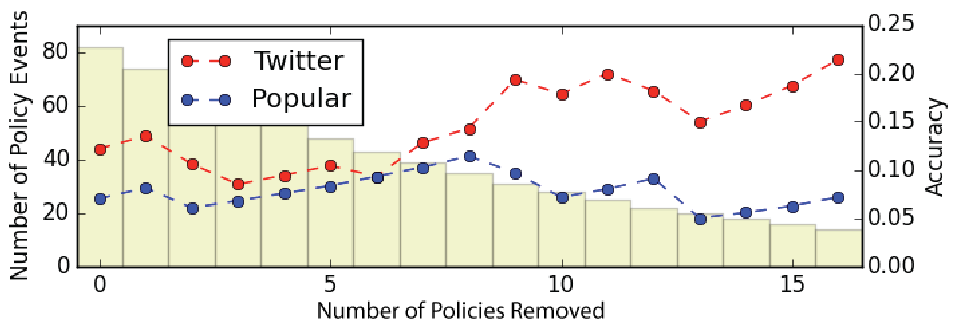 The Twitter metric (Blue) shows a clear lead over Ideology polls (Red) and Geographic distance (Green) in predicting enacted policies.
Critical Insight: The "Unity" of the Anti-Abortion Movement
The study highlights that anti-abortion supporters are not just more numerous in certain states; they are more unified in their language. In contrast, pro-abortion discourse is more fragmented. This linguistic cohesion acts as a "signal" that the model picks up to predict legislative success.
Conclusion & Future Impact
This work translates "noise" on social media into a "signal" for governance. While it exposes a gap where male voices seem to have a higher correlation with enacted abortion policies, it also provides a roadmap for using AI and NLP to:
- Modernize Political Science: Replacing slow 20th-century polls with real-time text analysis.
- Tooling for Activists: Helping organizations understand where their messaging is failing to resonate or where "policy contagion" is likely to strike next.
Limitations: The study is bound by Twitter's demographics (more urban, more tech-literate) and the inherent limitations of LIWC (which can miss irony or sarcasm). However, at the population level, these signals offer a powerful mirror of a nation's shifting moral landscape.