
The Ghost in the Code: Bridging Gender Theory and Machine Learning
Gender Bias in Artificial Intelligence: The Need for Diversity and Gender Theory in Machine Learning
This paper examines the socio-technical roots of gender bias in Machine Learning (ML), particularly in text-based models. It argues for the integration of Feminist Linguistic Theory and increased gender diversity in AI development to transition from reactive debiasing to proactive, theoretically-grounded prevention of algorithmic prejudice.
TL;DR
Machine Learning doesn't just process data; it inherits ideology. Susan Leavy’s research argues that current efforts to "fix" biased AI are insufficient because they ignore the rich history of gender theory. By integrating feminist linguistics into model development and ensuring diverse representation among creators, we can move beyond superficial patches to solve the structural "white guy problem" in AI.
The "Values of Creators" Problem
As Kate Crawford famously noted, AI reflects the values of its creators. Currently, those creators are overwhelmingly male. This demographic imbalance creates a blind spot where the subtle, systemic ways gender inequality is encoded in language—what scholars have studied for decades—are treated as "noise" or ignored entirely.
The core issue is that while humans use critical theory to navigate decisions, machines learn purely by observation. If the observation pool (the data) is poisoned by historical stereotypes, the machine will naturally conclude that those stereotypes are factual representations of the world.
Methodology: Operationalizing Critical Theory
Leavy suggests that instead of treating bias as a hidden variable, we should use Feminist Stylistics to identify measurable linguistic features of bias during the training phase. She breaks this down into four key dimensions:
1. Naming & Reference
Language often treats the male as the "default" and the female as the "deviation." For example:
- Asymmetry: "Working mother" exists as a common term, but "working father" does not, implying that a mother's primary role is domestic.
- Diminutives: Adult women are 3x more likely to be called "girls" than men are to be called "boys," stripping women of professional authority and agency.
2. The Power of Ordering
In English, the "socially dominant" term usually comes first in pairs (e.g., Husband and wife, Mr. and Mrs.). Leavy points out that this persists in occupations like "Doctor and nurse." These ordering constraints reinforce an implicit hierarchy that ML models pick up and amplify.
3. Biased Descriptions (Adjectives)
One of the most striking parts of the research is the qualitative difference in how genders are described.
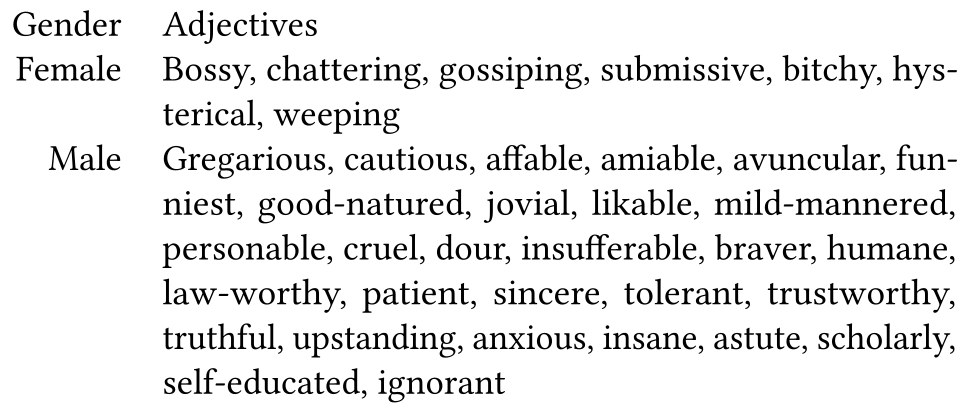 Table 1: Adjectives commonly associated with gender in the British National Corpus.
As seen in the table above, adjectives for women (hysterics, submissive, gossiping) focus on negative emotionality or lack of agency, whereas adjectives for men (astute, scholarly, jovial) focus on intellect or behavior.
Quantitative Evidence: The Erasure of Women
The study provides hard numbers on gender presence in training data:
- Visibility Gap: Men are referenced in 49% of top news stories, while women appear in only 18%.
- Frequency Asymmetry: In business literature, mentions of men occur 10 times more often than women.
- Title Bias: The title "Mr" is more frequent in the British National Corpus (BNC) than "Mrs," "Miss," and "Ms" combined.
Critical Insight: Why Diversity is a Technical Requirement
Leavy argues that the people most affected by bias are the most likely to see and understand it. The fact that the leading thinkers in AI bias (like Joy Buolamwini and Fei-Fei Li) are female is not a coincidence. Diversity in ML is not just a PR move; it is a critical safeguard. Without a diverse set of eyes, the subtle metaphors and linguistic structures that maintain gender inequality will remain invisible to the developers, and thus, permanently embedded in the software that runs our modern world.
Conclusion & Future Outlook
We cannot "debias" an algorithm if we don't understand the linguistics of the bias itself. The path forward requires:
- Quota Systems: Implementing balance in training data subjects.
- Transdisciplinary Teams: Bringing linguists and gender theorists into the ML pipeline.
- Operationalized Ethics: Designing features that specifically target the linguistic markers of prejudice identified in this study.
AI has the potential to influence every facet of human behavior. If we don't actively curate its "upbringing" using the best of human critical thought, we risk automating the very inequalities we have spent decades trying to dismantle.