
As the Tweet, so the Reply? The Persistence of Gender Bias in Digital Politics
As the Tweet, so the Reply?: Gender Bias in Digital Communication with Politicians
This study examines gender bias in digital political communication during the 2017 German federal elections. Using dictionary-based sentiment analysis and a novel "personal- vs. job-related" text measure, the researchers analyzed 22.12 million tweets to determine how politicians present themselves and how the public reciprocates.
TL;DR
Does a politician's self-presentation on Twitter dictate how the public treats them? This study of the 2017 German elections reveals a stark disconnect: while male and female politicians both maintain professional, party-aligned personas, the public consistently targets female politicians with personal, non-professional content. Even in the digital age, women in power are still reduced to their "identities" while men are permitted to remain "professionals."
Background: The Digital Double Standard
Within the framework of Social Identity Theory, individuals carry multiple categorizations—politician, party member, mother, or spouse. In the political arena, gender stereotypes often act as a cognitive shortcut for voters. Prior work has noted that these shortcuts often penalize women, labeling them as "compassionate" but "less competent" in traditional hard-power sectors like defense or economics.
The authors of this paper sought to move beyond simple interaction counts (who gets more retweets?) to investigate the substance of the interaction: the "What" and the "Why."
Methodology: Quantifying the "Personal"
The study’s core innovation is the Personal- vs. Job-Related Communication Measure. By calculating the log ratio of words associated with private life (family, friends, leisure) against those associated with professional life (work, meetings, contracts), the researchers could mathematically map the "professionalism" of a tweet.

Further, they employed Structural Topic Models (STM), which allow topic distributions to vary based on "covariates" like gender. This allowed them to see not just how much people talked, but the specific themes—like "children and women" vs. "democracy and future"—associated with each gender.
Results: Party Identity vs. Gendered Reception
The findings present a fascinating asymmetry between politicians' output and their incoming mentions.
1. The Output: Party First, Gender Second
Contrary to some "gendered communication style" theories, German politicians on Twitter are remarkably similar regardless of gender. Their sentiment and focus are driven by the Government-Opposition Divide. Those in power (CDU/SPD) are more positive; those in opposition (AfD/Left) are more negative. Both genders focus heavily on professional content.
2. The Input: The Public's Gendered Lens
When we look at tweets at politicians, the "professional" facade crumbles. As shown in the study's results, female politicians across almost all parties (especially the CDU and SPD) receive a much higher ratio of personal-to-job-related tweets compared to their male counterparts.
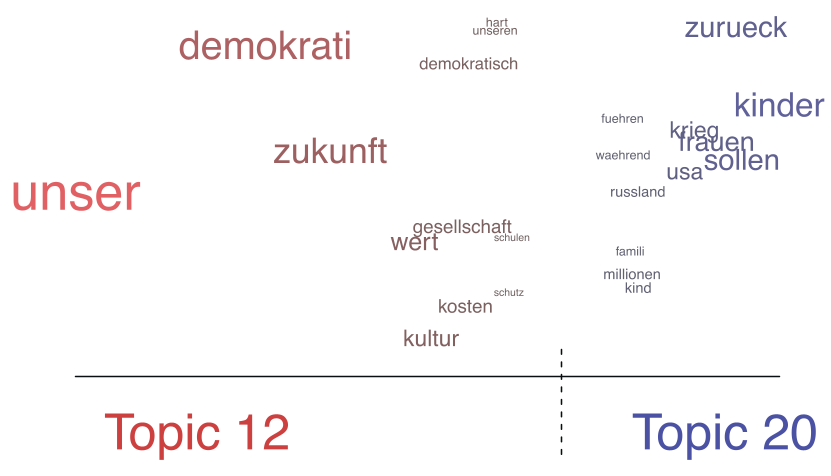
The STM analysis confirmed this: Topics 12 (received by men) centered on "Future," "Society," and "Schools," while Topic 20 (received by women) centered on "Children," "Women," and "Family."
Critical Analysis: The Professionalism Penalty
The most striking takeaway is that female politicians cannot "tweet their way out" of gender bias. Despite maintaining the same professional tone and party-aligned focus as their male colleagues, the public response remains anchored in domestic stereotypes.
Key Findings include:
- Sentiment Bias: Right-leaning women and left-leaning men receive more positive sentiment, suggesting the public has specific "allowable" archetypes for each end of the political spectrum.
- The AfD Anomaly: While the far-right AfD has few women in the Bundestag, their digital presence was dominated by female voices, which in turn gathered massive (often highly polarized) attention.
Conclusion
This study provides empirical evidence that digital platforms do not necessarily "level the playing field." instead, they may amplify the tendency to reduce female professionals to their private identities. For future researchers and platform designers, the challenge remains: how do we build digital arenas where a woman's expertise is not perpetually overshadowed by her "private-sphere" identity?
The limitation of this study—specifically its focus on a single election cycle and the German language—leaves the door open for global comparative studies to see if this "personalization penalty" is a universal feature of digital democracy.