
Does Gender Matter in the News? Unmasking Implicit Bias in Modern Journalism
Does Gender Matter in the News? Detecting and Examining Gender Bias in News Articles
This paper investigates gender bias in news article abstracts using large-scale NLP analysis on the MIND and NCD datasets. The authors introduce two benchmark datasets of gendered nouns and attribute words, revealing significant female underrepresentation and persistent socially-constructed stereotypes in media.
TL;DR
Journalists often craft news abstracts specifically to hook readers, but at what cost? This study analyzes nearly 300,000 news abstracts to prove that media bias isn't just a relic of the past—it’s alive in our digital algorithms. By releasing two massive datasets of gendered nouns and attribute words, the researchers show that while men are "Leaders" and "Heroes," women remain "Mothers" and "Influencers" in the eyes of mainstream news.
Background & Motivation
Despite representing half the global population, women are systematically under-examined in serious news categories like Politics and Business. The authors argue that news abstracts—the snippets you see before clicking—are primary vehicles for ideological and coverage bias. The goal was to move beyond simple word counts and understand the relational bias: how words like "career" and "family" gravitate toward specific genders, reinforcing harmful social hierarchies.
Methodology: A Multi-Layered Audit
The researchers conducted three sophisticated experiments using two major datasets: MIND (Microsoft News) and NCD (News Category Dataset).
1. The Linguistic Toolkit
The authors built and released two benchmark datasets to foster fairness research:
- Possessive Nouns Dataset: 465 terms used to classify the "gender" of an abstract.
- Attribute Words Dataset: 357 terms categorized into "Career-related" (e.g., Executive, Engineer) and "Family-related" (e.g., Grandmother, Wedding).
2. Centering Resonance Analysis (CRA)
To visualize the "DNA" of gendered news, the team used CRA to identify the most central nouns in abstracts. This method doesn't just count words; it looks at how words serve as anchors for meaning within a text.

Key Findings: The Great Divide
Occupational Devaluation
The study found a "distressing" distribution. In the MIND dataset, male abstracts dominated the corpus. Even when looking at career words, a heavy male bias persisted. For instance, words like "Chairman" or "Congress" appeared significantly more often in male-tagged abstracts than their female counterparts (Chairwoman/Congresswoman).
| Career Word | MIND (Man) | MIND (Woman) | NCD (Man) | NCD (Woman) |
|---|---|---|---|---|
| Spokes- | 192 | 121 | 112 | 42 |
| Congress | 191 | 49 | 94 | 25 |
| Chair | 225 | 20 | 102 | 5 |
Semantic Archetypes (The CRA Networks)
The most striking evidence of bias appeared in the semantic network visualizations. When the authors isolated "positive" abstracts (to remove the noise of negative crime news), the resulting word clouds revealed two different worlds:
- The Male Network: Anchored by President, Washington, Manager, Economy, and Hero.
- The Female Network: Anchored by Mother, Wife, Beauty, Wedding, and Influencer.
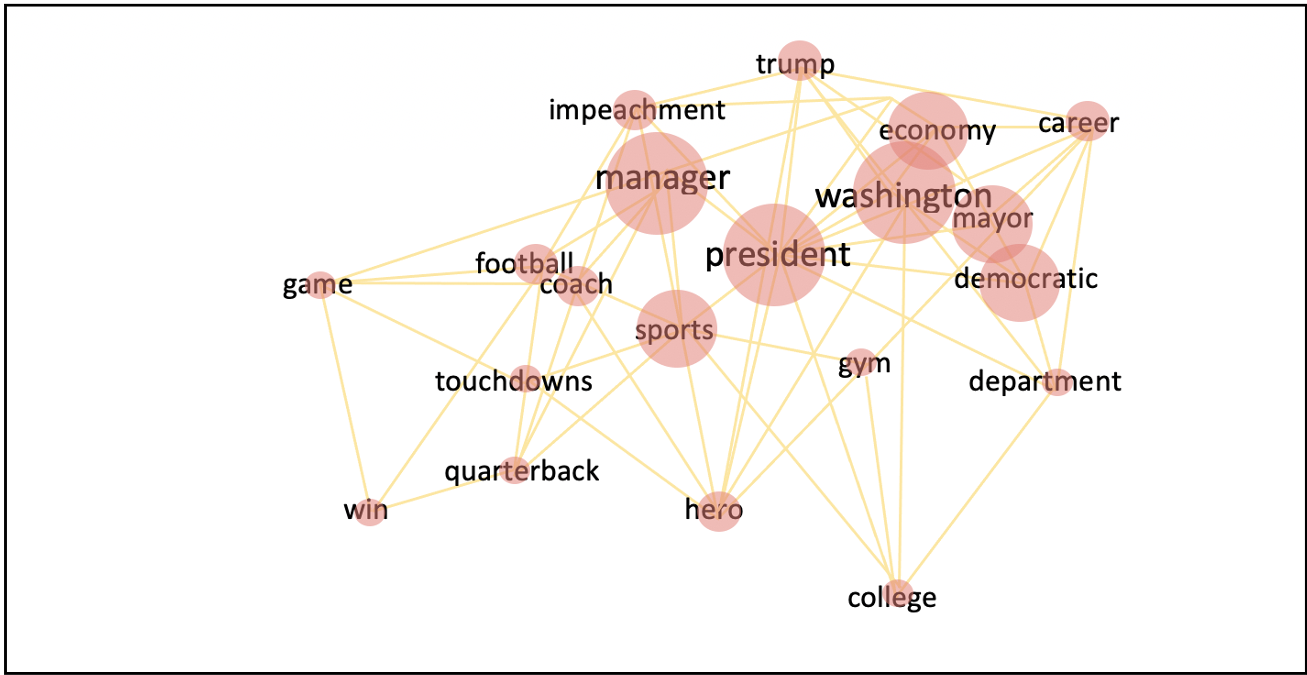 Figure 1a: The Male network focuses on structural power and sports.
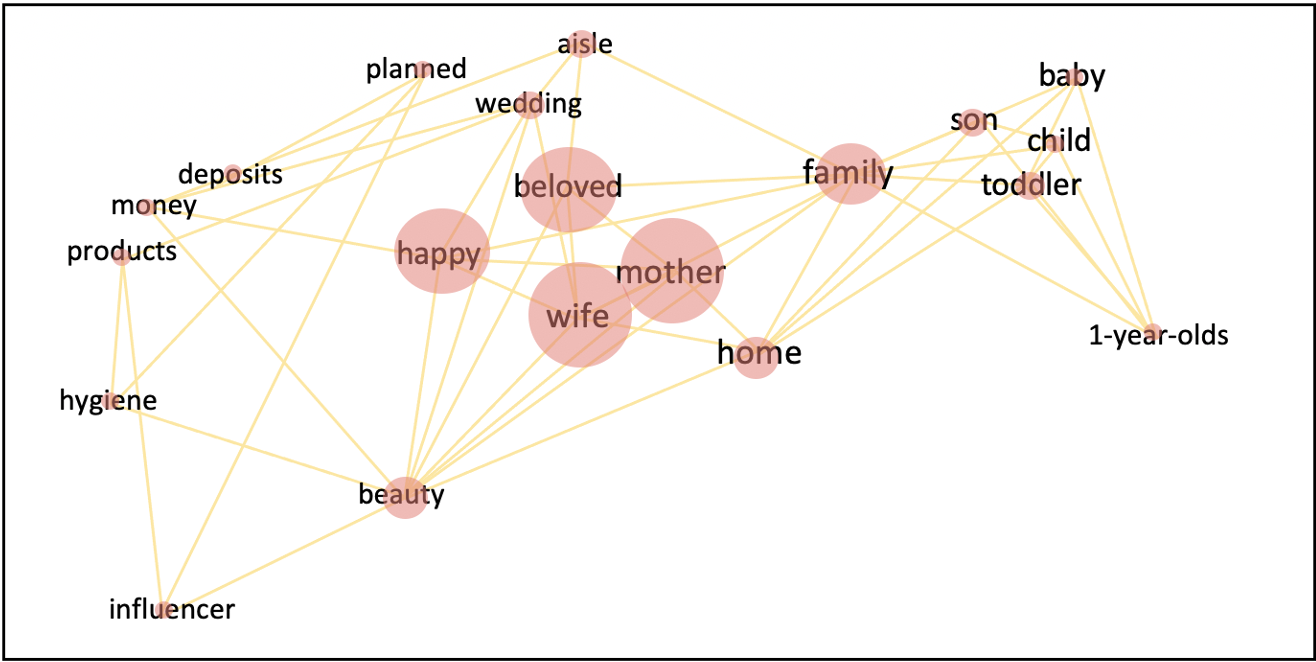 Figure 1b: The Female network is heavily constrained to domestic and aesthetic spheres.
Critical Insight & Conclusion
The results are a "paradox of gender bias." Even in modern datasets used to train the next generation of Recommender Systems, women are depicted through the lens of physical appearance and motherhood.
The Takeaway: Machine Learning models trained on this data will inherently learn that "Business" is a male category and "Beauty" is a female one. To break this cycle, the researchers emphasize that we must move beyond detecting bias to actively utilizing de-biased grounding datasets—like the ones provided in this study—to ensure NLP systems promote social justice rather than domestic stereotypes.
Limitations
The study primarily focuses on binary gender (M/F) and English-language news. Future work is needed to address non-binary identities and the nuances of gender bias in languages with grammatical gender (like Spanish or German).