
Gender and the Blogosphere: Why Do We Switch Service Providers?
Understanding the role of gender in bloggers' switching behavior
This study investigates the post-adoption switching behavior of bloggers using a research model that incorporates Satisfaction, Sunk Costs, and Attractive Alternatives. Leveraging Social Role Theory (SRT), the authors demonstrate that gender significantly moderates the decision-making process for switching blog service providers.
Executive Summary
TL;DR: This research identifies why bloggers abandon their current platforms for competitors. By analyzing 299 active bloggers, the study finds that while satisfaction and "sunk costs" (time/effort invested) keep users loyal, the presence of attractive alternatives pulls them away. Crucially, it reveals that gender is a primary lens through which these factors are filtered: women prioritize satisfaction (communal), while men prioritize the functional "wow factor" of alternatives (agentic).
Background: This work sits at the intersection of Marketing and Information Systems (IS) research, moving beyond "Initial Adoption" to the more critical phase of "Post-Adoption Continuance."
The "Sticky" Problem: Why Stay or Go?
In a world of free services like WordPress, Blogger, and Xanga, switching costs are rarely monetary. So why do users stay? Prior work suggested that satisfaction is the main driver, but this paper argues that it is a multi-dimensional battlefield. The authors identify a gap: we don't fully understand the "switching triggers" that overcome user inertia, nor do we understand if men and women navigate these triggers differently.
Methodology: The Behavioral Model
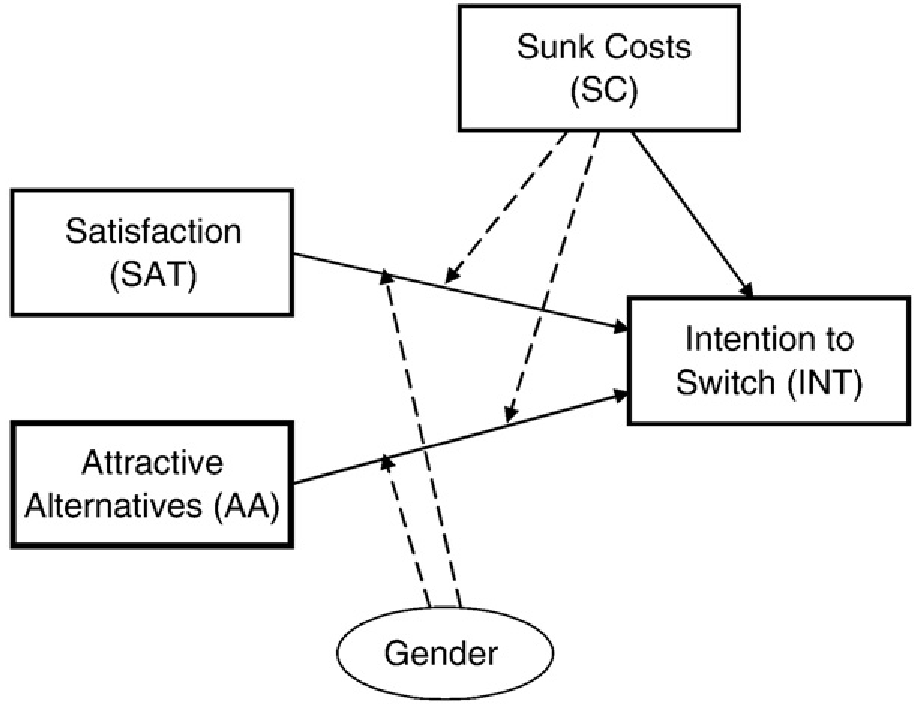
The authors propose a model where Intention to Switch (INT) is driven by:
- Satisfaction (SAT): Emotional and cognitive evaluation of the current service.
- Sunk Costs (SC): The irrecoverable "sweat equity" (posts, uploads, friendships).
- Attractive Alternatives (AA): The pull of better features elsewhere.
The study uses Social Role Theory (SRT) to hypothesize that women are more "communal" (valuing emotional satisfaction) and men are more "agentic" (valuing instrumental utility and advancement).
Key Results: Men vs. Women
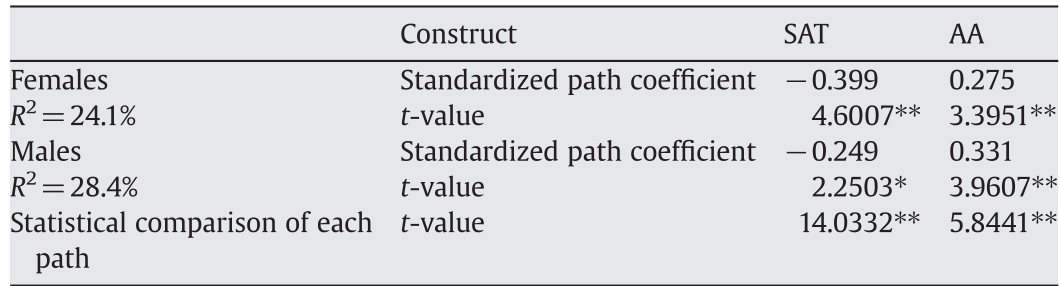
The empirical data (analyzed via PLS modeling) confirms several high-impact insights:
- Direct Drivers: Higher satisfaction and higher sunk costs significantly reduce the urge to leave. Conversely, the "grass is greener" effect of attractive alternatives is a potent predictor of switching.
- The Gender Divide:
- For Women: The path from Satisfaction to Switch Intention was significantly stronger. If a woman is unhappy, she is much more likely to leave regardless of other factors.
- For Men: The pull of "Attractive Alternatives" was the dominant force. Men are more likely to switch just because a new platform looks more "competent" or "advanced."
- The Sunk Cost Surprise: Unexpectedly, high Sunk Costs did not make users less sensitive to dissatisfaction. In the digital age, users feel they can migrate their content or inform their social circle easily, rendering the "investment" less of a trap than once thought.
Critical Insight & Conclusion
Takeaway for Platform Designers
- Retention is not one-size-fits-all. To keep female users, platforms must prioritize the user experience and emotional community (Satisfaction). To keep male users, platforms must constantly innovate to ensure no competitor looks "more attractive" (Utility).
- Sunk Costs are Evaporating. Don't rely on "lock-in" via content volume. In the era of data portability, loyalty must be earned through active satisfaction rather than historical investment.
Limitations
The study was confined to Hong Kong and a specific timeframe (mid-2000s). In the modern era of "Super-Apps" like Instagram or TikTok, the "Sunk Costs" of social graphs (followers) might carry significantly more weight than the "archival entries" discussed in this paper.
Conclusion: This study remains a foundational piece in understanding that demographic variables aren't just "control variables"—they are fundamental moderators of how we perceive technology value.