
Universal Stylometry: Deciphering Gender Across Five Languages Using Psycholinguistic Markers
Gender Classification with Data Independent Features in Multiple Languages
This paper presents a multi-lingual gender classification framework using data-independent features derived from the Linguistic Inquiry and Word Count (LIWC) tool. By evaluating blogs in English, Swedish, French, Spanish, and Russian, the study achieves a peak accuracy of 79.6% on English datasets and maintains over 73% across all tested languages using a Support Vector Machine (SVM) classifier.
TL;DR
Can the way we use "function words"—the tiny, often ignored scaffolding of language—reveal our gender regardless of the language we speak? This study leverages the Linguistic Inquiry and Word Count (LIWC) tool to classify authors' gender in English, Swedish, French, Spanish, and Russian. By focusing on data-independent psychological features rather than specific topics, the researchers achieved up to 79.6% accuracy, proving that our psychological "fingerprint" transcends vocabulary.
Context: Why "What" We Say Matters Less Than "How" We Say It
Most gender classification models are "topic-obsessed." They learn that "football" might correlate with men and "makeup" with women. However, these models break down when the topic changes. The authors of this study pivot toward stylometry: the study of linguistic style.
The core insight is that Function Words (pronouns, prepositions, articles) are processed differently in the brain than content words. They are largely subconscious and reflect how a person relates to the world. Because these markers are tied to psychology rather than subject matter, they are hypothesized to be "data-independent" and cross-linguistically valid.
Methodology: The LIWC Framework
The researchers utilized LIWC (Linguistic Inquiry and Word Count), a gold-standard tool in psycholinguistics. LIWC categorizes words into psychologically meaningful buckets:
- Linguistic Dimensions: Parts of speech like pronouns, articles, and auxiliary verbs.
- Psychological Processes: Emotions (positive/negative), social orientation, and cognitive mechanisms.
Systematic Classification
The team collected blogs across five languages, ensuring an equal distribution of male and female authors. They then used a Linear Support Vector Machine (SVM) to classify the gender based on the relative frequencies of these LIWC categories.
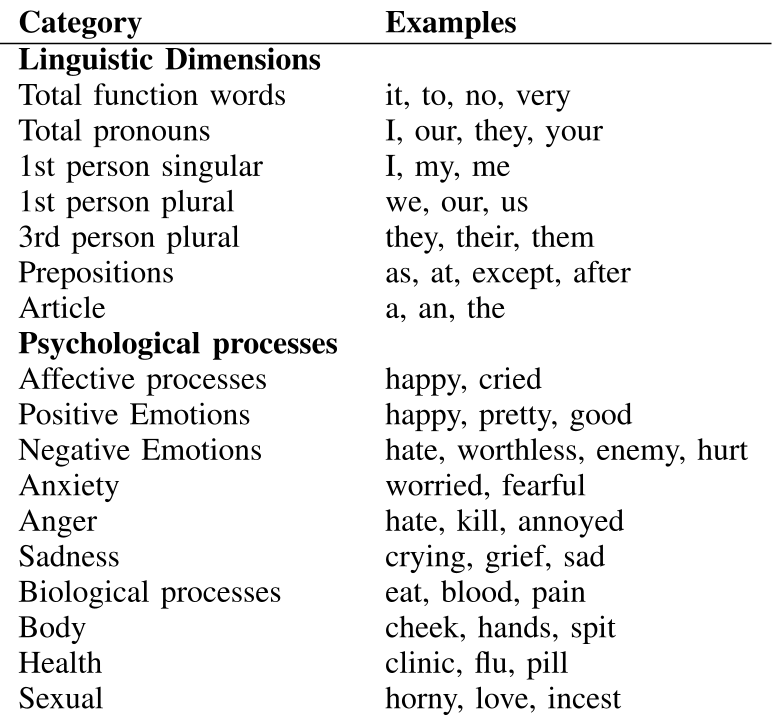 LIWC extracts the "psychological DNA" of a text by counting word frequencies across these predefined categories.
Experiments & Results: A Cross-Lingual Comparison
The model was put to the test across a diverse linguistic landscape. English and Swedish led the pack in performance.
| Language | No. of Docs | Accuracy | Precision | Recall |
|---|---|---|---|---|
| English | 2274 | 79.61% | 80.79% | 77.97% |
| Swedish | 1986 | 77.06% | 79.18% | 75.48% |
| Russian | 1178 | 76.61% | 80.55% | 72.85% |
| Spanish | 2236 | 74.24% | 75.67% | 73.00% |
| French | 1662 | 73.80% | 82.67% | 65.42% |
Key Linguistic Findings
- The Pronoun Gap: In every language studied, women used significantly more pronouns and first-person singular words ("I", "me"). This aligns with psychological theories suggesting women’s writing often focuses more on social relationships and internal states.
- The Informative Male: Men consistently used more articles (the, a, an) in English, French, Spanish, and Russian. A higher frequency of articles usually suggests the use of more nouns, indicating a more "fact-oriented" or informative writing style.
- The Swedish Outlier: Interestingly, the difference in article use was non-significant in Swedish. The authors attribute this to Swedish grammar, where articles are often suffixed to the end of words rather than standing alone.
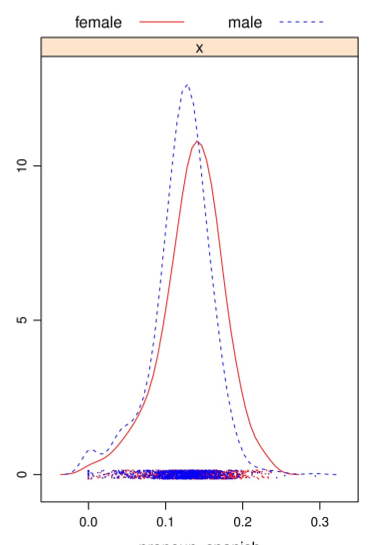 Visualizing the higher use of articles by males across most languages, highlighting the "Informative vs. Personal" stylistic split.
Critical Insight: The Privacy Paradox
This research sits at a delicate intersection of technology and ethics. While these techniques are invaluable for law enforcement in de-anonymizing threats or propaganda, they also pose a significant risk to personal privacy. The fact that gender can be predicted with ~75% accuracy using only the structural frequency of words—without even considering the "meaning"—means that pseudonyms offer much less protection than users might think.
Conclusion & Future Work
The study successfully demonstrates that gender-specific linguistic patterns are not just an English phenomenon but are present across multiple language families. However, the authors note that Russian and French showed lower recall for females, suggesting that current LIWC translations may need refinement to capture the specific nuances of those languages.
Takeaway for AI Researchers: When building robust classifiers, moving away from N-grams toward psycholinguistic features (LIWC) provides a powerful Inductive Bias that resists over-fitting to specific topics or datasets.
Future Directions: Adding "F-measures" (which calculate the formality vs. contextuality of text) and syntactic Part-of-Speech (POS) tags could push accuracy north of the 85% mark without sacrificing data independence.