
AF-SVM: Revolutionizing Real-Time Audience Analytics with Adaptive Feature Learning
Gender classification for real-time audience analysis system
The paper introduces AF-SVM, a real-time gender classification algorithm integrating adaptive feature extraction with Support Vector Machines (SVM). Part of a comprehensive audience analysis system, it achieves a State-of-the-Art (SOTA) accuracy of 90.8% and processes 65 faces per second.
TL;DR
In the landscape of smart retail and digital signage, understanding your audience is key. This paper presents AF-SVM, a highly efficient gender recognition algorithm that achieves 90.8% accuracy while maintaining a blazing speed of 65 faces per second. By combining adaptive feature extraction (optimized via LDA principles) and SVM classification, the authors provide a robust solution for real-time video stream analysis without the massive computational overhead of traditional pixel-based methods.
Context & Motivation: The Bottleneck of Raw Pixel Analysis
While face detection (e.g., AdaBoost) has become a commodity, granular classification like gender and age remains difficult in real-time "wild" environments. Previous SOTA methods like KDDA (Kernel Direct Discriminant Analysis) and standard SVMs often operate directly on image pixel values.
The Problem:
- High Dimensionality: Raw pixels create a massive feature space, making it harder for classifiers to find an optimal decision boundary.
- Scalability Issues: As training datasets grow, the complexity of these kernel methods increases dramatically, often leading to a "diminishing returns" effect where more data doesn't translate to better performance due to optimization difficulties.
The authors' insight was to move away from raw pixels towards Adaptive Features—low-dimensional representations specifically engineered to maximize the "utility" or statistical distance between "Male" and "Female" classes.
Methodology: The AF-SVM Architecture
The proposed system follows a pipeline: Face Detection → Preprocessing → Adaptive Feature Extraction → SVM Classification.
1. Adaptive Feature (AF) Extraction
The core innovation lies in the feature generation. Instead of using predefined filters (like Gabor wavelets), the system learns a set of coefficient matrices .
- Physical Intuition: The matrix acts as a learned mask that highlights gender-discriminative regions of the face.
- Optimization: These matrices are refined iteratively. The goal is to maximize the utility function , which represents the square of the difference between class averages divided by the sum of their variances—a direct application of the LDA (Linear Discriminant Analysis) principle.
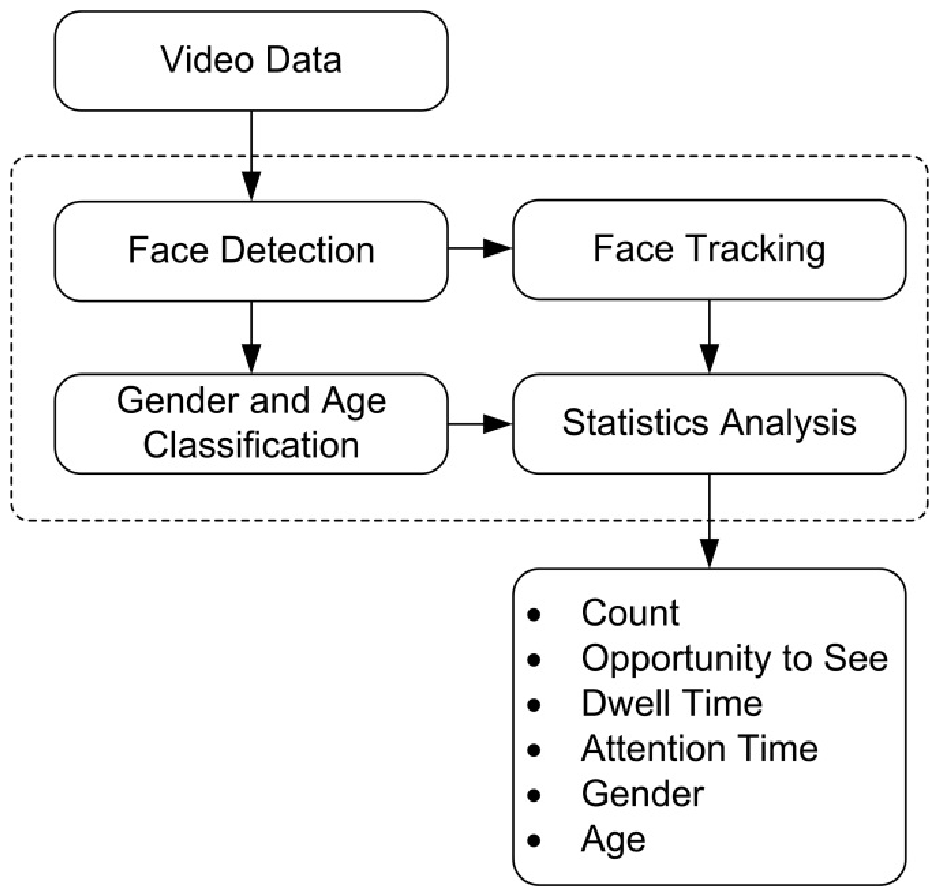 Fig 1: The block diagram of the audience analysis system, from input stream to statistical metrics.
2. SVM with RBF Kernel
Once the optimal (and much smaller) feature vector is extracted, it is fed into a non-linear SVM. By using a Radial Basis Function (RBF) kernel, the algorithm can handle the non-linear nuances of facial structures that differentiate genders.
Experimental Results & Performance
The authors curated a dataset of 10,500 image fragments. The results validate that focusing on "informative" features rather than "all" pixels is superior.
Performance Comparison
| Algorithm | Total Accuracy | Speed (Faces/sec) |
|---|---|---|
| AF-SVM (Proposed) | 79.6% (400 imgs) / 90.8% (5000 imgs) | 65 |
| Standard SVM | 77.7% | 44 |
| KDDA | 69.7% | 45 |
Deep Dive into Accuracy vs. Dataset Size
Most traditional algorithms hit a wall when the dataset increases. However, AF-SVM showed a massive jump from 79.6% to 90.8% when the training images per class were increased from 400 to 5,000.
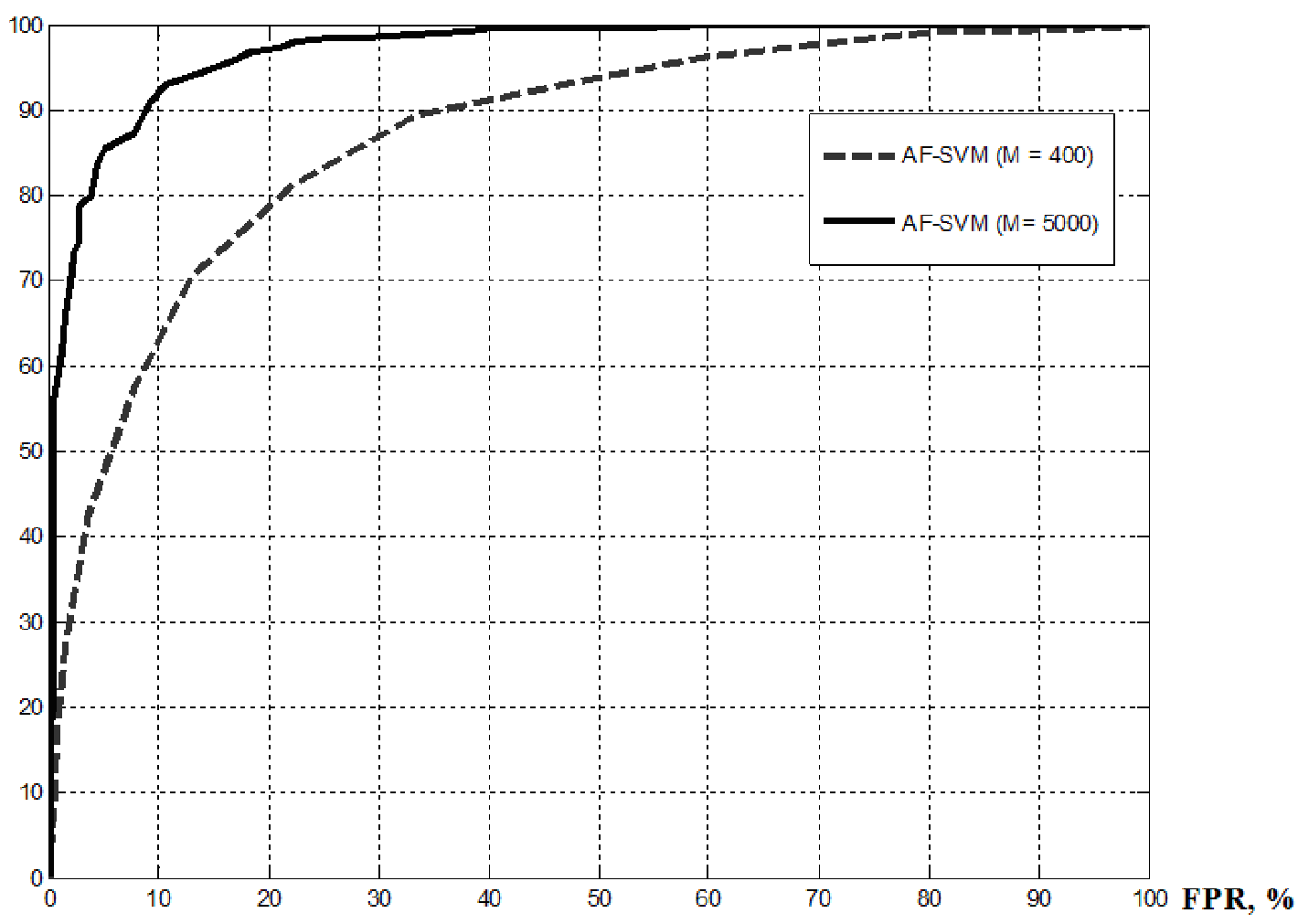 Fig 2: ROC curves demonstrating the performance gain of AF-SVM when scaled with more data (M=5000 vs M=400).
Critical Insight: Why Does It Work?
The efficiency gain (50% faster than SVM) is a result of the dimensionality reduction. By processing a small number of adaptive features (only 30 per color component), the SVM decision rule becomes computationally "light."
Furthermore, because each feature is trained on a random subset of the database, the feature set collectively captures global variance without the noise inherent in raw pixel distributions. This proves that Inductive Bias—specifically the LDA-based feature selection—can significantly outperform "brute-force" pixel learning in constrained environments.
Conclusion & Future Outlook
The AF-SVM algorithm presents a compelling case for real-time biometrics. It provides:
- High Accuracy (91%) for demographic tracking.
- Low Latency for interactive advertising.
- Generalizability: The authors suggest this method could be retrained for any object recognition task beyond just faces.
While modern Deep Learning (CNNs/Transformers) has since taken over the field, the principles of adaptive feature generation and computational efficiency highlighted in this paper remain foundational for edge-AI applications where GPU resources are limited.
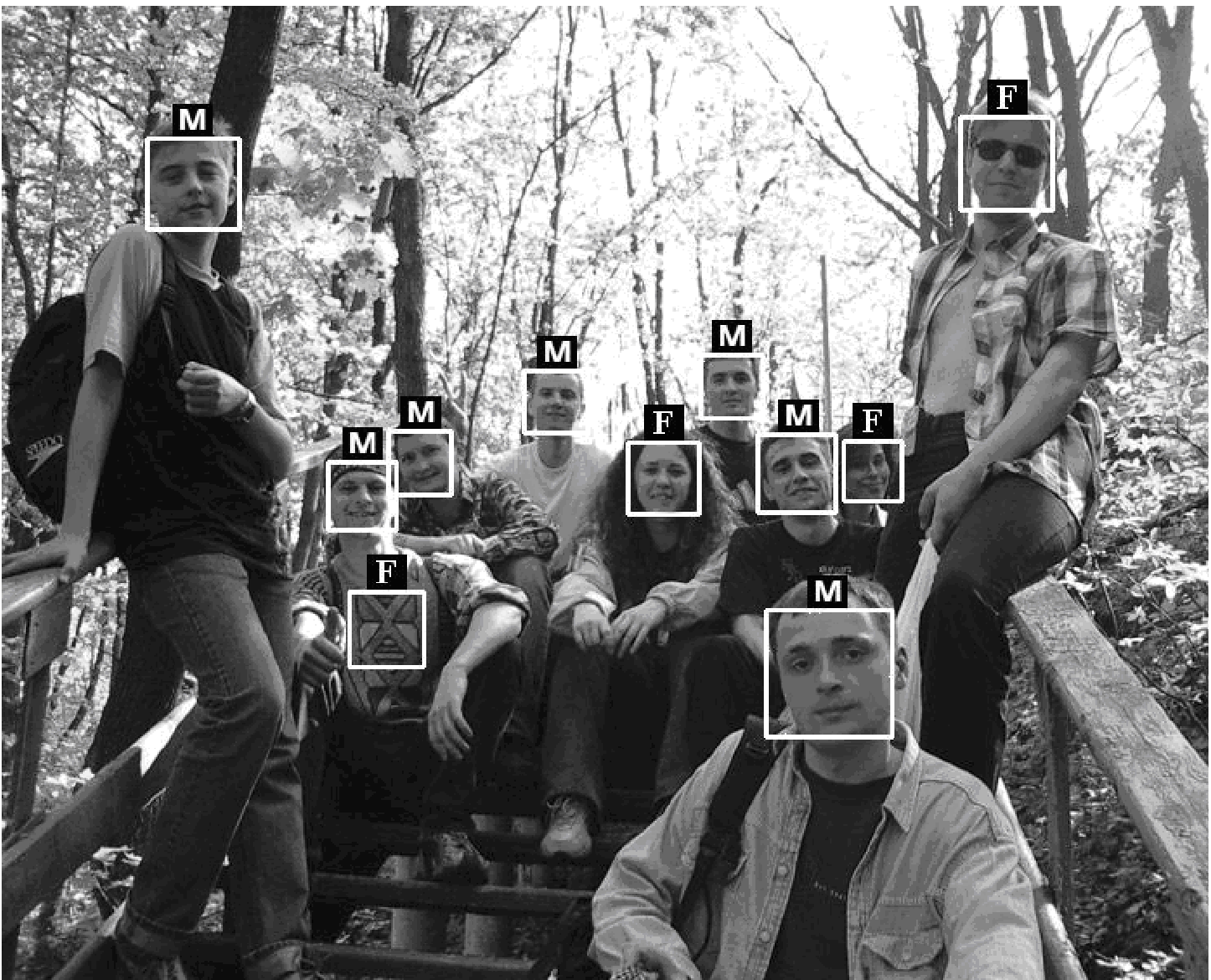 Fig 3: Real-time gender classification in action: "M" for Male, "F" for Female.