
Gender Classification for Web Forums: Decoding Stylometric and Topical Signatures
7822_Gender Classification for Web Forums.
This paper introduces a feature-based text classification framework specifically designed for gender classification in Web forums. By utilizing a Support Vector Machine (SVM) classifier and a rich hybrid feature set, the authors achieved a peak accuracy of 86% on a large-scale Islamic women's political forum.
TL;DR
This research presents a robust framework for identifying gender in Web 2.0 forums by analyzing both writing style and topical interests. By combining lexical, syntactic, structural, and content-specific features (unigrams/bigrams) with SVM and Information Gain feature selection, the authors achieved an 86% accuracy rate on real-world political forum data, revealing deep-seated gender differences in online discourse.
Background and Motivation: Beyond Web 1.0
While the "digital gender gap" regarding Internet access has closed, a significant gap remains in how different genders utilize the public sphere of Web 2.0. Previous research focused on emails (private) or blogs (owner-centric). However, Web Forums present a unique "balanced" environment where conversation is decentralized.
The authors argue that understanding these differences is not just an academic exercise—it is vital for:
- Security: Tracking threats and monitoring gender-specific radicalization trends.
- Marketing: Tailoring products and services based on gendered topical preferences.
Methodology: The Hybrid Feature Framework
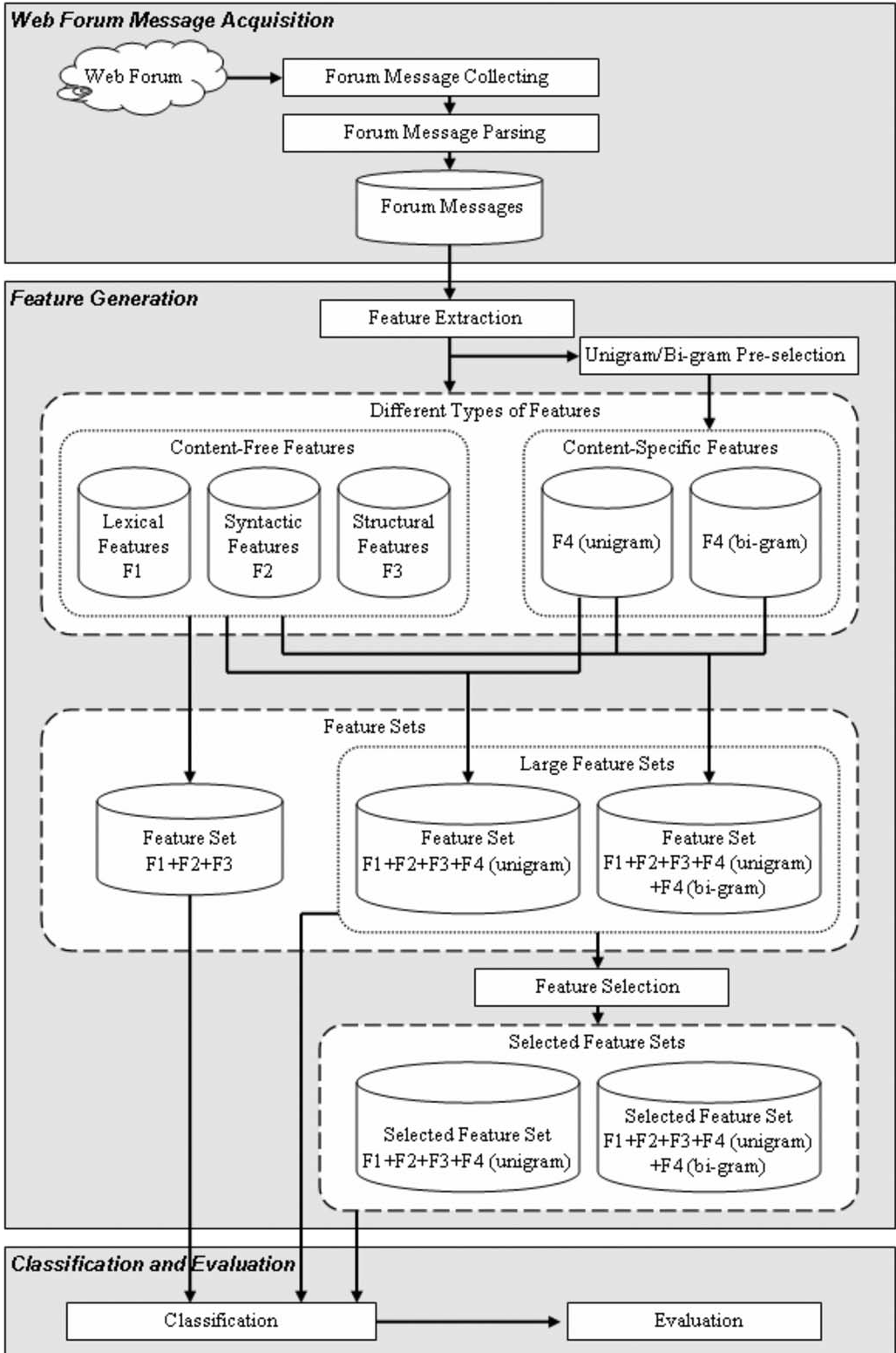
The core innovation lies in the incremental feature generation strategy. Instead of relying on a single signal, the framework extracts four distinct layers of information:
- Lexical (F1): Character-based measures, word length frequency, and vocabulary richness.
- Syntactic (F2): Frequencies of function words (the, of, and) and punctuation marks.
- Structural (F3): Post organization, such as paragraph count and sentence-per-paragraph ratios.
- Content-Specific (F4): Unigrams and Bigrams that capture the actual topics discussed.
The Power of Feature Selection
In natural language, n-grams create a "curse of dimensionality." The authors used Information Gain (IG) to strip away irrelevant features, reducing the feature space from over 10,000 to a high-impact subset of 640. This not only improved efficiency but significantly boosted the F-measure by eliminating linguistic noise.
Experimental Insights
The experiment was conducted on an Islamic women's political forum, providing a "gold standard" of self-reported gender data.
Key Findings
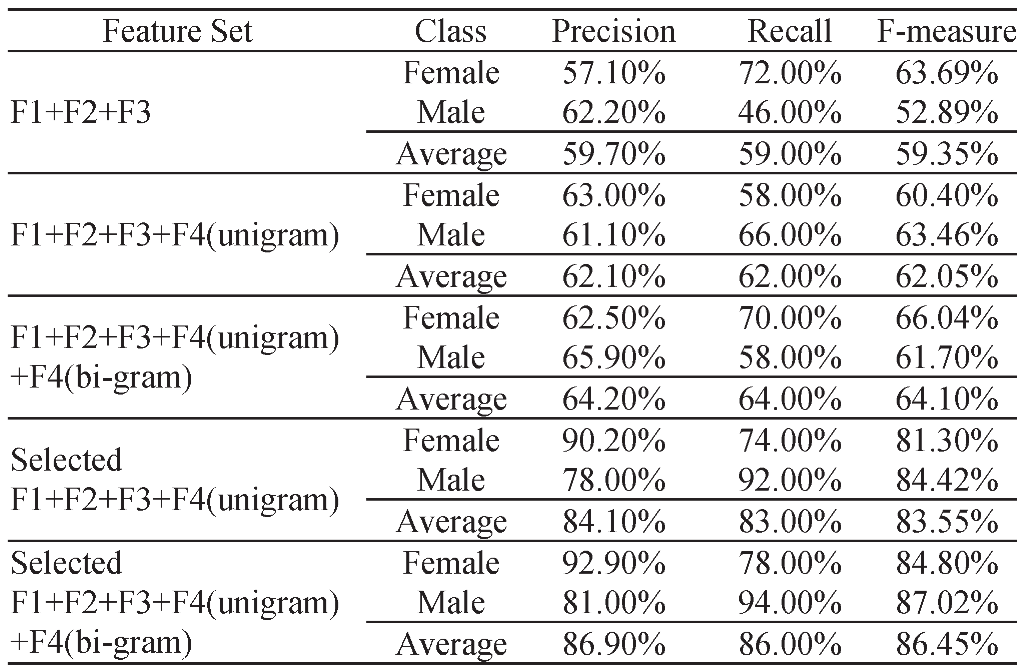
- Content is King: Adding n-grams to style features improved accuracy significantly (from ~62% to 86% after selection).
- Style Still Matters: While content-specific features are powerful, lexical and syntactic features provide a baseline that anchors the classification.
Identifying Gendered Topics
The research went beyond binary classification to perform a Chi-square (χ2) analysis of the topics favored by each group.
- Female Signatures: Focused on "private sphere" and community—using terms like sis, mother, husband, and emotional/religious expressions like Alhamdulillah (Thank God).
- Male Signatures: Focused on the "public/legal sphere"—using terms like Salafi (sect), Army, Ijtihaad (legal interpretation), and references to specific scholars or Imams.
Critical Analysis & Future Directions
The study successfully proves that gendered "Digital Fingerprints" exist in forum environments. However, a notable limitation is the reliance on English-only data and self-reported gender, which may not always be truthful in anonymous settings.
Furthermore, lexical features (F1) showed reduced effectiveness in short forum posts—a common issue in modern NLP where context is sparse. Future work should look toward Multilingual stylometry and the integration of behavioral metadata (posting frequency, interaction networks) to further sharpen the accuracy of these classifiers.
Takeaway for Practitioners
In the era of AI, this paper reminds us that stylometry—the study of linguistic style—remains a potent tool for digital forensics. For those building moderation or marketing tools, the combination of stylistic "how" and topic-based "what" is the gold standard for user profiling.