
Decoding the Digital Gender Gap: Automated Analysis of Political Discourse in Islamic Forums
Gender difference analysis of political web forums: An experiment on an international islamic women's forum
This paper introduces an automated stylometric and content-based approach to analyze gender differences in political Web forums using Support Vector Machines (SVM). By evaluating a long-standing international Islamic women’s forum (talk.islamicnetwork.com), the study achieves a high classification accuracy of 92% in distinguishing male from female contributors.
TL;DR
Researchers from the University of Arizona have developed a machine learning framework capable of identifying the gender of forum participants with 92% accuracy. By analyzing a massive dataset from an international Islamic women's political forum, the study proves that men and women not only write differently but also gravitate toward vastly different ideological and social topics in digital spaces.
The Evolution of the Digital "Writeprint"
While the early Internet was a male-dominated frontier, modern social media is a diverse battleground of opinions. However, even as access has equalized, how we communicate remains gendered. Previous research into the "Gendered Blogosphere" suggested that men and women have distinct "stylistic signatures."
The authors of this study aimed to take this further by looking at a high-stakes environment: an International Islamic Women's Political Forum. This testbed is unique because it provides a rare balance of male and female voices (approx. 17,000 messages each) discussing sensitive cultural and political issues.
Methodology: Beyond Simple Keywords
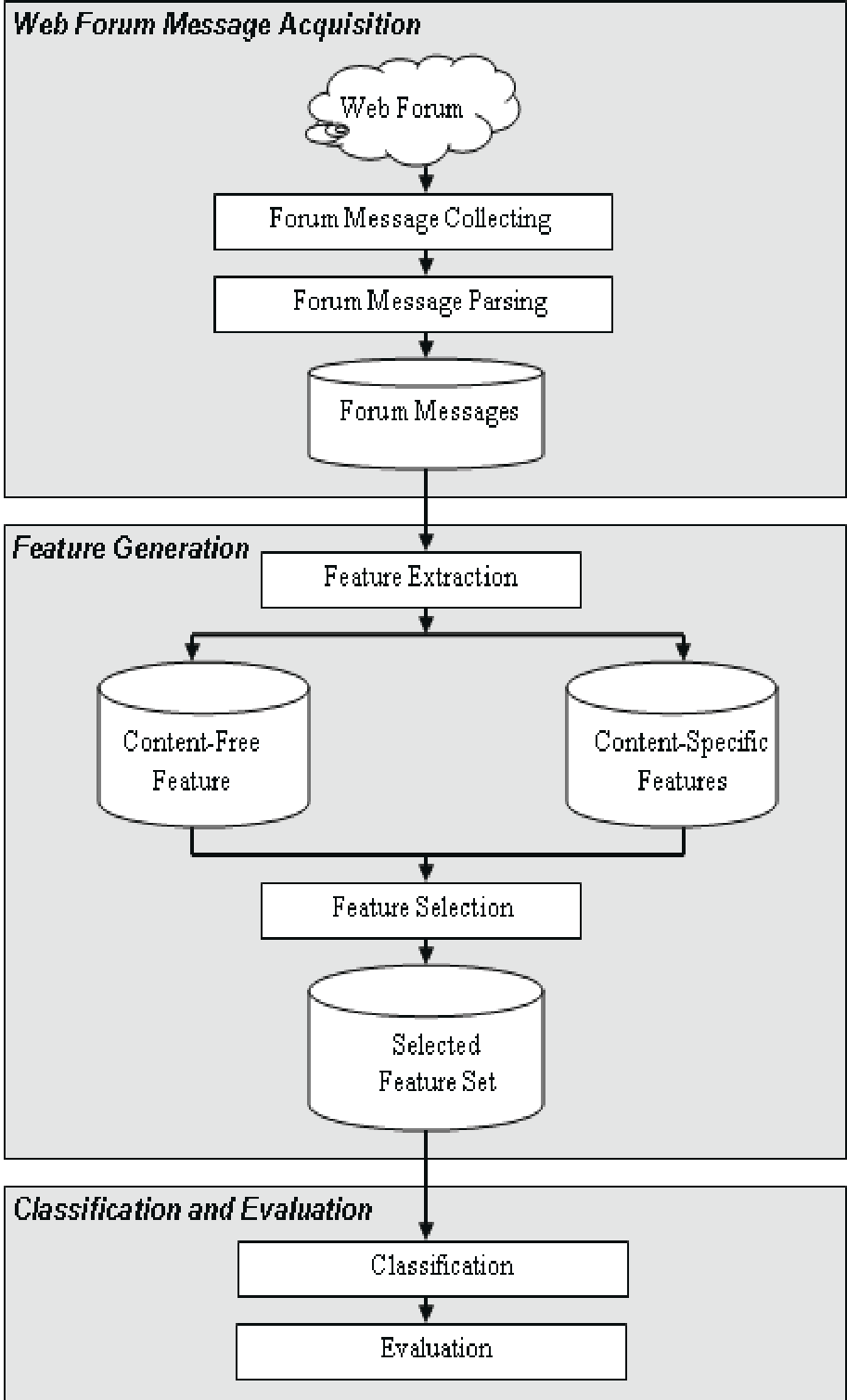
The core of this research is an automated pipeline that transforms raw HTML messages into a structured "feature space."
1. Feature Engineering
The study doesn't just look at what people say, but how they say it. They extracted:
- Content-Free Features (250): Lexical variations (word length), Syntactic patterns (Part-of-Speech tags, function words), and Structural traits (use of signatures, font sizes, greetings).
- Content-Specific Features (10,000+): Unigrams and bi-grams that capture the essence of the discussion.
2. The Power of Feature Selection
Using all 10,000+ features resulted in a noisy model with only 66% accuracy. By applying Information Gain, the researchers distilled the noise down to the 640 most "informative" features, which catapulted the accuracy to 92%.
Results: Where the Paths Diverge
The experimental results confirmed that gender identity significantly dictates both the vocabulary and the venues of online interaction.
Topical Polarization
- Female Interests: Highly centered on community and domestic life. Key terms included "sis" (sisters), "mother," and "husband." Popular threads focused on marriage and interpersonal relations (e.g., "Inter-racial marriages").
- Male Interests: More focused on theological debate and geopolitical conflict. Key terms included "Salafi," "Army," "Deviant," and "Ijtihaad." Male participants dominated threads on "Suicide bombing" and "Taliban forces".
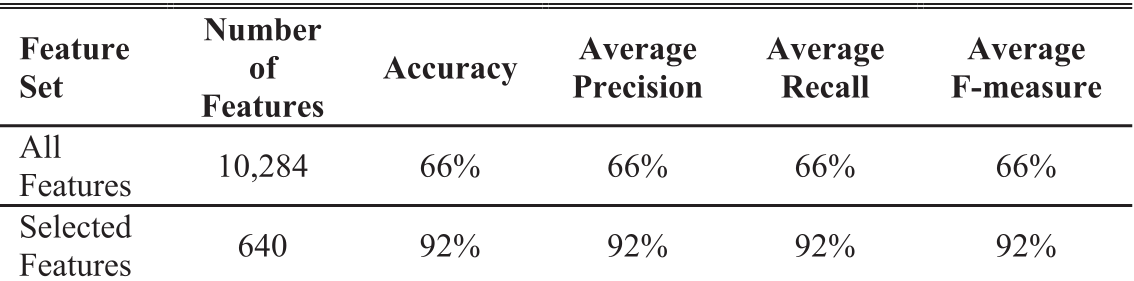
The table above shows that while the baseline model struggled, the optimized "Selected Features" model achieved near-perfect F-measures, proving that gendered linguistic patterns are highly consistent.
Critical Insight: Why Does This Matter?
This work goes beyond simple classification. It highlights an "Inductive Bias" in how gender roles are projected online. Even in a forum specifically designed for women, male participants often shift the discourse toward harder political and extremist topics, while women maintain the social and communal fabric of the platform.
Limitations and Future Work
While the SVM-based approach is robust, it relies on static feature sets. Modern Large Language Models (LLMs) could potentially uncover even more nuanced "latent" gender markers that traditional stylometry might miss. Additionally, as the authors note, the study is context-specific; applying this to a Western secular political forum might yield entirely different "topical interest" signatures.
Final Takeaway
Gender is not just a demographic label; it is a linguistic framework. As we move toward more sophisticated AI moderation and social sentiment analysis, understanding these stylistic differences is crucial for accurately interpreting the "voice of the people."