
Decoding the Silhouette of a Liar: Gender Differences in Deceptive Writing Style
Gender Differences in Deceivers Writing Style
This paper investigates gender-based linguistic variations in deceptive writing using a machine learning approach on a custom-collected open-domain dataset. By leveraging an ensemble of n-grams, syntactic trees (CFG), and psycholinguistic features (LIWC), the authors built classifiers capable of identifying a deceiver's gender with 60-70% accuracy.
TL;DR
Can your writing style betray your gender when you are lying? According to research from the University of North Texas and the University of Michigan, the answer is a resounding yes. By analyzing a dataset of "one-liner" truths and lies, researchers established that female and male deceivers leave distinct linguistic footprints, allowing machine learning models to identify a liar's gender with up to 70% accuracy.
Problem & Motivation: The Missing Demographic Dimension
In the realm of automated deception detection, the focus has historically been on what constitutes a lie. Researchers have successfully flagged "opinion spam" (fake reviews) or deceptive court testimonies. However, they often treated all liars as a homogeneous group.
The authors of this paper argue that this is a significant oversight. In social media, dating sites, and forums, users don't just lie about facts; they misrepresent their identities. To catch a deceiver, we must understand how demographic factors like gender act as an "inductive bias" that shapes the structure and content of a lie.
Methodology: Beyond Simple Keywords
To solve the data scarcity problem, the authors built a dataset of 7,168 statements. Each participant provided seven truths and seven lies on any topic, providing a raw look at "open domain" deception.
The technical core of the paper lies in its Multi-Feature Ensemble:
- N-grams: The basic "Bag of Words" (TF-IDF).
- Syntactic Stylometry: Using CFG (Context-Free Grammar) parse trees to analyze the "deep" structure of sentences.
- LIWC (Psycholinguistics): Utilizing a 80-category lexicon to capture psychological processes (e.g., negative emotions, references to others).
- Readability Metrics: Measuring the cognitive load through sentence length and complexity indexes.
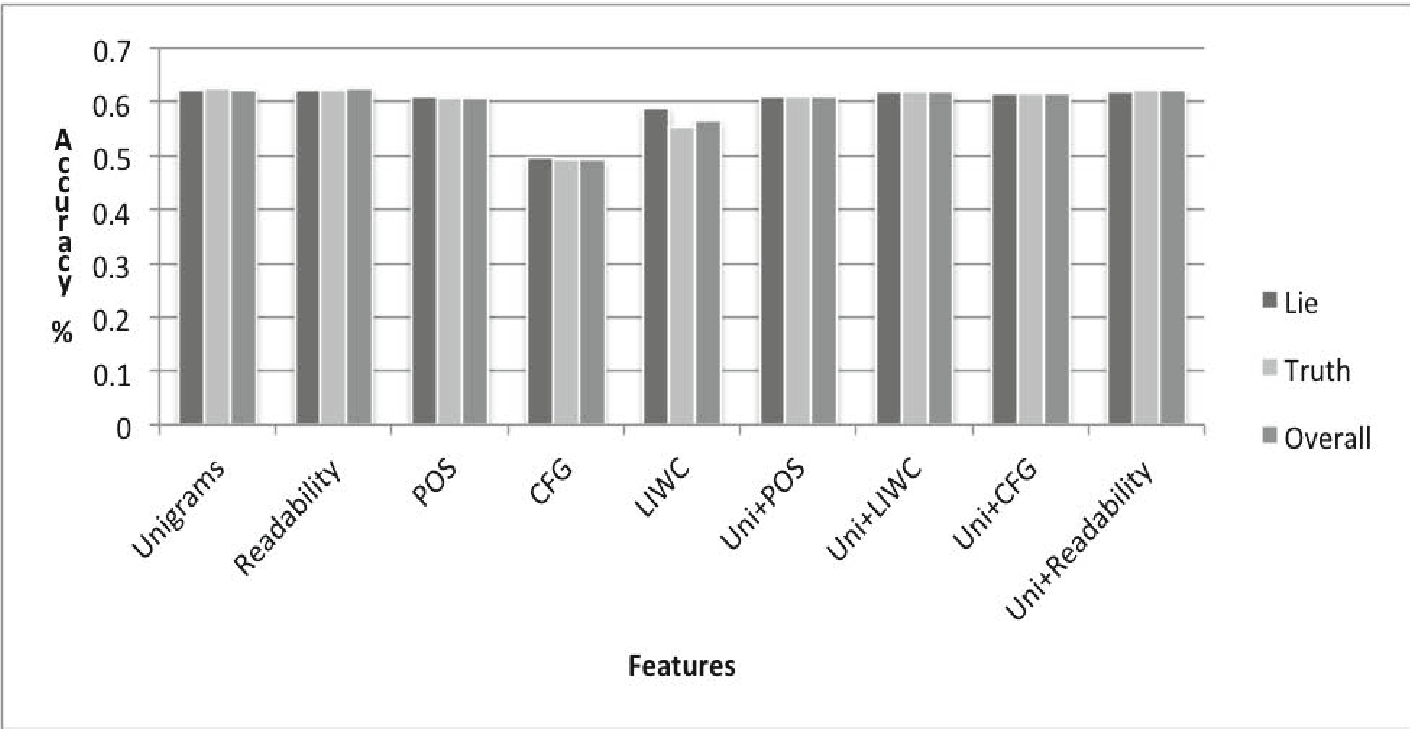 Figure 1: Performance of various feature sets in detecting deception within female-authored text.
Key Insights: How Do Genders Lie Differently?
The study reveals a fascinating dichotomy in the "Topic Bias" of lies:
- Commonalities: Regardless of gender, deceivers tend to use more negations ("I don't," "I never"), negative emotions, and references to other people—likely to distance themselves from the lie.
- Gender Divergence:
- Males lie more about topics involving Death, Sleep, and Alcohol.
- Females lie more about Sports, Future Actions, and Eating.
- Detectability: Female deceivers are generally more "identifiable" than males. The researchers suggest that when women lie, they may deviate more noticeably from their truthful Baseline writing style compared to men.
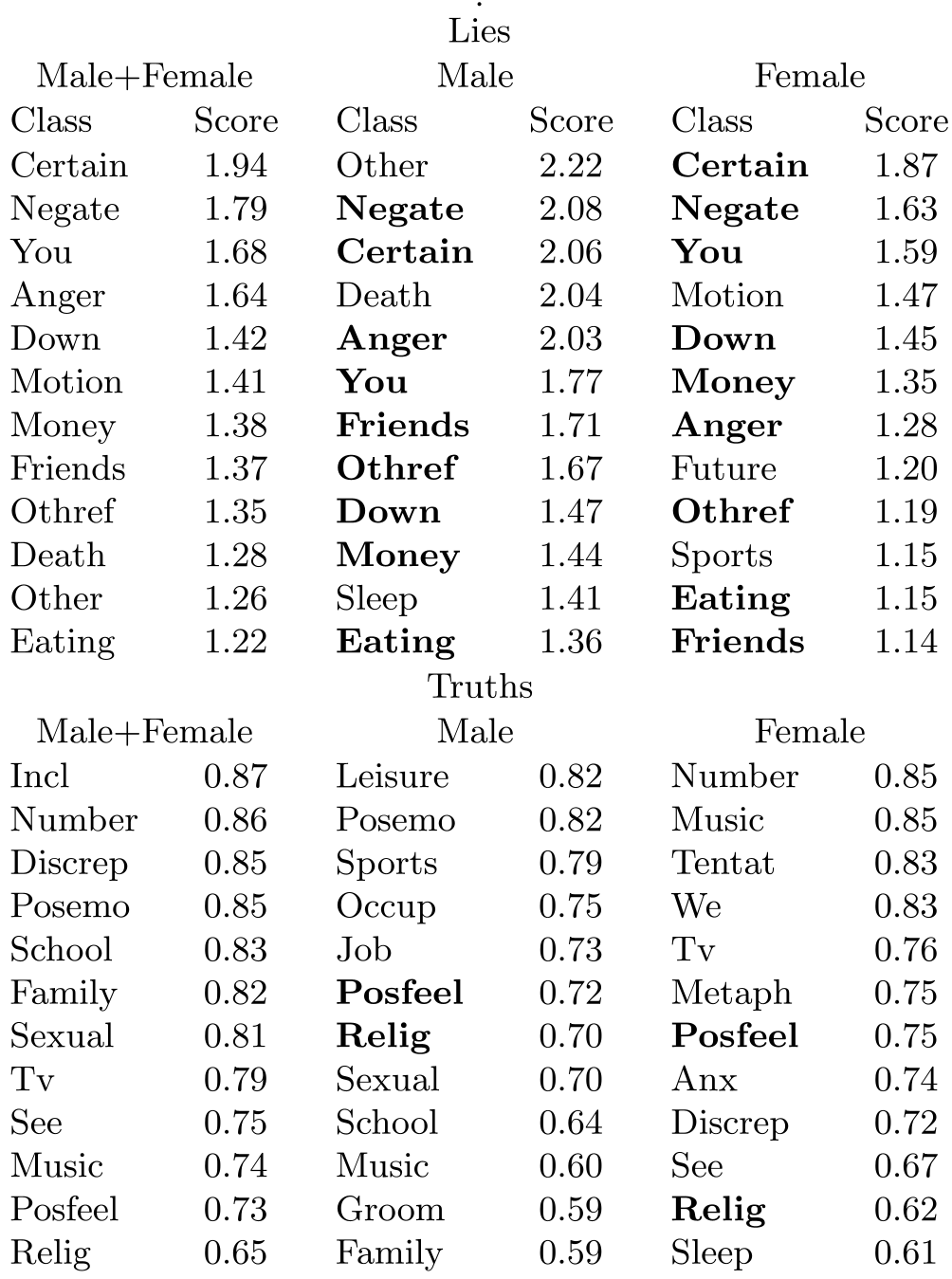 Table 1: Dominant semantic word classes for male and female deceivers vs. truth-tellers.
Experiments & Results
The researchers used Support Vector Machines (SVM) to test three main questions:
- Can we detect lies in short sentences? Yes, especially when combining Unigrams with Syntactic Complexity features.
- Can we predict a liar’s gender? Yes, with accuracies between 60-70%.
- Is one class easier to catch? Truths were consistently easier to identify than lies across both genders, suggesting that "Truth" has a more stable linguistic signature while "Lies" are more varied.
Critical Analysis & Future Outlook
This work provides a crucial stepping stone for "Demographic Profiling" in security contexts. However, there are inherent limitations:
- Short Length: The dataset uses "one-liners," which might lack the complexity needed to see long-term strategic deception.
- Imbalance: There were more female participants than male (58% baseline), which may skew the gender prediction results.
Takeaway: The study proves that gender is not just a demographic label, but a stylistic filter. As we move toward more sophisticated AI-driven moderation, incorporating these "Demographic Signatures" will be essential for identifying strategic misrepresentation in digital spaces.