
Digital Peacocks and Caregivers: Decoding the Evolutionary Logic of Facebook Profiles
Gender differences in Facebook self-presentation: An international randomized study
This study investigates gender differences in Facebook self-presentation by analyzing the profile and cover photos of a random international sample of 500 users. Grounded in Evolutionary Psychology, the research reveals that males emphasize status and risk-taking, while females highlight familial relations and emotional expressivity in their digital identities.
TL;DR
Why do men often pose with cars or in suits, while women are more likely to share photos with their children or offer a bright smile? This international study of 500 Facebook users suggests these aren't just cultural tropes. By applying Evolutionary Psychology, the research demonstrates that our digital "avatars" are deeply rooted in ancestral strategies for survival, status-seeking, and kin-care.
Beyond Self-Reports: The Quest for Objective Data
For years, cyberpsychology relied heavily on surveys—asking people what they do online. However, human memory is fickle, and we often answer in ways that make us look "good" (Social Desirability Bias).
The authors of this study took a different route. They bypassed the questionnaire and went straight to the source: the images themselves. By analyzing a random, international sample, they escaped the "American college student" bubble that plagues social science, seeking to find if these gender signals are universal or merely local.
The Evolutionary Intuition
The core argument is simple: Men and women faced different adaptive challenges over millions of years.
- Men (The Signalers): Success often depended on displaying status (to attract mates) and physical risk-taking (to secure resources).
- Women (The Keepers): Success was often tied to high empathy (for childcare) and maintaining strong familial bonds.
On Facebook—a modern "lek" or mating/social arena—these ancient drives manifest as modern pixels.
Methodology: Coding the Digital Persona
The researchers developed a 38-item checklist to audit 500 profiles. They looked at two distinct spaces: the Profile Photo (the primary self-image) and the Cover Photo (the background context).
 Figure 1: The study utilized a rigorous process of independent coding to identify status symbols, emotional cues, and familial presence.
Key Findings: Status vs. Connection
The results confirmed a striking gender split in profile photos:
1. Status and Power (The Male Domain)
Men were significantly more likely to include objects (cars, instruments, electronics) in their photos (29% vs 19% for women). They also leaned toward formal clothing and outdoor settings, which the authors interpret as signals of professional competence and "rugged individualism"—traits that historically signaled a high-quality mate.
2. Emotion and Empathy (The Female Domain)
Women were the "emotional expressors." They smiled with higher intensity, maintained more eye contact, and were less likely to hide behind sunglasses. Remarkably, women were twice as likely to post family photos (18% vs 10%) as their primary profile picture.
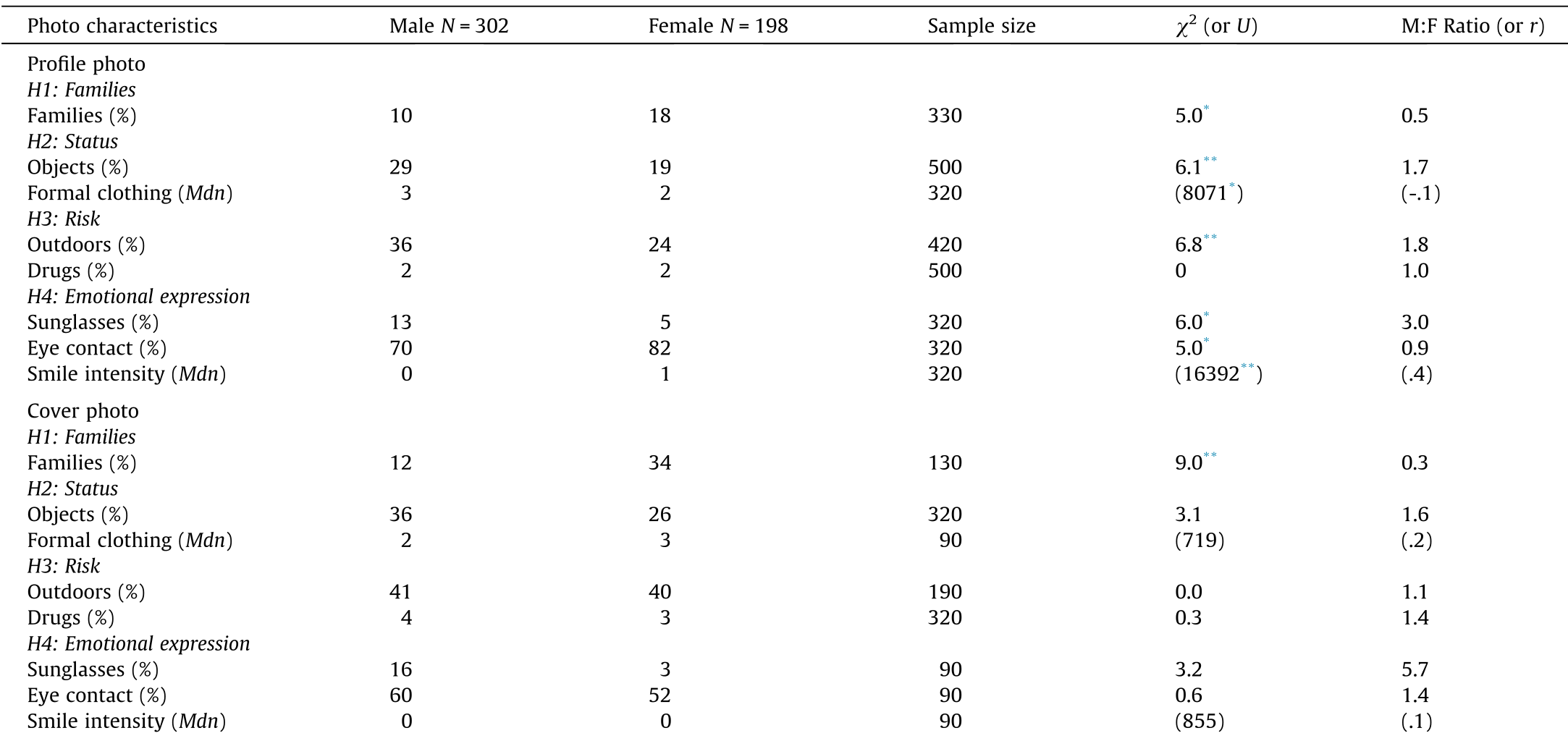 Table 2: Quantitative breakdown of gender differences across Profile and Cover photos.
Critical Insight: The Profile vs. The Cover
One of the most fascinating findings was the lack of difference in cover photos. While profile photos are the "face" of the individual (highly gendered), cover photos serve as a "contextual background."
The study suggests that when we present our essential self, we fall back on evolutionary default settings. When we present our environment (cover photos), the gender distinctions blur, as both men and women value landscapes and general social settings similarly.
Limitations and Future Outlook
While the data is compelling, the authors admit a "Social vs. Nature" overlap. Are women socialized to be caregivers, or is it biological? The study argues for a biosocial model—where nature and nurture interact.
The real takeaway for the future? As we move toward even more visual platforms (Instagram, TikTok), the "digital signals" we send are becoming more sophisticated, but the underlying psychological hardware remains the same. Professionals in marketing, UI/UX, and even online dating can leverage these insights to understand how users instinctively manage their impressions.
Final Conclusion
Evolutionary theory, though rooted in the distant past, provides a remarkably clear lens for the future of social technology. We are, quite literally, prehistoric minds navigating a high-tech world.