
Gendered Signatures in Portuguese: A LIWC-Based Analysis of Social Media
Gender Differences in the Use of Portuguese in Social Networks: Evidence from LIWC
This study investigates linguistic gender differences in Brazilian Portuguese using the LIWC (Linguistic Inquiry and Word Count) framework. By analyzing over 180,000 entries from the social network "Meu Querido Diário," the researchers established a statistically significant baseline for gendered writing styles in Portuguese, aligning with international findings in English.
TL;DR
This paper provides the first comprehensive look at how gender influences the use of Brazilian Portuguese on social networks. Utilizing the LIWC (Linguistic Inquiry and Word Count) tool, researchers analyzed a massive dataset from the "Meu Querido Diário" platform. The findings confirm that women use more personal and emotional language, while men focus on impersonal, task-oriented categories like work and money—aligning Brazilian linguistic patterns with global standards.
The Motivation: Can Language Reveal Identity?
In the digital age, a profile picture can be faked, but writing style—the "stylometric fingerprint"—is much harder to mask. Previous sociolinguistic studies (primarily in English) have shown that demographics like age and gender significantly influence an individual’s Inductive Bias toward certain word classes. However, the Brazilian Portuguese landscape remained largely unexplored.
The authors identified this gap as a barrier to developing effective tools for:
- Cybersecurity: Detecting predators or drug traffickers using false identities.
- Sentiment Analysis: Improving the accuracy of market research by understanding gender-specific nuances.
- Psycholinguistics: Verifying if "gendered language" is a cultural construct or a cross-linguistic psychological phenomenon.
Methodology: Vectorizing Human Emotion
The study utilized a dataset named MQD1016-LIWC-PT-1NORM, consisting of 1,016 users (510 female, 506 male). Each user's history was converted into a 64-dimensional vector, where each dimension represents a LIWC category (e.g., Anger, Religion, Space).
The Feature Extraction Pipeline:
- Categorization: Every word used by a user was matched against the 127,149 words in the Portuguese LIWC dictionary.
- Normalization: The raw counts were converted using the L1 Norm, ensuring the sum of all components in a user's vector equals 1. This allows for fair comparison regardless of how much a user writes.
- Effect Size Analysis: They used Cohen's d to measure the magnitude of the difference between gender means, ensuring that results weren't just "statistically significant" but practically meaningful.
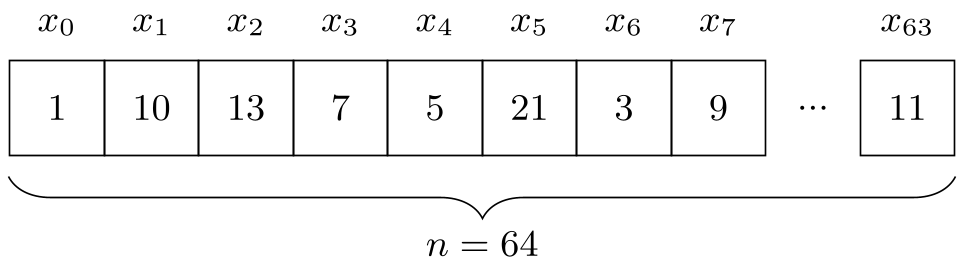 Figure 1: Example of raw frequency mapping before normalization.
Experimental Results: Who Says What?
The study found distinct "clusters" of language use that varied by gender. These findings are summarized in the primary results table:
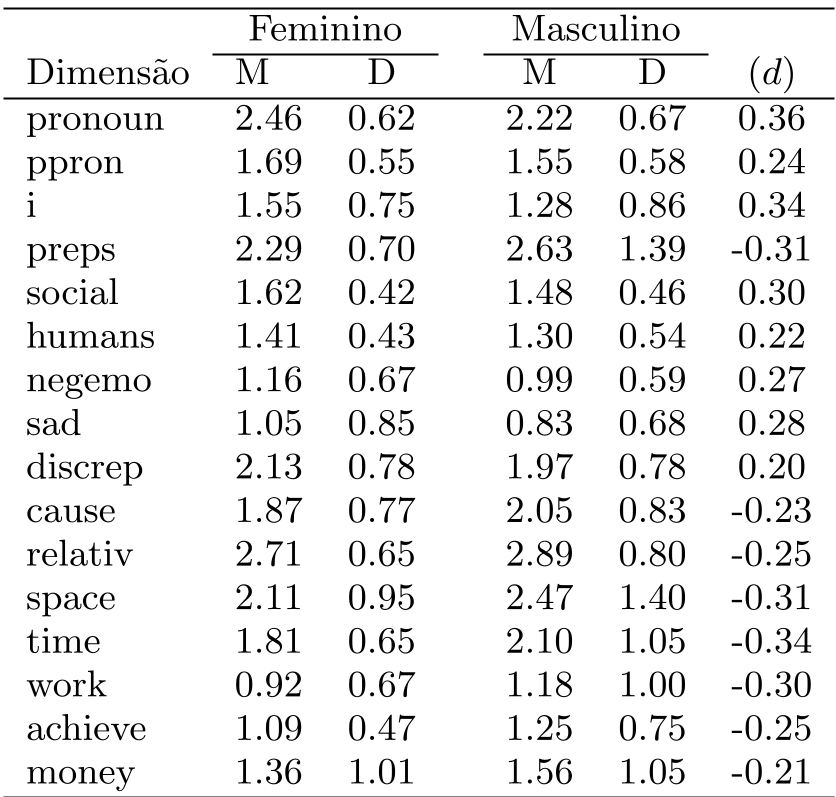 Table 1: Key LIWC categories showing the highest gender disparity.
Key Insights:
- The Female "Social-Emotional" Profile: Women significantly outperformed men in the use of Personal Pronouns (ppron) and Social Words. They also expressed Negative Emotions (negemo) and Sadness (sad) more frequently in their diaries. This suggests a more inter-subjective approach to writing, focusing on the self and its relationship to others.
- The Male "Objective-Structural" Profile: Men used more Prepositions, Numbers, and categories related to Work, Money, and Time. This points to a more objective and descriptive style, focusing on external events and concrete objects rather than internal states.
- Cognitive Discrepancy: Women used more "discrepancy" words (e.g., should, would), a finding that mirrors English studies where women often reflect more on hypothetical social scenarios or self-improvement.
Critical Analysis & Conclusion
This work is a vital bridge between Portuguese linguistics and computational social science. By validating that the Brazilian Portuguese LIWC produces results consistent with the English versions, it proves that many gendered linguistic markers are likely driven by broader psychological traits rather than purely language-specific grammar.
Limitation & Future Work:
While the study provides a robust statistical baseline, it is primarily descriptive. The authors acknowledge that the next step is to explore correlation—for instance, does the increased use of "Money" by men correlate directly with "Work" mentions, or are they independent markers?
Furthermore, the study does not account for the intersubjectivity of the social network's structure. Future research should investigate if these writing styles change when users interact with friends vs. writing in a private-style diary.
Takeaway for Practitioners:
If you are building a classifier for gender or personality in Portuguese, these LIWC-based results provide the "Gold Standard" features you should prioritize in your feature engineering process.