
Discovering the "Niches" of Bias: A Data Mining Approach to Gender Discrimination in Research Funding
Discovering Gender Discrimination in Project Funding
This paper presents a data mining approach to uncover gender discrimination in scientific project funding, using a dataset from the Italian FIRB "Future in Research" call. By implementing a k-NN based 'situation testing' methodology, the authors identify specific niches where female applicants face unexplained rejection rates compared to similarly qualified males.
Executive Summary
TL;DR: While many global studies suggest gender parity in grant awards, this paper proves that discrimination often hides in the shadows of specific sub-fields and demographic "niches." By applying a k-NN based situation testing methodology to Italian national research calls, the authors move beyond simple averages to reveal where and why "equally qualified" female researchers are being left behind.
Academic Context: This work bridges the gap between legal methodology and Knowledge Discovery in Databases (KDD). It argues that discrimination is not a global constant but a local phenomenon that requires high-dimensional classification models to uncover.
The Problem: The Flaw of Averages
Most social science research relies on linear or logistic regression to find a single "gender coefficient." However, this assumes that discrimination acts uniformly across all applicants.
The authors argue that this is a fundamental oversight. Discrimination might not exist for a senior professor in Physics, but it could be rampant for a young female researcher in Life Sciences with a specific publication profile. Traditional methods suffer from aggregated value bias, where the lack of global evidence is mistaken for the absence of local injustice.
Methodology: Simulating "Situation Testing"
In legal settings, "situation testing" involves sending two identical applicants (one protected, one not) to the same job interview to see if they are treated differently. The authors replicate this digitally:
- k-NN Matching: For a rejected project led by a woman, the algorithm finds the most similar projects led by women and the most similar projects led by men.
- Distance Metrics: Similarity is calculated based on "legally admissible" factors: PI age, publication count, project costs, and research area.
- Risk Difference (): They calculate the difference in rejection rates between the female neighborhood () and the male neighborhood ().
- Rule Induction: If , the instance is labeled "discriminated." Systems like C4.5 and RIPPER are then trained to find the "rules" that describe these instances.
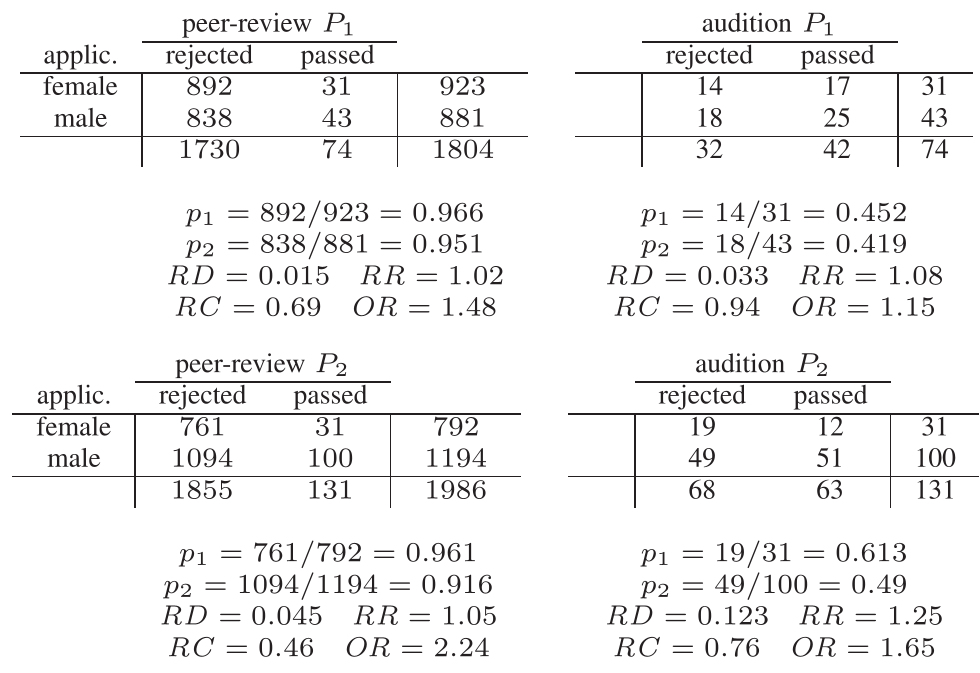 The evaluation pipeline analyzed: Peer-review (Step 1) and Audition (Step 2).
Key Findings: The Anatomy of Bias
The study highlights that gender bias is highly contextual. Two major "niches" of discrimination emerged:
Niche 1: The "Statistical Discrimination" in Life Sciences
In the Life Sciences (LS) domain, the authors found a rule (R1) where discrimination was extremely high ():
- The Context: Female PIs with 12 publications but high average co-author counts ( 8.4).
- The Intuition: Reviewers may perceive a lack of individual independence in women with many co-authors, defaulting to "gender-based performance associations" (rational racism) rather than individual merit.
Niche 2: The Budget Barrier in Physical Sciences
In the PE4 panel (Physical/Analytical Chemistry), a different barrier exists (R2) ():
- The Context: Young female PIs ( 35 years) asking for high budgets ( €1.3M).
- The Intuition: There appears to be a "trust gap" where reviewers are significantly less likely to grant large sums to young women compared to young men with identical qualifications.
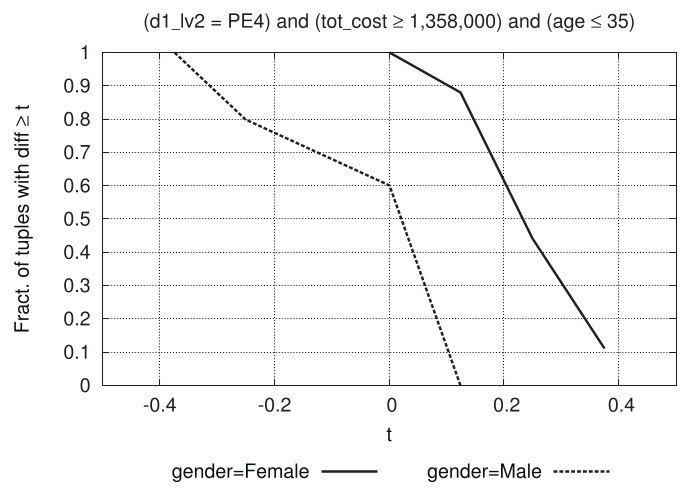 Figure: The "dual face" of discrimination. While women in this niche (R2) suffer higher risk, their male counterparts conversely benefit from 'favoritism' (rejection rates lower than the average).
Deep Insights & Conclusion
Takeaway
The core contribution of this paper is the transition from discrimination detection (is there a problem?) to discrimination description (under what specific conditions does it happen?). By using decision trees and rules, the authors provide a "map" of systemic bias that can be used by policy-makers to train reviewers or adjust evaluation criteria.
Limitations
- Omitted Variables: Since the data was anonymized, the authors couldn't account for the quality of publications (e.g., impact factor) or the PI's professional network, which might explain some of the variance.
- Audition Bias: The second phase (auditions) likely involves even more subjective bias (appearance, speech style) which was not captured in the tabular data.
Future Outlook
As AI increasingly automates "screening" processes, the k-NN/Rule-induction pipeline proposed here serves as a vital blueprint for Auditable AI. It offers a way to probe black-box systems for hidden biases that would otherwise remain invisible to standard statistical audits.