
Understanding Gender Equity in Author Order: Why the CS 'Prestige Slot' is Leaking
Understanding Gender Equity in Author Order Assignment
This paper presents a comprehensive study on gender equity in author order assignment within Computer Science (specifically HCI and ML). Using a dual-method approach—qualitative interviews with 38 researchers and bibliometric analysis of 4,355 papers—the authors reveal systemic gender disparities in prestige-slot attainment (last authorship) and negotiation patterns.
TL;DR
Academic success is a currency traded in author lists. While we often assume author order is a meritocratic reflection of effort, this study by Early et al. uncovers a sobering reality: in Computer Science, the process is an ad-hoc negotiation where gendered power dynamics frequently push women out of prestigious positions. Even of equal seniority, women are statistically less likely to occupy the "last author" slot (signifying intellectual leadership) compared to their male counterparts.
Background Positioning
This work resides at the critical intersection of Bibliometrics and Sociology of Science. Unlike previous "pipeline" studies that simply count how many women are in the field, this paper performs a "surgical" analysis of credit attribution. It defines the field's current state not as a lack of participation, but as a systematic failure in the negotiation and interpretation of intellectual leadership.
The Problem: The Ambiguity of "Contribution"
In Human-Computer Interaction (HCI) and Machine Learning (ML), multi-author papers are the standard. However, the norms for ordering those names are often unwritten. This lack of formalization leads to several failure modes:
- Cultural Assumptions: Readers often assume the first author did the work and the last author is the PI. If these roles aren't negotiated fairly, credit is "stolen" or misattributed.
- Negotiation Friction: Women face higher social costs for "advocating for themselves."
- The Invisible Ceiling: Senior women are not transitioning into the prestige "last author" slot at the same rate as senior men, regardless of the number of juniors they supervise.
Methodology: Mixing Qualitative Insight with Quantitative Power
The authors employed a robust two-pronged approach:
- Interviews (N=38): Uncovering the "thorny" and "ad-hoc" nature of how researchers actually decide who goes where.
- Bibliometric Data Science: Analyzing 7,376 authors across CSCW, UIST, and ICML from 1996–2016.
The Analytical Framework
The team built a logistic regression model to predict author positions. Essential to their methodology was the concept of Rank Inference, where seniority was calculated based on the author's publishing history in the DBLP database.
 Figure 1: The study framework spans from interpersonal interview themes to large-scale data trends.
Key Insights: Why "Gender-Neutral" Norms aren't Neutral
The most striking part of the methodology was the interaction effect in their predictive model. For a male author, having more junior (lower-ranked) co-authors is a strong predictor that he will be the last author.
The anomaly: For a female author, this same condition (having junior co-authors) actually decreases her likelihood of being in the last position.
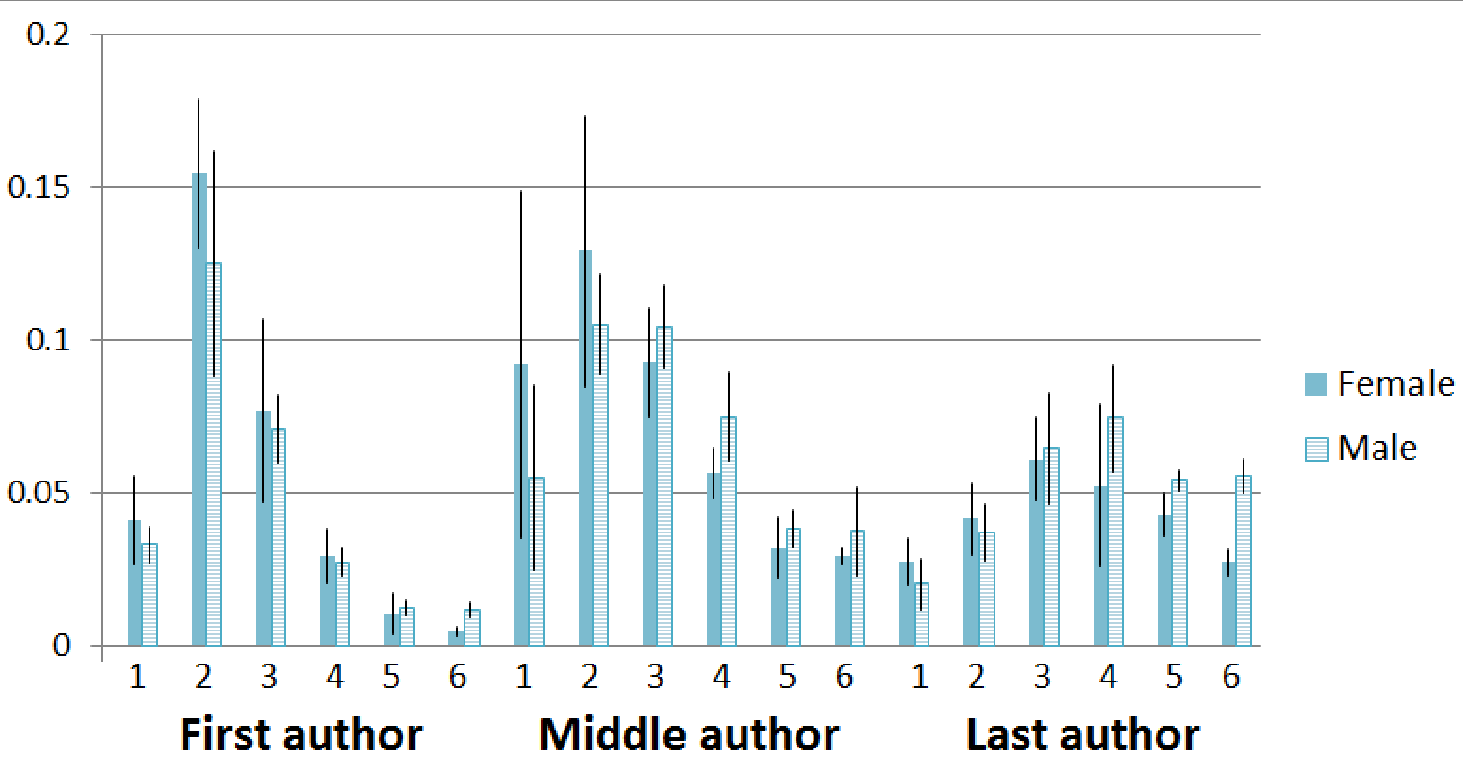 Figure 2: Data shows that as seniority (Rank 5-6) increases, men dominate the last author slot (striped light bars), while women (dark bars) lag behind.
The "Invisibility" of Timing
The qualitative data revealed a significant "negotiation gap":
- Women tended to discuss author order much earlier (31% very early vs. 18% of men).
- Men were more likely to wait until submission or later, often relying on "trust" or "reasonableness"—a luxury often only available to the dominant group who fits the "default" persona of a leader.
Experiments & Results: The Concrete Impact
- Underrepresentation in Collaboration: In UIST, 63% of papers have no women, which is 14% higher than what random chance would dictate based on the author pool.
- The Multi-Woman Effect: Interestingly, when a woman publishes with other women, she is significantly more likely to hold the prestigious last-author slot. This suggests that "all-female" or "majority-female" environments might bypass the traditional patriarchal norms of the PI slot.
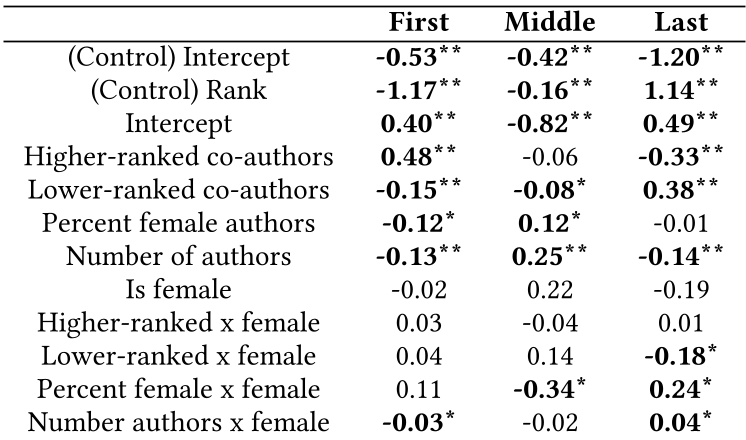 Table 4: Statistical evidence showing how variables like "Lower-ranked co-authors" interact negatively with "Is female" for the last author slot.
Critical Analysis & Conclusion
This paper is a wakeup call for the CS community. It proves that the "meritocracy" of our publication records is partially a social construct influenced by who feels comfortable speaking up at the 11th hour before a deadline.
Limitations: The study relies on name-based gender inference (which can be binary-biased) and lacks "impact" metrics like citation counts. It also doesn't account for the "lost authors"—those who contributed but were excluded from the list entirely.
Future Outlook: The authors recommend moving toward Contribution Disclosures (identifying who did the coding, who did the writing, etc.) rather than relying on the imprecise "prestige" of the last author slot. As AI and CS become even more collaborative, institutional scale scorecards and early-stage negotiation scripts will be essential to ensure that "intellectual leadership" isn't just a synonym for "social dominance."