
Beyond the Soundboard: Quantifying the Gender Gap in Audio Engineering Research
15567_The Impact of Gender on Conference Authorship in Audio Engineering Analysis Using a New Data Collection Method.
This paper presents a comprehensive longitudinal analysis of gender diversity at Audio Engineering Society (AES) conferences from 2012 to 2016. Using a novel, inclusive gender determination methodology based on self-identified pronouns, the study reveals a staggering underrepresentation of non-male authors, hovering around only 9-10% across the field.
TL;DR
A deep dive into five years of Audio Engineering Society (AES) conference data reveals a field struggling with diversity. Utilizing a new, high-precision gender determination method, researchers found that non-male authors represent less than 10% of the community, with "invited" celebrity roles and theoretical topics being the most male-heavy.
Executive Summary
Audio engineering has long carried the anecdotal reputation of being a "boys' club." While diversity initiatives have gained traction, hard data to drive policy has been missing or flawed. This study provides that data, analyzing 1,761 data points across 20 conferences. It serves as a critical diagnostic tool, positioning audio engineering as lagging significantly behind broader STEM and even general Engineering averages in terms of gender parity.
The Flaw in "Auto-Gendering" Algorithms
Previous attempts to measure gender in academia typically feed author lists into databases like Genderize.io. The authors of this paper argue that these methods are fundamentally flawed for global research:
- Cultural Blindness: Many algorithms struggle with non-Western names.
- Binary Rigidity: Traditional methods cannot account for non-binary identities.
- Data Waste: High "Non-assignable" rates (often >40%) lead to sampled subsets that may not reflect the actual population.
The authors' insight was to move from names to pronouns, using a "direct-first" approach that asks authors how they identify rather than guessing based on a label.
Methodology: A Human-Centric Data Collection
The methodology outperformed standard bibliometric tools by a wide margin, reducing the "Unknown" author count from over 40% to less than 2%.
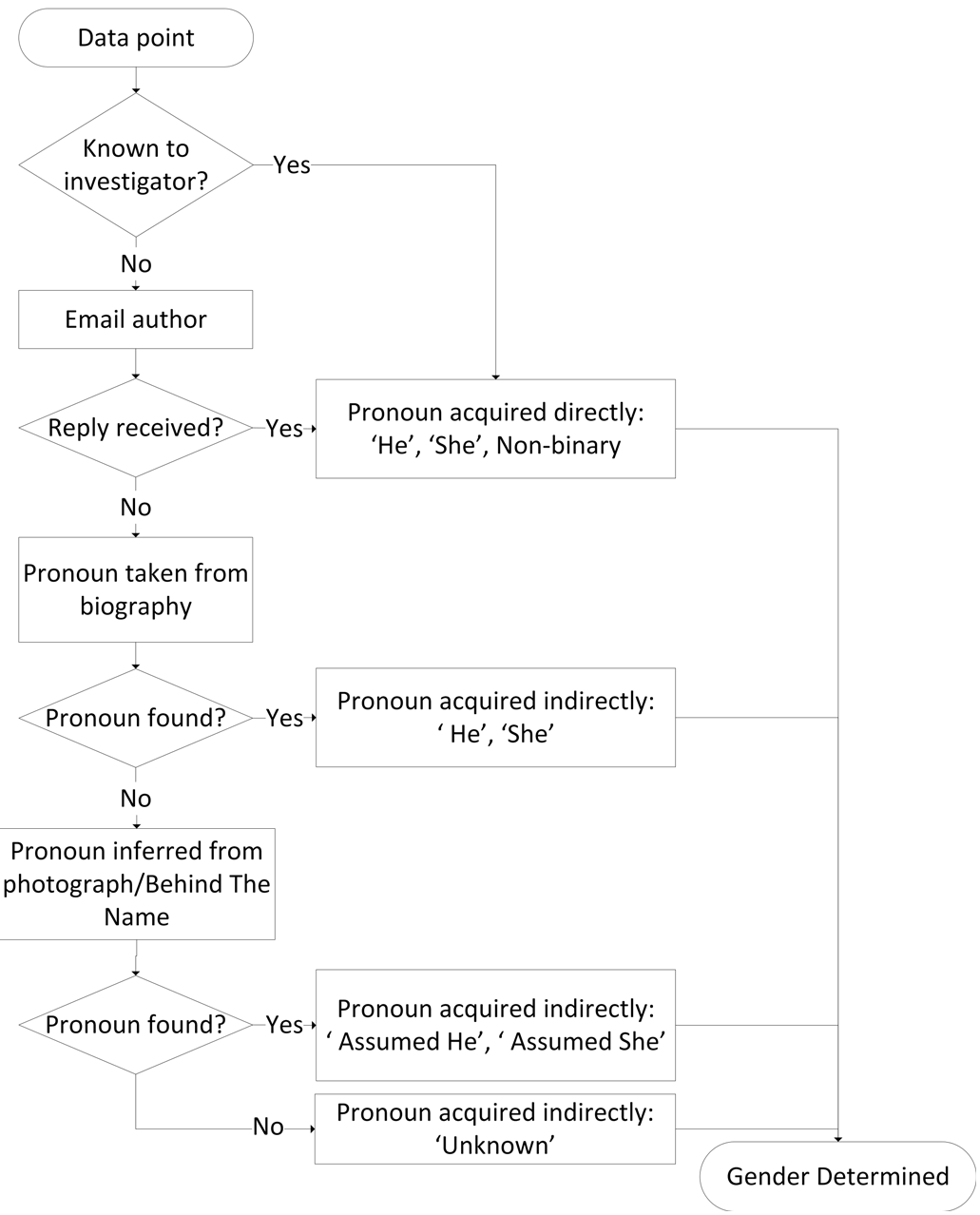
The multi-tiered approach: starting with direct email/personal knowledge, moving to professional biographies, and only using name-markers as a last resort.
Key Findings: Where the Disparity is Loudest
The data suggests that the lack of diversity is not uniform—it clusters in specific areas of the profession.
1. The Topic Divide
There is a statistically significant link between the "nature" of the topic and its diversity.
- Theoretical/Heavy Engineering: Topics like Sound Field Control (3.73% female) remain heavily male-dominated.
- Applied/Interdisciplinary: Audio Education (15.48%) and Medical Audio (21.11%) show the highest non-male representation, reflecting broader trends in those parent fields.
2. The "Invited" Glass Ceiling
Perhaps the most damning finding involves Invited Papers and Keynotes. These represent the elite of the field—the role models.
- Ironically, the very positions meant to inspire the next generation have the lowest diversity (just over 2% for invited papers).
- This suggests either an unconscious bias in selection committees (who often invite from their own networks) or a "silo" effect where senior leadership remains unchanged despite a diversifying student body.
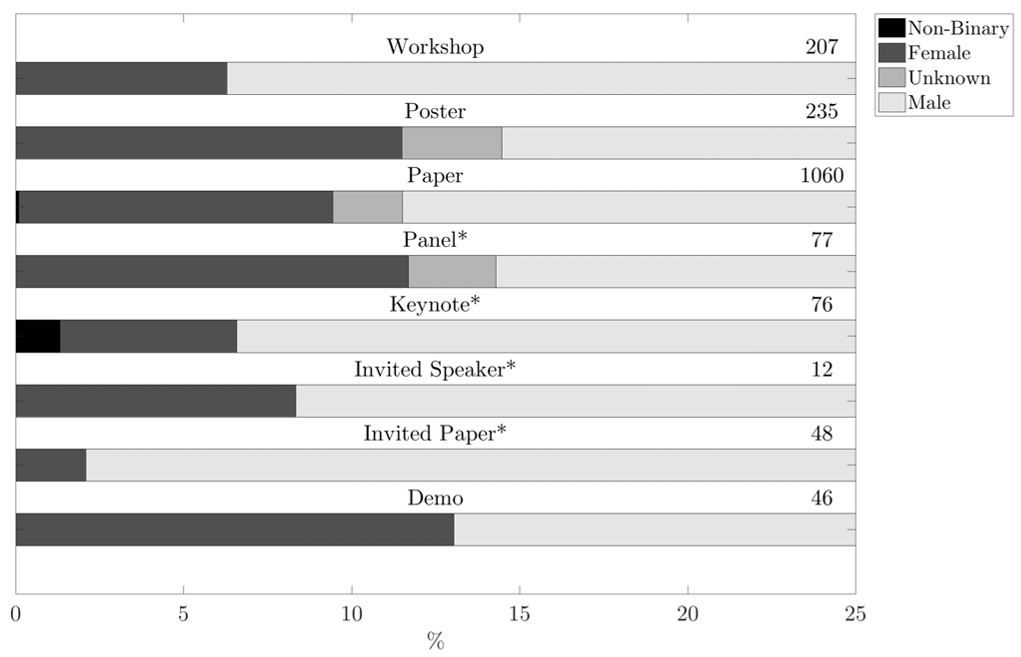
Visual evidence: Note the drastic drop in non-male participation for 'Invited' categories (marked with asterisks) compared to Posters or Demos.
Critical Analysis: Why This Matters
The study concludes that the "pipeline" is not the only problem. The fact that female representation in AES conferences (9%) is roughly similar to AES membership (7%) suggests that the few women in the field are publishing. However, the stagnation of these numbers over five years (2012-2016) is a warning sign.
Limitations:
- The method is incredibly time-intensive, making it hard to scale to the millions of papers in databases like Scopus.
- The reliance on English pronouns may still miss nuances in non-English speaking research cultures.
Conclusion
This paper is a call to action for the Audio Engineering Society and similar STEM bodies. To achieve true gender parity—defined as a 40/60 split—the industry needs more than just inclusive "language"; it needs a structural overhaul of how invited speakers are selected and how role models are elevated. The authors have provided the metric; now the industry must provide the movement.