
Decoding the Universal Clock: Identifying Gender-Independent Biomarkers of Muscle Aging
The scope of this study is the identification of gender-independent muscle transcriptional differences between younger and older subjects using skeletal muscle gene expression profiles. Towards this end, a combination of statistical methods, functional analyses, and machine learning techniques were exploited, and applied on an integrative dataset of publicly available microarray data obtained from healthy males and females. Through the proposed framework, a set of 46 reliable genes was identified that comprise a candidate gender-independent aging signature in human skeletal muscle. The identification was based on differential expression, information gain content, and significance regarding their central regulatory role in the underlying active molecular networks in the GO. The resulted gene subset was also tested for its generalization potency regarding the classification task, through the use of a series of classifiers, and results show that high classification accuracies could be obtained. Therefore, the selected genes comprise a promising group of biomarkers of ageing in human skeletal muscle to be evaluated in future studies
This study identifies a gender-independent transcriptomic signature of muscle aging by integrating multi-experiment microarray data. Using a pipeline of statistical filtering, functional analysis (StRAnGER/GORevenge), and machine learning, the authors identified 46 key biomarkers that achieve up to 96.67% classification accuracy in distinguishing young from old subjects.
TL;DR
Aging is universal, but its molecular signature in skeletal muscle is often obscured by physiological differences between men and women. Researchers have developed a robust computational pipeline—integrating statistical physics (entropy), graph theory (GORevenge), and machine learning—to identify 46 core genes that define muscle aging across genders with 96.67% accuracy.
Problem & Motivation: Beyond the Gender Divide
Sarcopenia (age-related muscle loss) affects nearly half of the human cell mass, leading to frailty and reduced quality of life. Historically, transcriptomic studies have often been siloed by gender, citing hormonal differences (e.g., testosterone and estrogen levels) as reasons for distinct aging profiles.
The authors of this study challenged this fragmentation. They aimed to answer: Is there a fundamental molecular program for aging that transcends sex? To find it, they integrated multiple publicly available microarray datasets (from the GEO database) to create a diverse cohort of young (20-29) and elderly (65-75) males and females.
Methodology: A Hybrid Intelligence Pipeline
The study's strength lies in its three-layered filtering process:
- Statistical Selection: Using linear models and empirical Bayes shrinkage (via the
limmapackage), they pre-selected 1,507 probe IDs that were differentially expressed in aging. - Systemic Functional Analysis: They didn't just look for "high numbers"; they looked for "influence." Using the GORevenge algorithm, they mapped genes onto the Gene Ontology (GO) tree to find "central molecular players"—genes that act as regulatory hubs in biological processes.
- Information Gain (IG) Filtering: They applied Kullback–Leibler divergence to rank genes by their informative content. Only genes that were both topologically central in the GO graph and high in information content were retained.
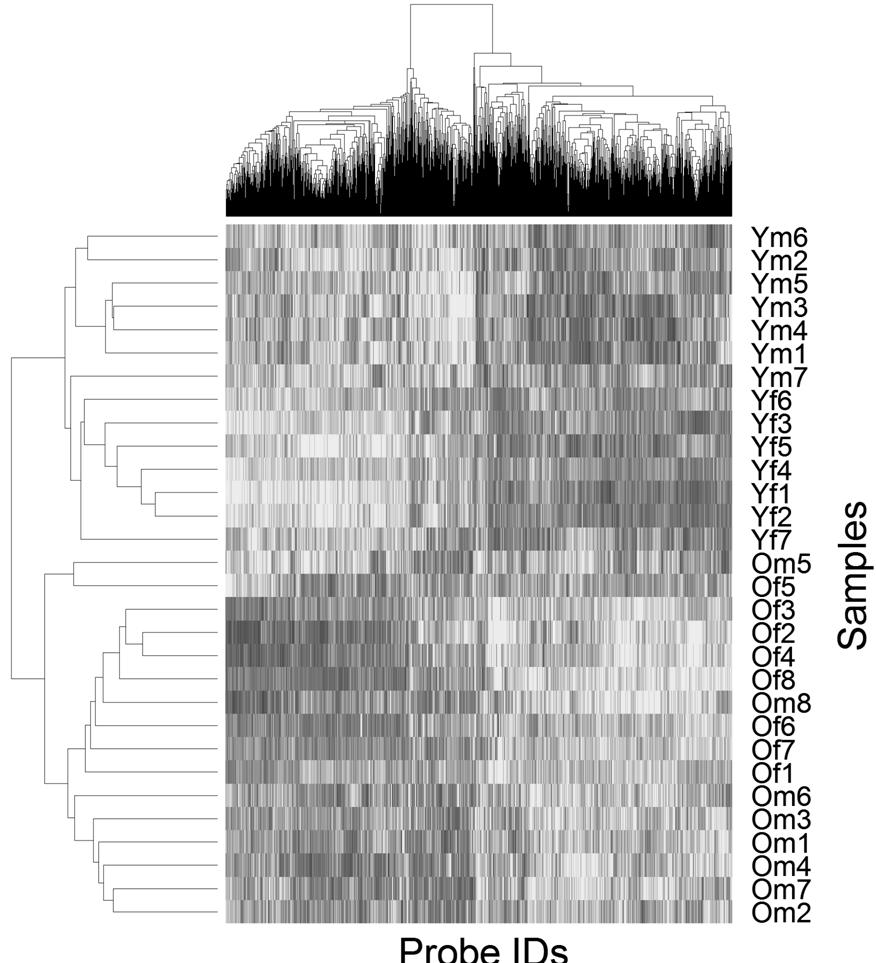 Fig 1: Hierarchical clustering of the 1,507 initial probes, showing a clear separation between Young (Y) and Old (O) cohorts regardless of male (m) or female (f) labels.
Key Findings: Metabolism and Splicing
The final 46-gene signature points to two primary drivers of muscle aging:
- Metabolic Collapse: Massive enrichment in terms like "tricarboxylic acid cycle" and "ATP catabolic process." Genes like DLD (central to longevity) and VLDLR were highlighted.
- RNA Splicing Alterations: A surprising and significant finding was the role of alternative RNA splicing (GO:0008380). This suggests that as we age, the "editing" of our genetic instructions becomes error-prone.
Performance Comparison
To validate these 46 genes, the team tested them as features in various machine learning models. The results were striking:
| Classifier | Accuracy |
|---|---|
| 6-Nearest Neighbor (6-NN) | 96.67 % |
| 10-Nearest Neighbor (10-NN) | 96.67 % |
| Random Forest (RF) | 90.00 % |
| Decision Tree (DT) | 63.33 % |
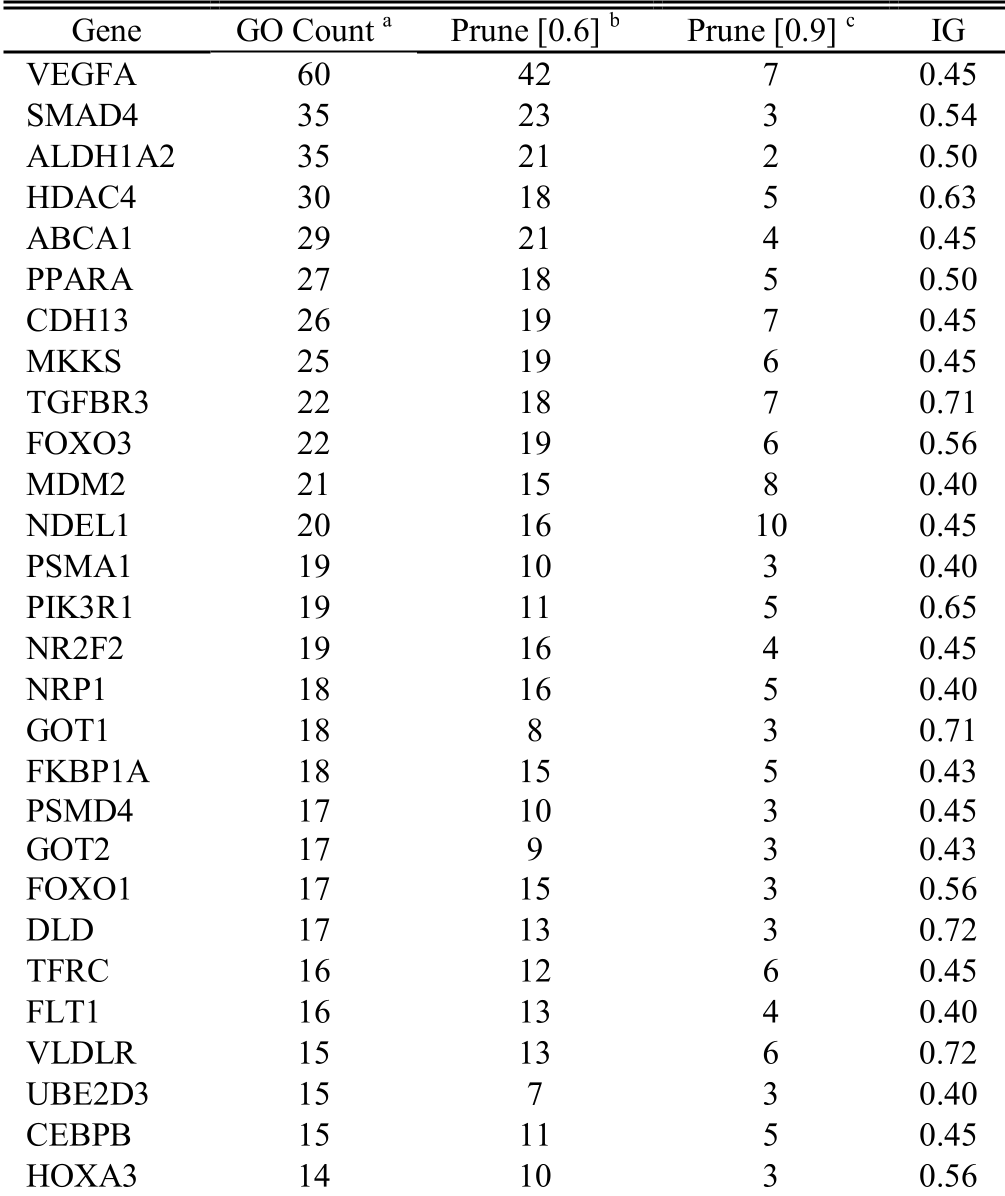 Table 1: A subset of the 46 identified genes, ranked by their GO centrality and Information Gain (IG).
Critical Insight: Why This Works
Most aging studies suffer from the "Curse of Dimensionality"—too many genes, too few samples. By using orthogonal characteristics (combining functional centrality with entropy-based information gain), the authors successfully reduced 44,000 probes down to 46 highly potent features. This ensures that the model isn't just "overfitting" on a specific experiment but is capturing a genuine biological signal.
Conclusion & Future Outlook
This work provides a "Gold Standard" for cross-gender aging studies. While 46 genes are a manageable target for diagnostic panels, the next step is moving from correlation to causation. Do these genes drive aging, or are they just the "smoke" from the fire? For clinicians and researchers, these 46 biomarkers offer a roadmap for developing therapies that aim to maintain muscle health into our 70s and beyond.
Wait for the next wave: Future studies will likely apply these biomarkers to Single-Cell RNA-seq data to see which specific muscle cell types (e.g., satellite cells or myofibers) are the primary sites of this 46-gene signature.