
Gender Dynamics in the Tuenti Network: Homophily, Segregation, and the Popularity Effect
Gender Patterns in a Large Online Social Network
This study analyzes a complete dataset of 9.8 million users from the Spanish social network Tuenti to investigate gender patterns in online social dynamics. It uncovers a general tendency toward gender homophily, particularly among female users, and identifies significant gender-based differences in network adoption and structural motifs like triangles.
TL;DR
Analyzing a massive, gender-balanced dataset from the Spanish social network Tuenti, researchers found that women are the primary drivers of technology adoption through same-gender invitations. While women generally prefer same-gender connections early on, men actually create more exclusive "boys' clubs" (gender-segregated triangles) in their interaction patterns. As users become more "popular" (higher degree), they shift from homophily to heterophily, connecting more with the opposite sex.
Problem & Motivation
Are men always the early adopters of tech? In social media, the answer is often "No." Yet, most research neglects the gender dimension or uses biased datasets from the US. The authors wanted to understand how gender influences the growth of an "ego network" (a user's personal circle) from the very first invitation. They aimed to determine if the "birds of a feather flock together" (homophily) principle applies differently to men and women when forming complex social structures like triangles.
Methodology: The "First Friend" and Triangle Shuffling
The study leverages the "invitation-only" nature of Tuenti to treat a user's first friend as their recruiter. To analyze group dynamics, they focused on Triangle Motifs—sets of three people who are all friends with each other.
To prove these patterns weren't just random, the authors used a Null Model via Shuffling:
- They kept the network structure (who follows whom) identical.
- They randomly reassigned "male" or "female" labels to users with the same number of friends.
- If the real network showed more single-gender triangles than the shuffled version, it's evidence of intentional Gender Segregation.
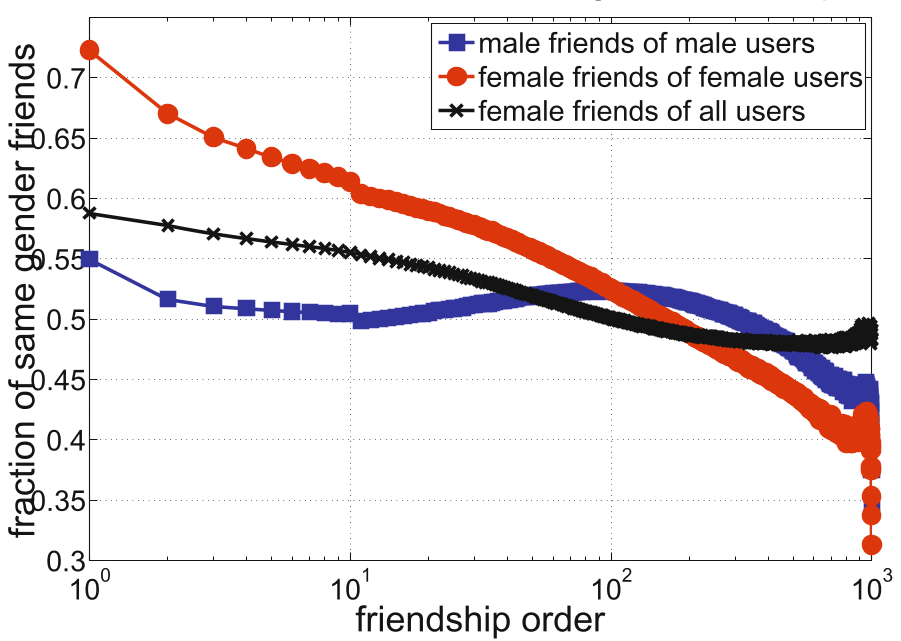 Figure 1: The preference for same-gender friends is highest at the start of the social journey (low k) and diminishes as the network grows.
Key Insights: Homophily vs. Segregation
1. The Gateway Effect
Women are the "gatekeepers" for other women. 72% of women join because of another woman. This suggests that for a platform to achieve gender balance, it must first win over a core group of female users who then act as a recruitment engine.
2. The Popularity Paradox (Heterophily)
The paper discovers a "Popularity Effect." Users with an average number of friends are homophilous (prefer their own gender). However, "social butterflies"—users with 300+ friends—tend to have more friends of the opposite gender.
- Females with few friends: ~60% female friends.
- Females with 450+ friends: Majority male friends.
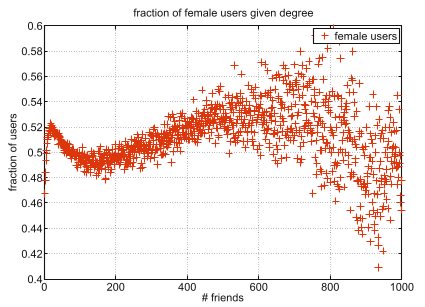 Figure 2: Ratio of female/same-gender friends based on user degree. Notice the decline in same-gender preference as degree increases.
3. The "Boys' Club" in Interactions
While women show higher one-to-one homophily, men dominate in Structural Segregation. In the "Interaction Network" (users who actually talk to each other), male-only triangles were 60% more frequent than expected by chance. Women talk more, but they are more inclusive of the opposite gender in their social cliques.
Critical Analysis & Conclusion
This work provides a rare "full-picture" view of a national social network. The core takeaway is that gender is not a binary variable to be "controlled for," but a fundamental driver of how networks grow.
Limitations: The study is a snapshot of Tuenti from over a decade ago (Spanish context). Modern algorithmic recommendations (like "People You May Know") might now suppress or amplify these natural human tendencies compared to the organic growth seen in this dataset.
Future Outlook: For product designers, this highlights that "cold start" problems for female users can be solved by ensuring they enter the platform through same-gender pods. For researchers, the next step is looking at larger cliques (4-nodes or 5-nodes) to see if these "boys' clubs" and "girls' circles" expand into larger, isolated communities.