
Advancing Robotic Social Intelligence: An Ensemble Approach to Gender Recognition
Abstract-Gender recognition for interactive functions becomes essential topic in terms of service robotics applications. Ensemble learning which combines multiple classifiers prediction is now an active area of research in Machine Learning and Pattern Recognition. We propose an ensemble learning to facilitate gender classification. The features which we use are raw data (image pixels as input), Local binary pattern (LBP), Local derivative pattern (LDP), Gabor, and Weber local descriptors (WLD). We carry out comparative experimental studies of various gender recognition schemes, including Eigenfaces, any individual classifiers, Rotation Forest, and Adaboost. Specifically, not only individual classifiers but also ensemble classifiers are based on Support Vector Machine, namely using SVM as component classifier in ensemble learning. Furthermore, we evaluate the effect of image size on classification rate. In conclusion, we find that the best classification rate is achieved with Discrete Adaboost with SVM as component classifier using the aforementioned features. Another finding is that the classification rates will increase when face image size increases
The paper introduces a robust gender recognition framework for service robotics using an ensemble learning approach. By combining multiple texture descriptors like LBP, LDP, and WLD with a Discrete AdaBoost meta-classifier using SVMs as base learners, the authors achieve a 90% classification accuracy on the FERET database.
TL;DR
To enhance the social interaction capabilities of service robots, this paper proposes a gender recognition system powered by an ensemble of SVMs. By fusing local texture descriptors—specifically Local Derivative Patterns (LDP) and Weber Local Descriptors (WLD)—within a Discrete AdaBoost framework, the researchers achieved a 90% accuracy rate, significantly improving the robot's ability to perceive human users in real-time environments.
Background & Positioning
Gender recognition is a fundamental building block for Human-Robot Interaction (HRI). For a robot to personalize its service, it must accurately categorize the demographics of its environment. While deep learning dominates today's landscape, this work provides a rigorous look at how ensemble learning and high-order local descriptors can provide high performance with more efficient computational profiles than heavy neural networks, specifically focusing on the trade-off between image resolution and classification accuracy.
The Core Challenge: Robustness Beyond Raw Pixels
Most early systems relied on Eigenfaces (PCA) or raw pixel data. The authors demonstrate that these methods are fragile; they work reasonably well for frontal faces but collapse when the subject's pose changes even slightly. The research intuition here is that "texture" is more invariant than "geometry." By focusing on how local pixel intensities change relative to one another (derivatives), the model can ignore global lighting shifts and minor alignment errors.
Methodology: The Power of Multi-Feature Fusion
The researchers didn't just pick one feature; they created a "committee" of classifiers. The architecture follows a two-pronged strategy:
- High-Order Feature Extraction: They utilize LDP, which goes beyond the standard LBP (Local Binary Pattern). While LBP looks at the first-order derivative (is the neighbor brighter or darker?), LDP looks at the direction of change between neighbors, capturing intricate facial details.
- The Discrete AdaBoost-SVM Synergy: Instead of using weak decision trees, they use SVMs as the base learners in the AdaBoost ensemble. This combines the "Strong Learner" capabilities of SVMs with the iterative refinement of Boosting.
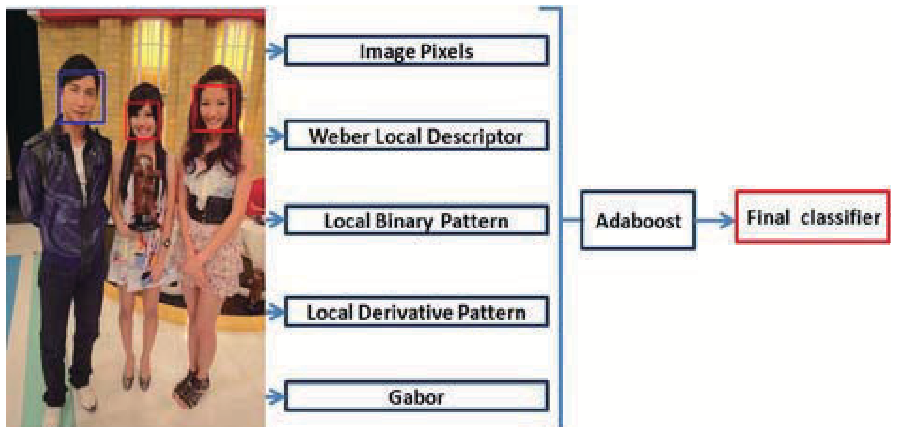 Fig 1: The Discrete AdaBoost process selecting discriminative features from a heterogeneous feature pool.
Experiments and Results
The study conducted a comprehensive sweep across different face sizes (36x36 vs 48x48) and poses.
Key Findings:
- Size Matters: Accuracy consistently increased as image resolution rose. At 48x48, the ensemble reached 90%, whereas, at smaller sizes, the lack of spatial detail hampered the LDP and Gabor filters.
- Ensemble Superiority: AdaBoost outperformed the Rotation Forest method (which uses PCA on feature subsets), proving that selecting features across multiple domains (Raw, LBP, LDP, Gabor) is superior to just Rotating a single feature set.
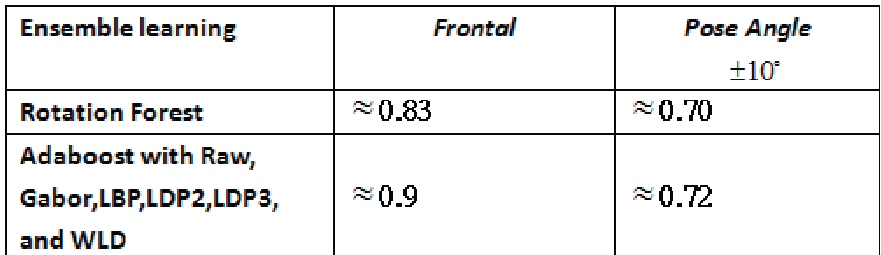 Table 1: The AdaBoost ensemble achieves the highest rates (up to 0.9 frontal) compared to other methods.
Critical Analysis & Conclusion
Takeaway
The integration of Local Derivative Patterns is the "secret sauce" of this paper. It provides the high-frequency detail needed to distinguish subtle gender cues that PCA-based methods average out. By using an ensemble of SVMs, the authors create a system that is robust enough for a mobile robot navigating a dynamic human environment.
Limitations & Future Work
The current approach shows a significant dip in performance (from 90% to approx. 72%) when the pose angle shifts by ±10°. While the ensemble helps, the "pose-invariant" descriptor problem remains a hurdle. Future iterations could explore 3D facial normalization or Deep Metric Learning to bridge this gap for robots that frequently view humans from oblique angles.
 Fig 2: Real-world implementation of the gender recognition system on the service robot platform.