
Smartphone-Based Gender Recognition: Achieving SOTA through Gait Analysis
Gender Recognition using in-built Inertial Sensors of Smartphone
This paper presents an analytical approach for gender recognition utilizing human gait data captured via smartphone inertial sensors (accelerometers). By employing PCA-based signal mapping and cycle-based feature extraction, it evaluates various machine learning algorithms, achieving a SOTA accuracy of 96.3% with Bagged Tree Ensemble classifiers.
TL;DR
Researchers from IIT (BHU) have developed a highly accurate method for identifying gender simply by analyzing how a person walks with a smartphone in their pocket. By streamlining complex tri-axial accelerometer data through PCA and focusing on normalized average gait cycles, the team achieved a 96.3% accuracy rate, setting a new benchmark for soft biometric recognition.
Context: Beyond Traditional Biometrics
While face and fingerprint recognition are the "gold standards" of security, they are often intrusive. "Soft biometrics" like gait (the manner of walking) offer a non-contact, "non-intellectual" (passive) alternative. The challenge? Accelerometer data is notoriously noisy and varies depending on how a person holds their phone. This paper aims to fix the "precision gap" in existing inertial sensor research.
The Problem & Motivation
Previous attempts at gait-based gender recognition used varied techniques like Local Binary Patterns (LBP) or Histogram of Oriented Gradients (HOG). However, these methods often failed to account for:
- Signal Correlation: The X, Y, and Z axes are highly correlated; processing them independently adds unnecessary noise.
- Intra-subject Fluctuation: No two steps are identical, even for the same person.
The authors' intuition was that by simplifying the data into a single "principal" dimension and averaging multiple gait cycles, they could extract a "signature" unique to male or female walking mechanics.
Methodology: From Raw Noise to Clean Cycles
The proposed workflow follows a rigid pipeline designed to maximize signal-to-noise ratios:
- Preprocessing: A 20 Hz Butterworth low-pass filter removes high-frequency jitter.
- PCA Mapping: Instead of juggling three axes, PCA transforms the data into a unidimensional representative signal.
- Gait Cycle Extraction: The system identifies local maxima (peaks). A "cycle" is defined from one peak to the next.
- Normalization & Averaging: Because walking speed varies, cycles are interpolated to a standard length and averaged over seven cycles to create a stable "gait template."
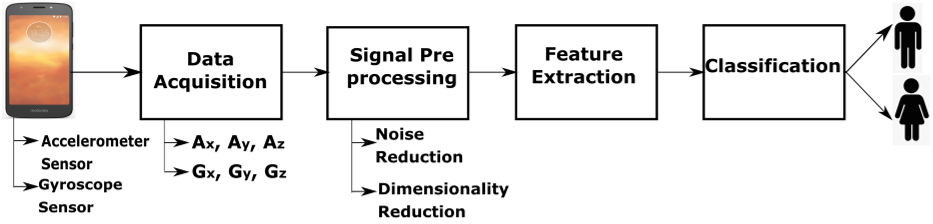 Fig 1: The systematic pipeline from signal acquisition to final classification.
Experiments and Breakthrough Results
The study utilized the OU-ISIR Inertial Gait Dataset, the largest of its kind. They compared traditional classifiers (SVM, kNN, Decision Trees) against Ensemble methods and Regressors.
Key Findings:
- The Champion: The Bagged Tree Ensemble outperformed all others with 96.3% accuracy.
- Regression Insight: Interestingly, the Gaussian Process Regressor (GPR) achieved an R² of 0.98, suggesting that gait features are highly predictable when mapped correctly.
- Comparison: This method significantly beat previous SOTA results which plateaued around 94.4%.
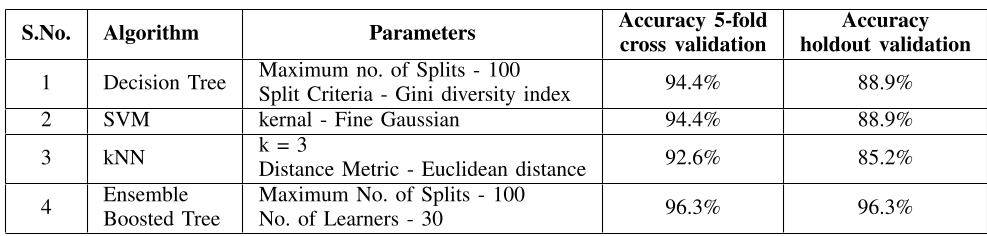 Table 1: Comparison of various algorithms. Note the superior performance of the Ensemble Boosted/Bagged Trees.
The confusion matrices below illustrate the high precision, specifically for the Bagged Tree model where misclassifications between "Male" and "Female" classes were minimized.
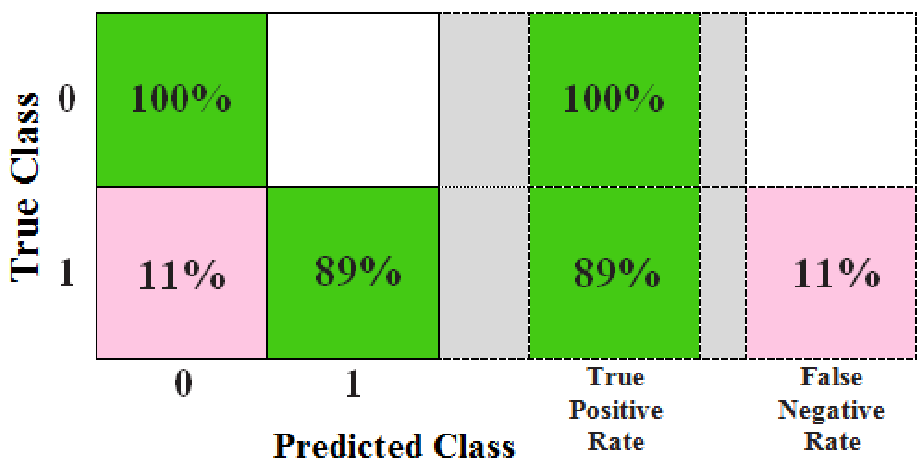 Fig 2: SVM performance showing 94.4% accuracy.
Critical Insight & Conclusion
The success of this research lies in its data simplification. By using PCA to reduce dimensionality before feature extraction, the model avoids "overfitting" to the noise of specific sensor axes.
Takeaway: This technology isn't just for surveillance. Imagine an e-commerce app that subtly adjusts its UI or featured products based on the detected gender of the user as they walk, or smart healthcare systems that detect changes in gait-health relative to gender-specific norms.
Limitations: The dataset was recorded with a waist-mounted smartphone. Future work must address "wild" scenarios where phones are carried in hands, bags, or pockets, which introduces varying orientations and higher displacement noise.