
Deciphering the Language of Touch: Nonlinear HRV and Gender-Specific Affective Computing
Classifying Affective Haptic Stimuli through Gender-Specific Heart Rate Variability Nonlinear Analysis
The paper presents a computational framework for classifying affective haptic stimuli (caress-like touch) based on Autonomic Nervous System (ANS) dynamics. Using a custom fabric-based haptic device, the authors demonstrate that Heart Rate Variability (HRV) analysis, specifically employing novel nonlinear features and gender-specific classification, can achieve up to 84.38% accuracy in identifying touch velocity and force.
TL;DR
Researchers from the University of Pisa have developed a system capable of "reading" how your heart reacts to a caress. By analyzing the nonlinear dynamics of Heart Rate Variability (HRV) and accounting for gender-specific physiological responses, they achieved over 84% accuracy in identifying the physical properties of tactile stimuli. This work highlights that our cardiovascular response to touch is not just about "fast vs. slow" but resides in complex, nonlinear feedback loops that differ significantly between sexes.
Contextual Positioning
In the landscape of Affective Computing, while visual and auditory triggers have been extensively mapped, the Haptic (touch) modality remains a frontier. This paper moves beyond simple observation and positions itself as a SOTA implementation of Physiological Haptic Characterization, bridging the gap between mechanical stimulation (Force/Velocity) and the Autonomic Nervous System (ANS).
The "Why": Why has Touch been so Hard to Decode?
Wait—doesn't a pleasant massage always lower your heart rate? Not necessarily. Prior literature is riddled with contradictions: some studies show increased parasympathetic activity, while others show the opposite.
The authors identify two fatal flaws in previous experimental designs:
- Linear Fallacy: Most studies use only "Standard" HRV (mean RR intervals). The heart, however, is a nonlinear oscillator controlled by competing sympathetic and parasympathetic inputs.
- Gender Neutrality: Men and women process emotional stimuli—and control their heart rates—differently at a neurobiological level. Treating them as a single group masks the very signals we want to detect.
Methodology: The Core Innovations
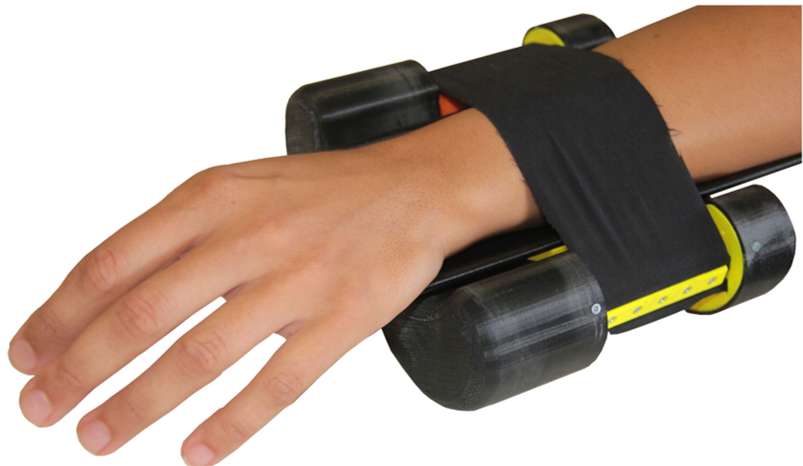
The team utilized a specialized haptic device (Fig. 1) that uses elastic fabric to replicate human-like caresses.
1. The Nonlinear Toolkit
Beyond the usual frequency bands (LF/HF), the authors introduced:
- Symbolic Analysis: Converting HRV series into a sequence of symbols (0-5) to detect hidden trends in variation.
- Lagged Poincaré Plot (LPP): A geometric approach that maps an RR interval against a future interval (lag M). They proposed a novel AUC (Area Under the Curve) metric for these plots to capture short-term and long-term variability.
2. The Feature Selection Strategy
To avoid the "Curse of Dimensionality," they used SVM-RFE (Recursive Feature Elimination), which systematically prunes less useful features. This ensured the model didn't just "memorize" the noise in the data (overfitting).
Experimental Insights & Results
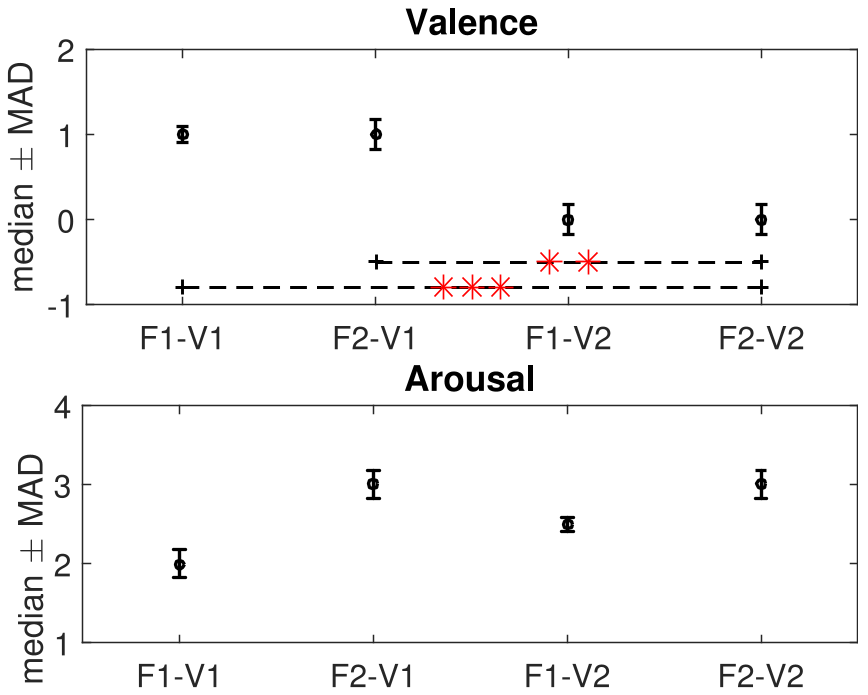
The experimental results confirmed that slow, light touch (9.4 mm/s) is perceived as more pleasant (Positive Valence), while higher force (6 N) triggers higher arousal.
Key Performance Metrics:
- Gender-Specific Superiority: When the model was split by gender, accuracy jumped from mediocre (~64%) to impressive (~84%).
- The Power of LPP: For women, the "Area Under Curve" of the Lagged Poincaré Plot was the single most discriminative feature for recognizing velocity (Fig. 8B).
- Symmetry in Perception: Interestingly, women showed more distinct physiological signatures for force and velocity than men, potentially suggesting a more refined autonomic sensitivity to affective touch.
Critical Analysis & Future Outlook
Takeaway: This research proves that "General Purpose" AI models for healthcare or emotion recognition are likely suboptimal. Gender-aware and nonlinear feature engineering are not just "extras"—they are fundamental to accuracy.
Limitations: The study used 35-second windows. While reliable for the techniques used, real-world haptic interactions are often shorter. Applying these nonlinear metrics to "ultra-short" (sub-10 second) bursts remains a challenging next step.
Future Impact: Imagine a prosthetic limb or a social robot that doesn't just "feel" pressure, but understands if a touch was meant to be comforting or aggressive, adjusting its response based on the specific physiological profile of the user. That is the future this paper helps build.