
Decoding the Instagram Folksonomy: How Gender Shapes the Way We Tag
Gender-Specific Tagging of Images on Instagram
This study presents a comprehensive content analysis of gender-specific image tagging behavior on Instagram, examining 14,951 hashtags across 1,000 images. The research identifies significant differences in hashtag frequency and category distribution (e.g., Content-relatedness, Emotiveness, Isness) between male and female users across ten distinct image genres.
TL;DR
Is a hashtag just a search term, or a digital fingerprint of our identity? This study analyzes over 14,000 hashtags to reveal that men and women "see" and "index" their Instagram photos through different lenses. While both genders prioritize factual content description, women lean into emotional metadata, whereas men are more likely to use technical "isness" tags and Instagram-specific branding slang.
Background: Beyond the Filter
In the world of Knowledge Organization, Instagram isn't just a photo gallery; it's a massive, user-generated folksonomy. Unlike rigid library taxonomies, folksonomies are messy, organic, and deeply human. While we know a lot about how people tweet, the visual-first nature of Instagram creates a unique challenge for information science: How do we translate pixels into searchable metadata, and does our gender influence that translation?
The Problem: The Missing Link in Social Indexing
Previous research has often treated social tagging as a monolithic activity. However, practitioners in marketing and UX design have long suspected that "Men are from Mars and Women are from Venus" even when it comes to #hashtags. Earlier studies lacked a granular breakdown of how tagging behavior changes based on the subject of the photo—whether it's a #selfie, a #pet, or a piece of #architecture.
Methodology: Coding the Visual
The researchers didn't just count tags; they categorized the intent behind them. Using a dataset of 1,000 images (perfectly balanced between male and female users), they applied a sophisticated coding system to group hashtags into seven categorical dimensions:
- Content-relatedness: What is actually in the picture? (e.g., #dog)
- Emotiveness: How does the user feel? (e.g., #love)
- Isness: Technical metadata (e.g., #landscapephotographer)
- "Insta"-Tags: Platform-specific slang (e.g., #instadaily)
- Performativeness: Calls to action (e.g., #followback)
- Fakeness: Intentionally ironic or wrong tags.
- Sentences: Full thoughts (e.g., #lifeisgood)
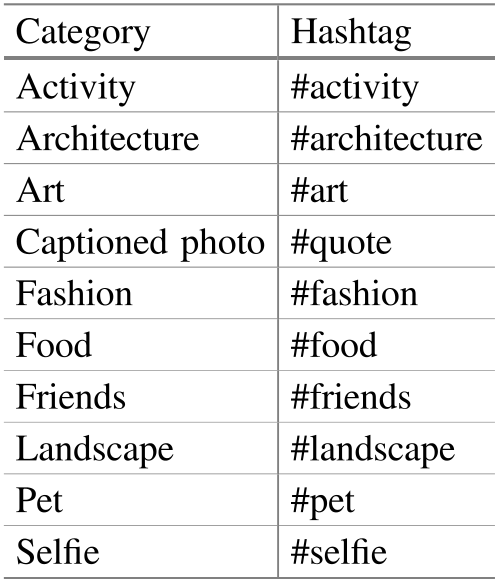 The ten categories used to anchor the study, ensuring a diverse cross-section of Instagram activity.
Key Insights: Mars vs. Venus in Metadata
1. The Quantity Gap
Surprising to many, men used more hashtags on average (15) than women (14). This gap exploded in specific categories like Captioned Photos (quotes), where men applied nearly double the tags that women did. This suggests a higher motivation among male users to maximize the discoverability or "SEO" of text-based posts.
2. Emotional vs. Technical
The data confirmed a classic sociolinguistic trend: Women are more emotional taggers. Across every image category, female users assigned higher percentages of Emotiveness tags. Meanwhile, men were the masters of "Isness," focusing on the technical aspects of the shot or the role of the photographer.
3. The "Pet" Phenomenon
One of the most interesting findings was the "Insta"-Tag category. Both genders used these tags (like #petstagram) at high frequencies for pet photos. There seems to be a specific community dialect for animal lovers that transcends gender, using platform-specific jargon to signal belonging to the "pet-fluencer" subculture.
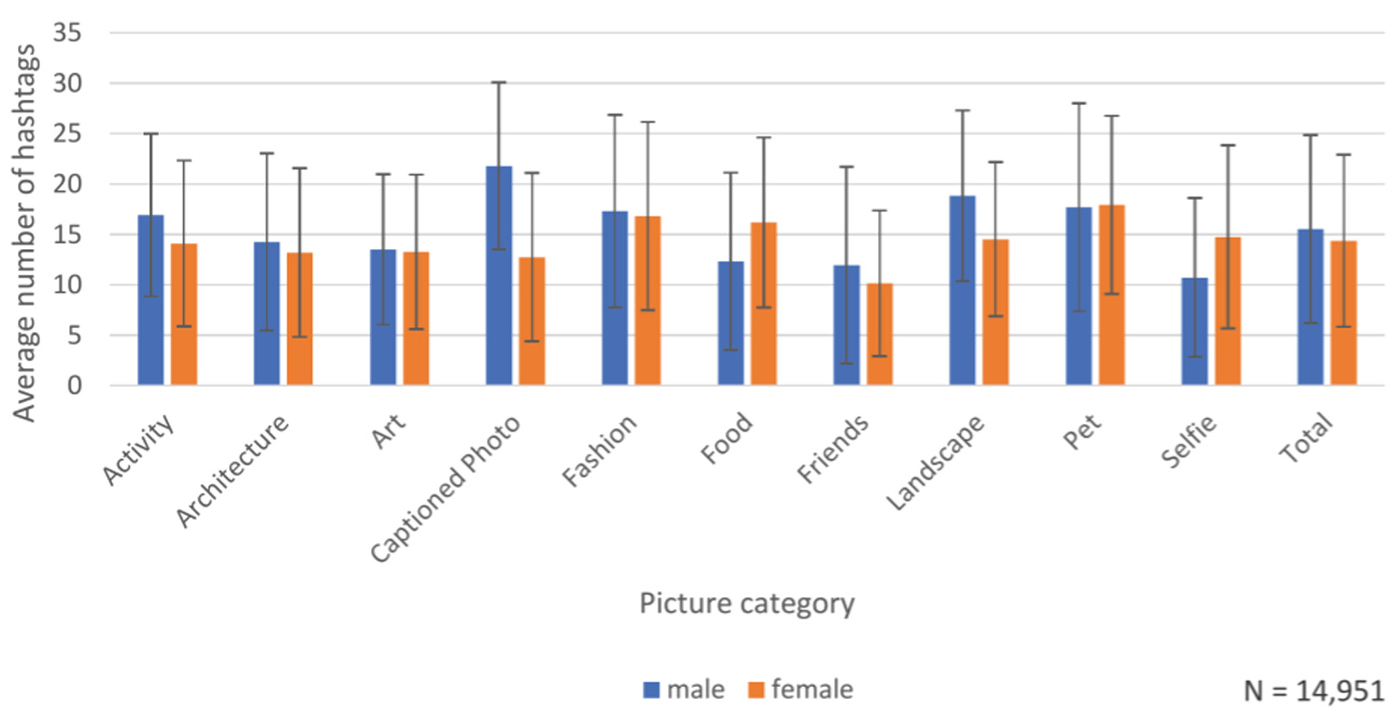 Graphic representation of hashtag density across genders. Note the significant spikes in certain categories.
Conclusion and Future Outlook
This study proves that our digital "indexing" behavior is far from neutral. It is an extension of our social identity.
Takeaways for the Industry:
- For Marketers: If targeting a female audience, emotional and positive hashtags carry more "authentic" weight. For a male audience, technical and informative tags provide the necessary context.
- For AI Developers: Image recognition systems that generate automated tags should consider these gendered folksonomies to produce descriptions that feel "human" and contextually appropriate.
Limitations: The study is a snapshot in time and acknowledges the fluidity of gender identity, which wasn't fully captured by the binary profile analysis. Future research should look into how these patterns shift with the advent of video-centric content like TikTok and Reels.
Final Thought
Whether it's a #selfie or a #landscape, our hashtags do more than help people find our photos—they tell the world who we are and what we value in the visual moment.