
Beyond Flat Selection: Exploiting Gene Ontology Hierarchies in Bayesian Network Classifiers
Two methods for constructing a gene ontology-based feature network for a Bayesian network classifier and applications to datasets of aging-related genes
The paper introduces two novel methods for constructing a gene ontology-based feature network (DAG) for a Bayesian Network Augmented Naïve Bayes (BAN) classifier. Applied to aging-related gene datasets, the core approach involves Hierarchical Feature Selection (HFS) to preserve biological generalization-specialization relationships while significantly outperforming baseline and flat feature selection methods.
Executive Summary
TL;DR: This paper tackles the challenge of predicting the "pro-longevity" or "anti-longevity" effects of genes by moving beyond simple "flat" machine learning. The authors propose a method to build Bayesian Network Augmented Naïve Bayes (BAN) classifiers that are "hierarchy-aware." By using a specialized technique called Hierarchical Information-Preserving (HIP) selection, they filter out redundant biological terms and reconstruct a streamlined feature network that significantly improves classification accuracy and prevents over-fitting.
Background: Within the landscape of bioinformatics, Gene Ontology (GO) terms are standard markers for gene properties. Most models treat these as independent features; however, this paper is a pioneer in treating them as a Directed Acyclic Graph (DAG) where "is-a" relationships dictate feature values.
The Problem: Hierarchical Redundancy
In the Gene Ontology, features are not independent. If a gene is annotated with "metabolic process," it is inherently annotated with "biological process."
Current "flat" feature selection methods (like Correlation-based Feature Selection or CFS) ignore this. This causes two major issues:
- Redundancy: High correlation between parents and children wastes computational resources.
- Over-fitting: In Bayesian Networks, every parent node increases the size of the Conditional Probability Table (CPT) exponentially. Large CPTs require massive amounts of training data that bioinformatics often lacks, leading to "noise-fitting."
Methodology: Reconstructing the BAN
The authors propose a two-step "reconstruction" process to bridge the gap between feature selection and the Bayesian network structure.
1. Lazy Hierarchical Feature Selection (HIP and MR)
Unlike "eager" learning which selects features once for all data, this paper uses Lazy Learning. For every specific instance being classified, the algorithm picks the most relevant features based on the hierarchy.
- HIP (Hierarchical Information-Preserving): Selects only the "boundary" features that logically define the rest of the branch.
- MR (Most Relevant): Selects features with the highest predictive "power" within each path.
2. Artificial Edge Creation
When features are selected, they might no longer be directly connected in the original GO graph. The authors' algorithm identifies the Closest Selected Ancestor for each node and creates a direct edge in the BAN. This ensures the generalization-specialization logic is preserved even after pruning the tree.
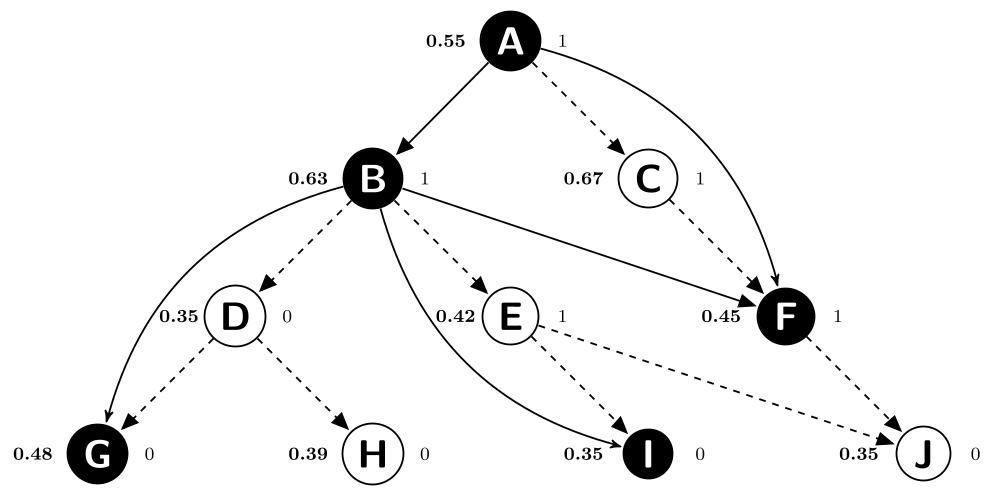 In the figure above, solid lines represent reconstructed dependencies between selected features (black nodes), bypassing intermediate unselected terms.
Experiments and Results
The methods were tested across 28 datasets involving model organisms like C. elegans (worm), D. melanogaster (fly), and S. cerevisiae (yeast).
Key Findings:
- Statistically Superior: The HIP+GO–BAN combo achieved the best results in 23 out of 28 benchmarks.
- CPT Compression: The complexity of the model (CPT dimensionality) dropped from 14.6 in the baseline to a lean 4.26 in HIP. This "simpler" model proved more powerful because its probability estimates were more stable.
- Imbalance Handling: Using GMean as a metric, the model showed it could effectively distinguish between "pro-longevity" and "anti-longevity" genes even when the class distribution was skewed.
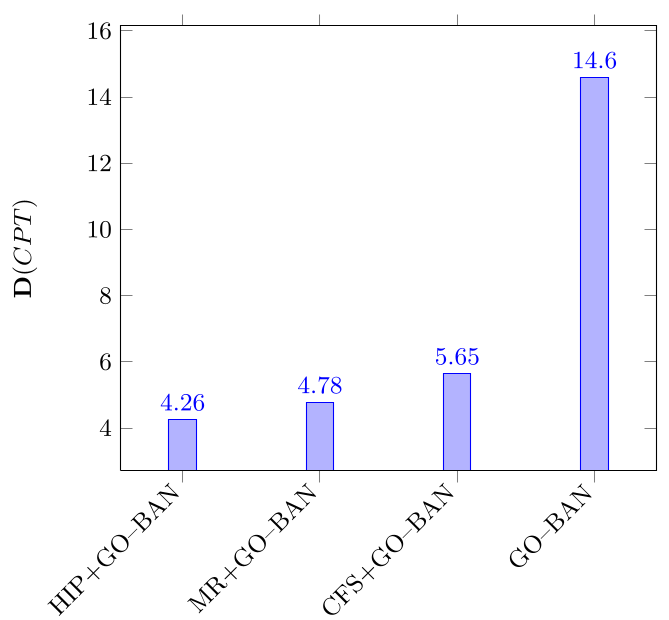 This chart demonstrates how HIP maintains the lowest model complexity (D(CPT)) while achieving higher accuracy than flat methods.
Critical Insight: Why HIP Wins
The brilliance of HIP (Hierarchical Information-Preserving) lies in its minimalism. By selecting fewer features that occupy critical logical junctures in the GO DAG, it creates a BAN that is almost as simple as a Naïve Bayes model (where features are independent) but retains the crucial structure of biological truth.
The failure of flat methods like CFS in this context is due to their inability to "understand" the tree structure—they often select both a parent and a child node, creating redundant parent-child dependencies that bloat the probability tables and degrade performance.
Conclusion & Future Outlook
Wan and Freitas have demonstrated that structure matters. In fields like genomics, the "physics" of the data—its logical hierarchy—is just as important as the raw values.
Future Work: This methodology provides a blueprint for integrating other structured knowledge bases (like Protein-Protein Interaction networks) into probabilistic models. For researchers dealing with categorical hierarchies, the move from "Flat" to "Hierarchical Aware" selection is no longer optional—it is a requirement for SOTA performance.