
The Genealogy of Ideology: Decoding Judicial Dissent through Machine Learning
The Genealogy of Ideology: Predicting Agreement and Persuasive Memes in the U.S. Courts of Appeals
This paper introduces a machine learning approach to predict vote alignment and dissent within the U.S. Courts of Appeals. By integrating judge biographies, case characteristics, and "memetic phrases" extracted via citation networks, the authors achieved a 73% label-averaged F1 score using an AdaBoosted Random Forest model.
TL;DR
Can we predict whether a judge will disagree with their colleagues before they even set foot in the courtroom? This paper demonstrates that by analyzing judge biographies, citation networks, and the "viral" spread of legal phrases (memes), machine learning models can predict vote alignment in the U.S. Courts of Appeals with an F1 score of 73%. The research reveals that the "narrative" of a case—how it is written and who writes it—is often as predictive as the law itself.
The Challenge: Predicting the 4%
In the U.S. appellate system, the vast majority of cases result in a unanimous agreement. Dissent is rare, appearing in only about 4.1% of cases according to the authors' dataset. This creates a massive "class imbalance" problem for AI: a model could achieve 96% accuracy simply by guessing "everyone agrees" every time, yet it would fail to provide any utility.
Prior legal analysis has often focused on static ideological scores (e.g., liberal vs. conservative). However, these fail to capture the dynamic "genealogy" of ideas—the way specific legal arguments (memes) move from one judge's opinion to another.
Methodology: Beyond Simple Ideology
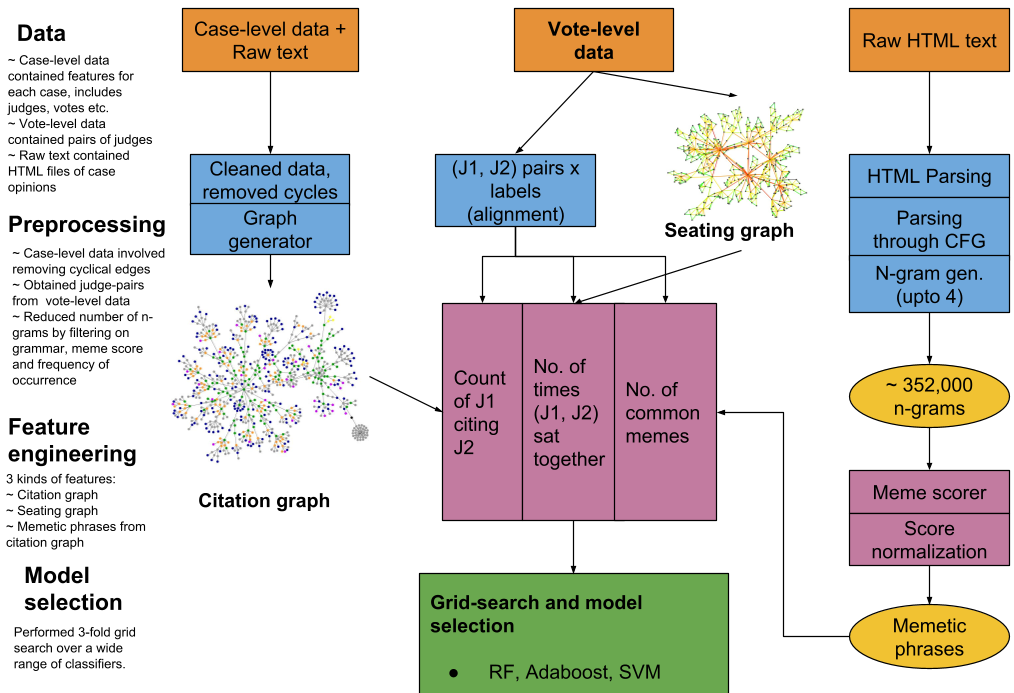
The researchers moved beyond traditional metrics by constructing a high-dimensional feature space categorized into:
- Judge Biographics: Commission year, law school, etc.
- Case Characteristics: Nature of the case, participants, and motions.
- Proceedings/N-grams: The actual text of the case broken down into phrases.
- Network-based Features: Seating patterns (how often judges sit together) and citation counts.
Scoring "Memetic" Phrases
The most innovative part of the methodology is the Meme Score. Identifying a "legal meme" isn't about cat pictures; it's about identifying phrases that exhibit high frequency and high propagation across the citation graph. Using a Context-Free Grammar (CFG), the authors filtered for linguistically valid legal phrases (e.g., "fourteenth amendment," "separable controversy") and scored them based on how they spread through citations.
Experiments and Results
The authors tested several models, including Logistic Regression, SVMs, and Random Forests. To handle the rarity of dissent, they employed Stratified Sampling (SS) and Class Weighting (CW).
The standout performer was AdaBoost combined with Random Forests. By penalizing the model more heavily for misclassifying a dissent ({+1: 1, -1: 25}), the model learned to recognize the subtle signals that precede a judicial split.
| Model | Precision | Avg. Recall | F1 |
|---|---|---|---|
| Baseline | 0.46 | 0.49 | 0.47 |
| Random Forests + CW | 0.66 | 0.73 | 0.69 |
| AdaBoost + RF + CW | 0.73 | 0.73 | 0.73 |
Deep Insights: What Actually Drives Dissent?
The model's feature importance ranking provides a fascinating look into the judicial mind:
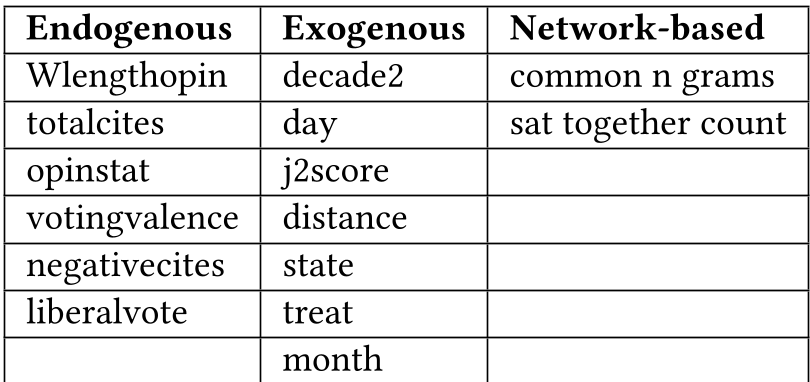
- Opinion Length & Total Citations: Longer opinions with more citations are strong indicators of dissent. This makes intuitive sense: a judge who disagrees often feels the need to write more and cite more to justify their departure from the majority.
- Common N-grams: Judges who "speak the same language"—using similar legal phrases—are significantly more likely to agree.
- Seating Counts: The frequency with which two judges have served together on a panel in the past is a major predictor of agreement, suggesting a social or collaborative "panel effect."
Critical Analysis & Conclusion
Takeaway: This work represents a significant step in "Legal Analytics." It proves that dissent isn't just about the law on the books; it’s about the linguistic and social "genealogy" of the judges involved.
Limitations: The study was performed on a 5% subset of the data due to the need for hand-labeled features. While the 73% F1 score is a major breakthrough, predicting the content of the dissent remains a future challenge.
Future Outlook: As NLP moves toward Large Language Models (LLMs), combining these "memetic" network analyses with deep semantic understanding could lead to models that not only predict if a judge will dissent but what legal arguments they will use to do so.