
Beyond MSE: Unifying Bias-Variance Decomposition via the Exponential Family
General BiadVariance Decomposition with Target Independent Variance of Error Functions Derived from the Exponential Family of Distributions
This paper establishes a generalized framework for bias/variance decomposition beyond the standard Mean Square Error (MSE). It proves that the class of error functions admitting a standard bias/variance split corresponds uniquely to the statistical deviance of the one-parameter exponential family of distributions.
TL;DR
In the landscape of machine learning theory, the Bias-Variance Decomposition is a cornerstone for understanding overfitting. While historically tied to the Mean Square Error (MSE), this paper proves that a "clean" decomposition (where ) is possible if and only if the error function originates from the exponential family of distributions.
The "Why": Why Generalize Decomposition?
In supervised learning, we strive to minimize generalization error. The MSE-based decomposition is intuitive:
- Bias: Error of the average predictor (systematic error).
- Variance: Variability of predictors around the average (stochastic sensitivity).
However, MSE implicitly assumes Gaussian noise. When dealing with count data (Poisson), binary outcomes (Binomial), or skewed intervals (Gamma), MSE is no longer the natural metric. The authors ask: Can we have our cake and eat it too? Can we use non-Gaussian error functions while keeping the elegant Bias + Variance additive structure?
Methodology: The Deviance Insight
The core contribution is the proof that the statistical deviance of a one-parameter exponential family is the unique candidate for such a decomposition.
The general form of the density function for the exponential family is:
From this, the deviance error function is derived as:
The Axiomatic Requirements
The authors define three requirements (R1-R3) for a "nice" decomposition:
- The error is minimized when the predictor equals the target .
- The error is zero at .
- The mean error splits perfectly into bias and variance, where the average predictor is the minimizer of the expected error.
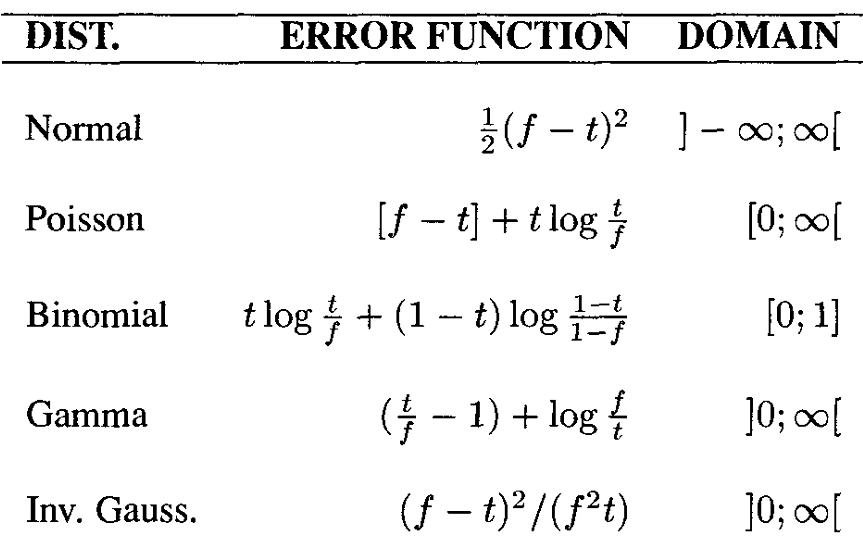
The table above showcases how diverse distributions like Poisson and Binomial generate specific error functions (like cross-entropy for Binomial) that still obey these rigorous decomposition rules.
Theoretical Proof: The Product Form
The "Crux" of the proof (Section 5) lies in demonstrating that the second derivative of the error function with respect to the target and predictor must decouple into a product of two independent functions: This derivation shows that any error function satisfying the decomposition is essentially a "canonical link sufficient statistic" structure plus normalization terms.
Application: Ensemble Ambiguity
The paper bridges the gap between the Bias/Variance decomposition and the Ambiguity decomposition used in ensemble learning.
In an ensemble of predictors, the error of the ensemble is always less than or equal to the average error of individual members . The difference is the Ambiguity (which is effectively the Variance).
The authors provide a critical practical tool: Quadratic Approximation. Since the ambiguity is often non-linear (making weight optimization hard), they suggest: This transforms a complex non-linear optimization task into a Quadratic Programming problem, making it computationally feasible to find optimal weights for model blending.
Critical Analysis & Conclusion
Takeaway
This paper elevates Bias/Variance decomposition from a "Gaussian-only" heuristic to a general statistical framework. It tells us that if our noise follows an exponential distribution, we can choose a corresponding loss function and still perform rigorous error analysis.
Limitations
- 0-1 Loss: The paper acknowledges that the 0-1 loss (standard in classification) is notably absent because it cannot be decomposed in this specific additive manner.
- One-Parameter Limitation: The proof is restricted to one-parameter families; extending this to multi-parameter (like heteroscedastic Gaussian where variance is also learned) remains a challenge.
Future Outlook
This work paves the way for more sophisticated Active Learning and Ensemble Weighting strategies. By using the deviance-based ambiguity, researchers can estimate generalization error on unlabeled data more accurately across different domains (e.g., probability estimation, count prediction).