
GT2FD: Redefining Node Importance in Multi-Central Social Networks via Type-2 Fuzzy Logic
General type-2 fuzzy degree of nodes in multi-central social networks set NAFIPS co-authorship network
The paper introduces the General Type-2 Fuzzy Degree (GT2FD), a novel centrality index for multi-central social networks. It leverages type-2 fuzzy sets to measure a node's belonging degree by combining primary similarity to central nodes and secondary importance of those central nodes within the global network.
TL;DR
Determining who "matters" in a network is usually a matter of counting links (Degree Centrality). However, in complex social structures like scientific co-authorship, being connected to a "superstar" is more valuable than being connected to a "novice." This paper introduces the General Type-2 Fuzzy Degree (GT2FD), a method that uses advanced fuzzy logic to measure node importance by considering both the proximity to centers and the relative weight of those centers themselves.
Background: Beyond Binary Connections
In traditional Social Network Analysis (SNA), a node is either central or it isn't. Even with Fuzzy SNA, we typically use Type-1 Fuzzy Sets, which assign a single membership value between 0 and 1.
The authors argue that this is insufficient for Multi-Central Networks. In these networks, uncertainty exists at two levels:
- Primary Uncertainty: How "close" is a node to a specific central hub?
- Secondary Uncertainty: How "central" is that hub compared to other hubs?
Methodology: The Mechanics of GT2FD
The core innovation lies in the transition from a single number to a General Type-2 Fuzzy Number.
1. Primary Membership (The Local View)
The primary degree measures the dissimilarity between a node and a designated central hub. It is based on common connections—essentially asking, "How much of my social circle overlaps with this leader?"
2. Secondary Membership (The Global View)
The secondary degree measures the status of the central hub itself. A hub that dominates the network provides more "prestige" to its members than a minor hub.
3. The Membership Function
The authors utilize a Generalized Bell Membership Function to map these dissimilarities into fuzzy values:
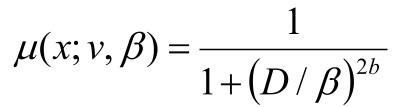
By combining these, they create a set of pairs that describe a node's position in the network's hierarchy.
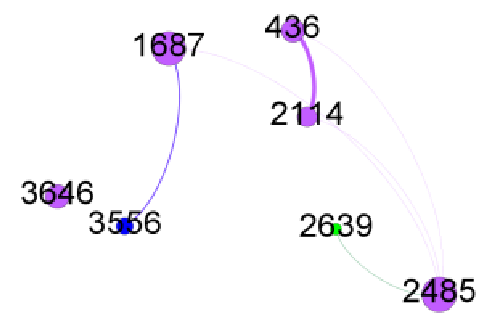 Fig (a): Visualizing the network structure and central huds under different thresholds.
Experimental Results: The NAFIPS Case Study
The researchers applied GT2FD to the NAFIPS co-authorship network (1995-2014). This network is a classic multi-central structure where several prominent professors or researchers act as clusters' nuclei.
Sensitivity to Thresholds
The study tested various centrality thresholds ():
- High Threshold (): Only the "titans" (6 nodes) are considered hubs.
- Medium Threshold (): 12 nodes act as hubs.
- Low Threshold (): 29 nodes act as hubs.
As the threshold lowers, the GT2FD provides a more complex and "blurred" status for authors, capturing the reality that in a large scientific community, "importance" is often a gradient rather than a peak.
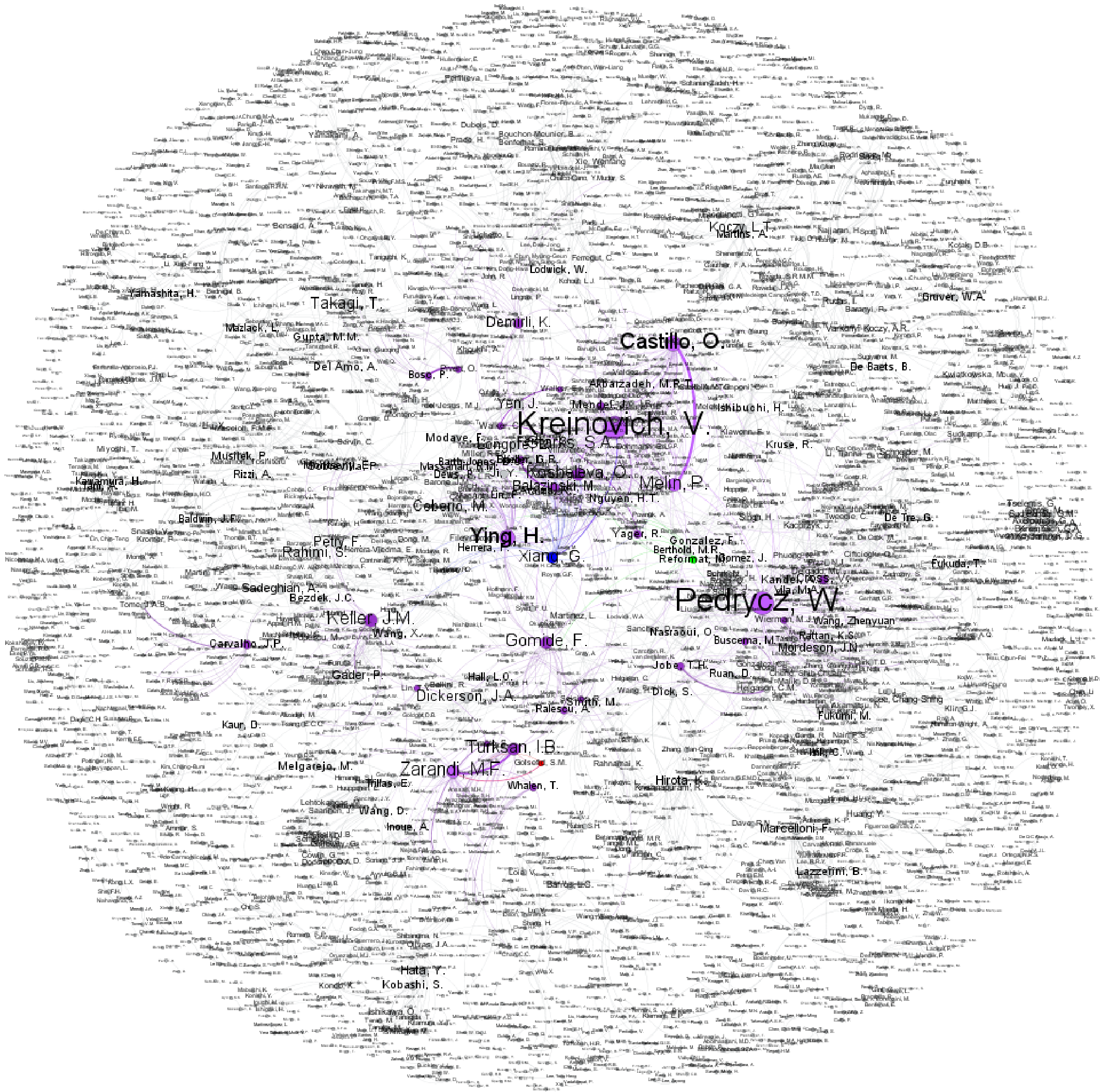 Fig 2: The identified central nodes within the NAFIPS network, illustrating the multi-hub nature of scientific collaboration.
Critical Insight: Why Use Type-2 Fuzzy?
The primary takeaway for the academic professional is the shift in Inductive Bias. While Type-1 fuzzy sets handle "vagueness," Type-2 fuzzy sets handle "uncertainty about vagueness." In social networks, our definition of a "hub" is often arbitrary (). GT2FD acknowledges this arbitrariness by allowing the importance of a node to be represented as a function rather than a point, essentially creating a "Signature of Influence."
Conclusion & Future Work
The GT2FD index is a robust tool for identifying individual status within complex, multi-layered networks. However, the paper leaves room for the automation of (standard deviation) selection and the exploration of how these fuzzy values evolve over time (Temporal GT2FD).
For practitioners in SNA, this research suggests that integrating fuzzy logic is no longer just a theoretical exercise but a necessary step for modeling the nuanced hierarchies of the real world.