
Making Sense of Sounds: Bridging Human Intuition and Machine Audition
Generalisation in Environmental Sound Classification: The ‘Making Sense of Sounds’ Data Set and Challenge
This paper introduces the 'Making Sense of Sounds' dataset and challenge, focusing on Environmental Sound Classification (ESC) across five high-level semantic categories (Nature, Human, Music, Effects, Urban) derived from human psychological experiments. The authors propose a VGG-style Deep Convolutional Neural Network (DCNN) baseline that achieves 80.8% average accuracy, demonstrating that machine learning models can replicate human-centric semantic grouping using purely acoustic features.
TL;DR
The "Making Sense of Sounds" project shifts the focus of environmental sound classification from identifying specific events to categorizing audio into five broad, human-derived semantic pillars: Nature, Human, Music, Effects, and Urban. By creating a dataset based on psychological sorting tasks and testing it with a VGG-style deep learning baseline, the researchers proved that machines can mimic human-like semantic generalization with over 80% accuracy using only raw acoustic data.
The "Generalization" Gap
Most AI sound classifiers are trained to be specialists—identifying a "dog bark" or a "siren." Humans, however, possess a remarkable ability to generalize. We can hear a rare instrument like a kora for the first time and instantly categorize it as "Music."
Existing taxonomies often rely on WordNet (lexical) or mechanical properties (how the sound is made). This paper asks a deeper question: Can we build a system that organizes sound the way the human brain does? The difficulty lies in the acoustic diversity within a category like "Urban," which might include anything from a jackhammer to a distant crowd, sharing almost no physical commonalities.
Methodology: From Human Brains to CNNs
The researchers used a two-step process to define the problem and solve it:
1. The Human Taxonomy
Using data from 101 participants who sorted 60 common sound terms, the team used Correspondence Analysis and Hierarchical Cluster Analysis to generate a dendrogram. By slicing this tree at a specific inertia ratio, they identified five core clusters that define the "human" way of hearing the world.
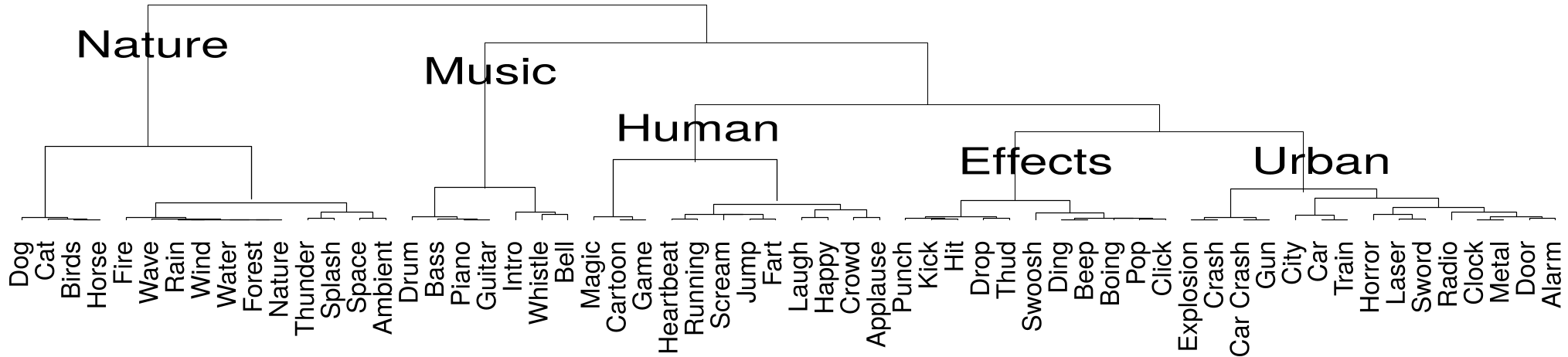 Fig 1: The dendrogram showing how 60 sound types cluster into five high-level semantic categories.
2. The Baseline Machine Classifier
The baseline system is a specialized VGG-style DCNN. It processes log mel-spectrograms through 8 convolutional layers. A critical design choice was the use of Global Max Pooling (GMP) at the end of the feature extraction phase, which allows the network to focus on the most salient acoustic features across a 5-second clip before making a final category prediction.
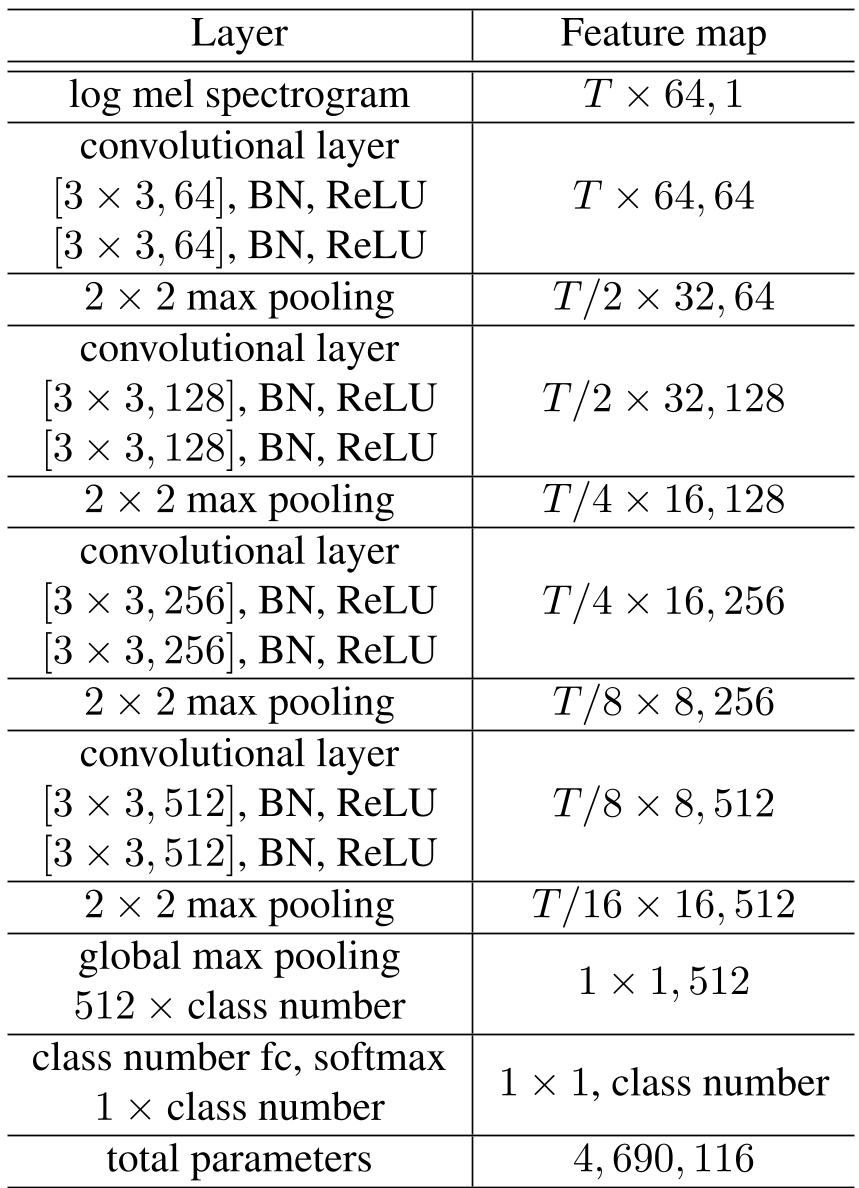 Table 1: The VGG-style configuration of the baseline network.
Experiments and Discoveries
The results confirm that semantic categories are not just abstract human labels—they have acoustic grounding.
- The Power of Music: The model easily identified "Music" (95% accuracy), likely due to its distinct rhythmic and harmonic structures.
- The Urban/Nature Confusion: The most common errors occurred between "Nature" and "Urban" categories. This makes intuitive sense, as wind, rain, and distant traffic often share similar broadband noise characteristics.
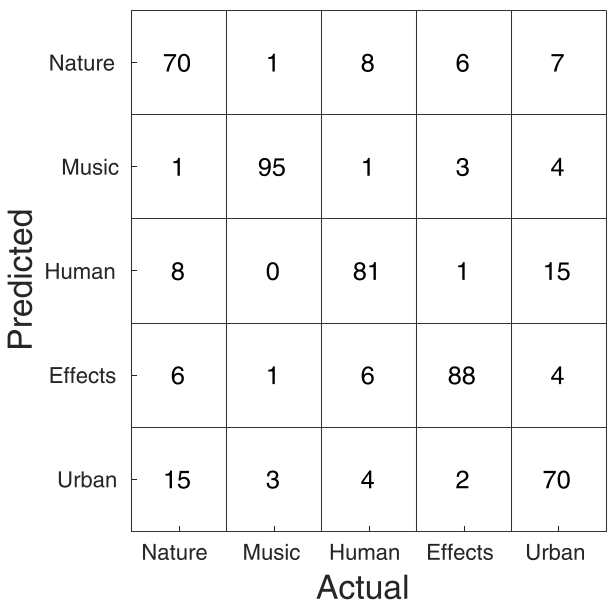 Fig 2: Confusion matrix showing high precision in Music and Effects, with some overlap between Urban and Human categories.
Deep Insights: Is it "Cheating" or "Understanding"?
The authors address a vital critical question: Is the AI actually "understanding" the category, or is it picking up on recording biases (e.g., all Music clips being higher quality)? Because the data was sourced from diverse databases (Freesound, ESC-50) recorded by thousands of individuals, a technical bias is unlikely.
The more exciting conclusion is that top-level semantic categories have a shared acoustic signature. This suggests that when we feel "Music" or "Urban," our brains are responding to specific signal properties that a DCNN can also detect.
Conclusion and Future Work
This work provides a roadmap for building more empathetic and intuitive AI. By prioritizing human-derived taxonomies over rigid mechanical ones, we can develop systems like "Audio Memories" that help users navigate soundscapes based on emotion and context rather than just technical labels.
Future research remains to be done on whether machine-human alignment in these high-level tasks can improve performance in low-level detection—a "top-down" approach to machine audition.