
Beyond Beating the Human: Why Game AI Needs a Formalism for Meaning
Generalised Player Modelling: Why Artificial Intelligence in Games Should Incorporate Meaning, with a Formalism for so Doing
The paper proposes a Generalised Player Model (GPM) framework that integrates human psychology into game AI. It introduces the Behavlets method within a Category Theory formalism to move beyond simple performance-based AI toward systems that understand the subjective "meaning" of play.
TL;DR
In an era where AI can beat world champions at Go and StarCraft, Benjamin Cowley argues we are missing a critical component: Meaning. This paper introduces a formal framework for a Generalised Player Model (GPM). By combining the Behavlets methodology with the mathematical rigor of Category Theory, the author provides a way to encode human psychology—cognition, emotion, and personality—directly into the control loops of adaptive game AI.
The Problem: The "Black Box" of Purely Optimal AI
Most modern game AI is designed with a single utility function: to win. While effective for competition, this creates a disconnect in human-computer interaction (HCI).
The author identifies two major risks in unconstrained adaptive AI:
- Violation of Logical Consistency: If an AI adjusts difficulty mid-game by suddenly making an enemy faster without narrative justification, the player’s trust in the game's "rules" is shattered.
- Breaking the Magic Circle: Players enter a "Magic Circle" where they accept a temporary reality. Arbitrary AI adaptations force players to "step out" of this immersion to re-evaluate the game world.
The insight here is that constraints are not limitations—they are facilitators. To act naturally, AI must be constrained by what humans find meaningful.
Methodology: Formalizing "Behavlets"
The paper’s core contribution is bridging the gap between high-level psychology and low-level game state transitions.
1. Behavlets as the Bridge
Behavlets are "composite features of game-play defined over action sequences" linked to psychological theory (e.g., temperament types). Instead of looking at a single button press, a Behavlet looks at a sequence—like a player persistently hovering near the "Ghost House" in Pac-Man—and maps it to a trait like "Caution" or "Aggression."
2. The Category Theory Formalism
The author uses Category Theory to define a game as a triple :
- : The state space (smooth manifolds for 3D environments).
- : The monoid of inputs (joystick movements, button presses).
- : The partial action (the ruleset).
By viewing player behaviors as Orbits (paths through the state space), Cowley allows us to treat player actions as mathematical objects that can be composed and restricted.
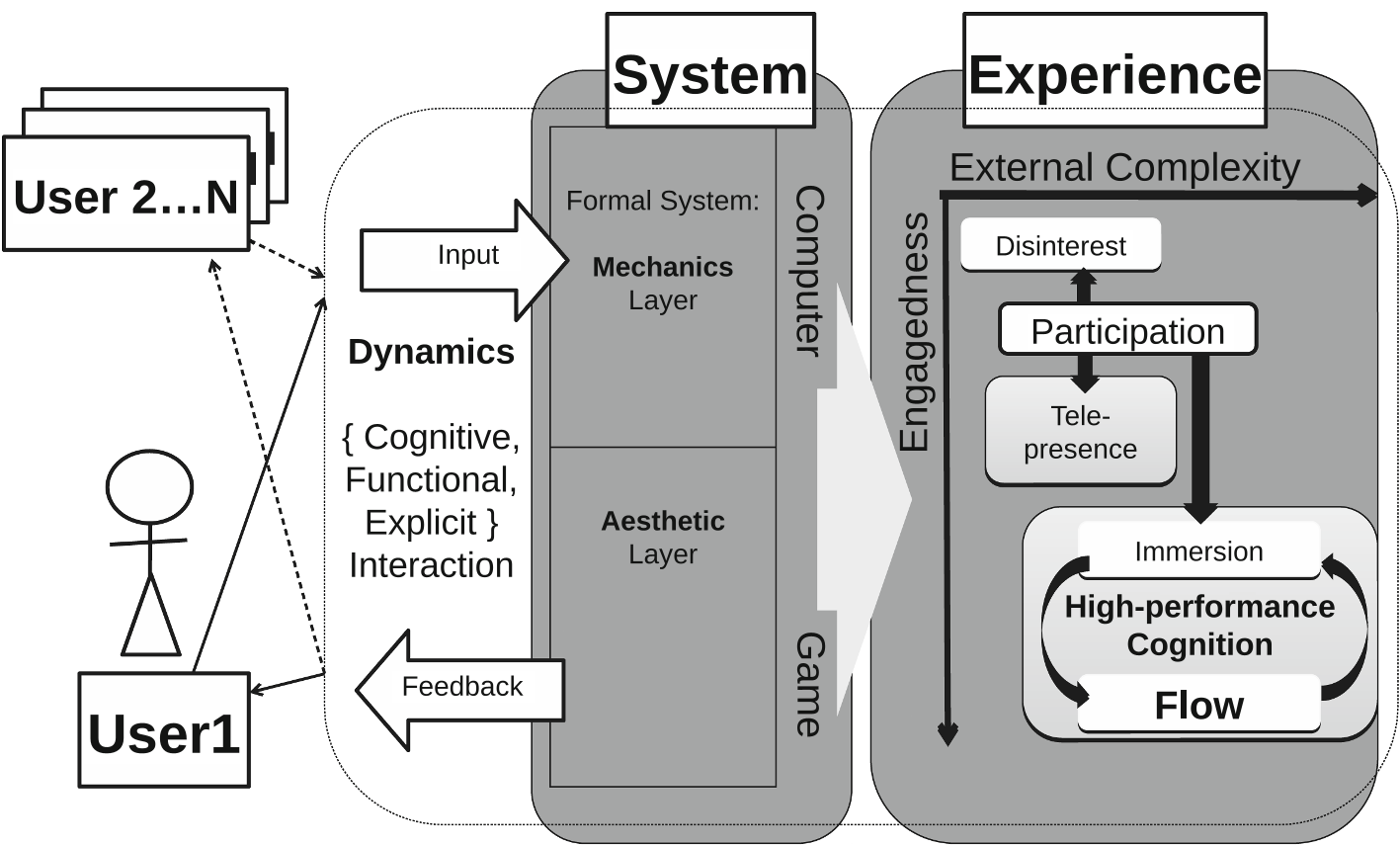 Figure 1: The relational schema showing how player participation in different modes (Cognitive, Functional, Explicit) creates the game dynamics.
Case Study: Pac-Man Formalization
To prove the concept, the paper formalizes Pac-Man. It defines the "Hunt Close To Ghost House" Behavlet as a specific orbit where the Manhattan distance between Pac-Man and the Ghost starting position remains small while a power pill is active.
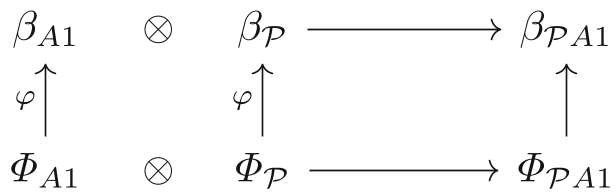 Equation 1: The mapping () used for model reduction, allowing a Pac-Man behavioral model to be compared to other games through abstraction.
This abstraction is powerful: it means we can compare "cautious play" in Pac-Man to "cautious play" in a First-Person Shooter (FPS) by reducing both to their formal simulation counterparts ().
Critical Insight: The "Why" vs. the "How"
The paper argues that AI should not just react to what a player does (skill level), but why they do it (interaction style).
- A "Conqueror" type player wants extreme challenge to feel achievement.
- A "Wanderer" type player wants a stress-free experience.
Standard Dynamic Difficulty Adjustment (DDA) usually fails because it treats both players the same—smoothing out the difficulty and potentially boring the Conqueror while stressing the Wanderer. A Generalised Player Model allows the AI to recognize these types through Behavlets and adapt the focus of play (reward structures, aesthetics, tactics) rather than just the difficulty slider.
Conclusion & Future Outlook
Benjamin Cowley’s work is a call to action for the AI community to stop viewing games merely as optimization puzzles. By providing a formal language (Category Theory) for psychological constructs (Behavlets), he offers a path toward AI that respects the Magic Circle.
Limitations: The framework is currently at the conceptual/mathematical stage. Implementing this in real-time for high-fidelity, non-discrete games (like modern open-world titles) remains a "cumbersome task" that requires significant engineering effort to define the state-space manifolds.
Takeaway: The future of game AI isn't just "smarter" agents; it's agents that possess a formal encoding of human meaning.