
Arbor: Elevating Autonomous Research via Persistent Hypothesis-Tree Refinement
Toward Generalist Autonomous Research via Hypothesis-Tree Refinement
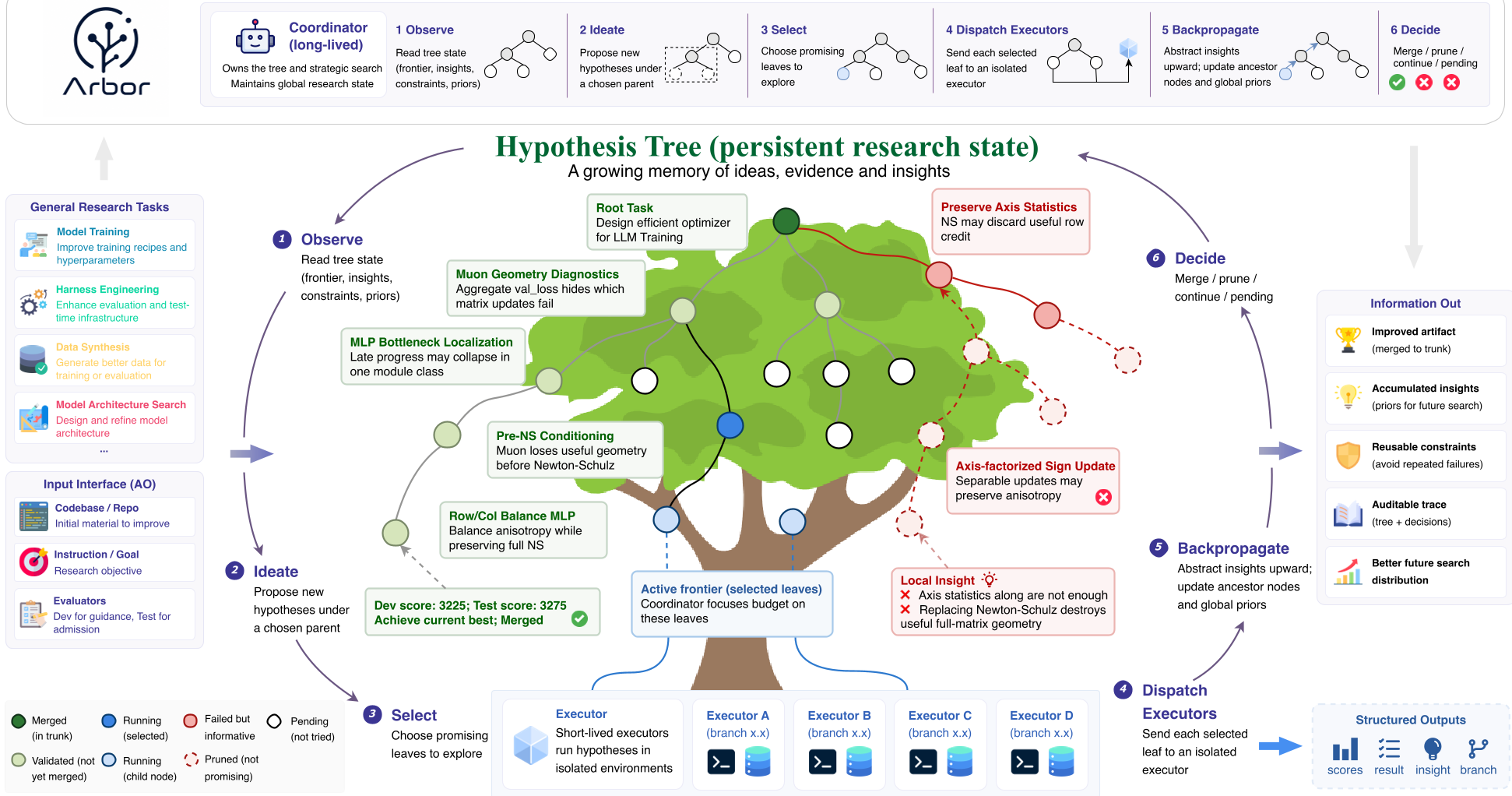
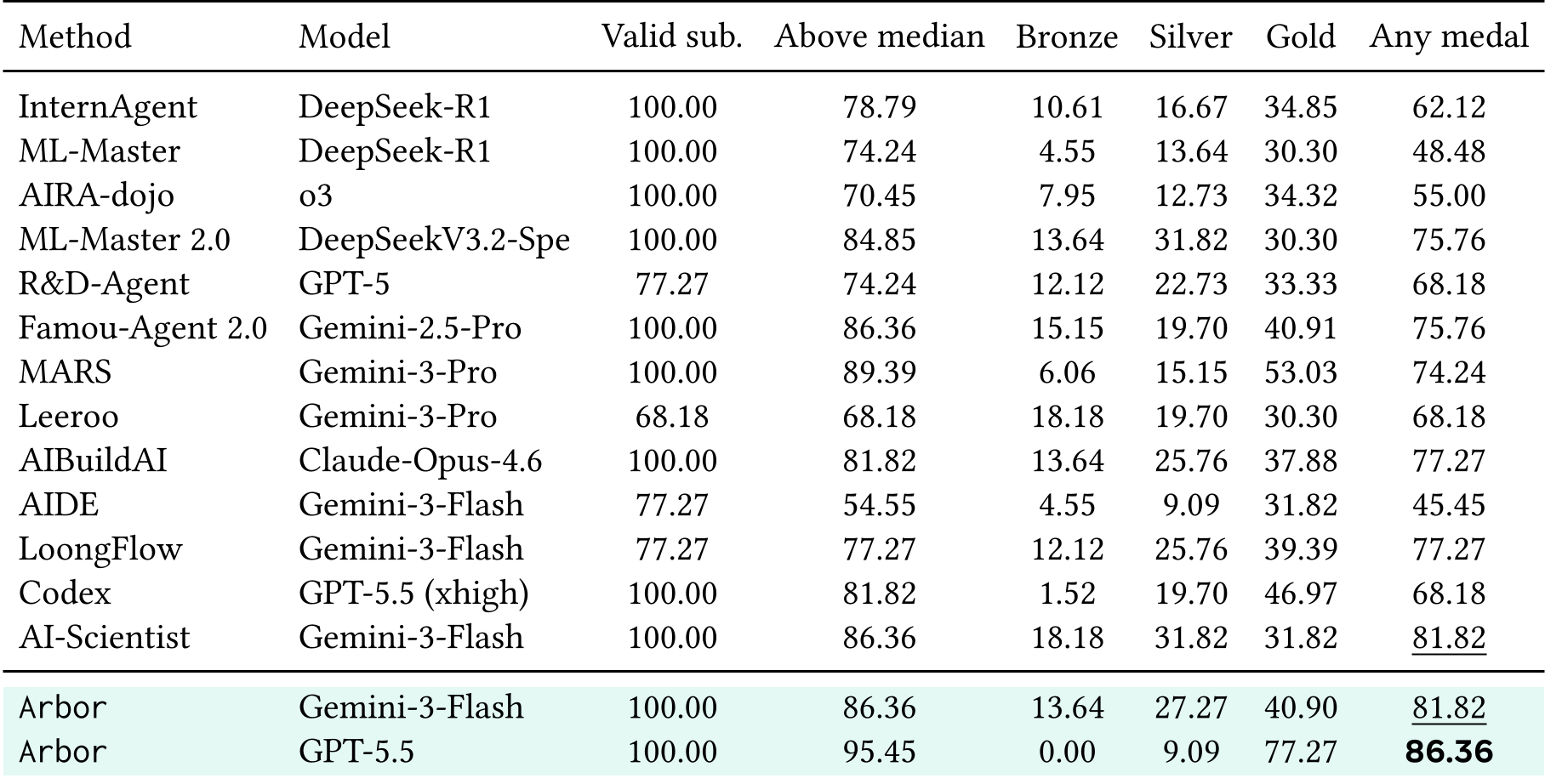
Arbor is a general framework for autonomous research that uses Hypothesis Tree Refinement (HTR) to manage long-horizon scientific optimization. By separating a long-lived coordinator from short-lived executors, it achieves a new SOTA on MLE-Bench Lite (86.36% Any Medal with GPT-5.5) and outperforms previous agents like Codex and Claude Code across six diverse research tasks.
TL;DR
Autonomous research is more than just long-running code execution; it is the cumulative refinement of ideas based on evidence. Arbor is a breakthrough framework that transforms AI agents from "trial-and-error" script-writers into systematic researchers. By utilizing a Hypothesis Tree Refinement (HTR) mechanism, Arbor outperforms flagship agents like Claude Code and Codex by 2.5x on complex optimization tasks and sets a new record on the MLE-Bench Lite leaderboard.
The Missing Link: Why Agents Struggle with "The Loop"
Scientific progress relies on a repeated loop: exploration, experimentation, and abstraction. While current LLM agents (like those powered by GPT-4 or Claude 3.5) are excellent at writing code or calling tools, they lack persistence.
Most agents operate in a linear or local fashion. If an experiment fails, the agent might "forget" why it failed three steps later, leading to repetitive mistakes or unstructured "metric chasing." The authors of Arbor identify that the bottleneck isn't just LLM reasoning—it's the externalization of the research state. Without a map of what was tried and what was learned, long-horizon research becomes an expensive walk in the dark.
Methodology: Hypothesis Tree Refinement (HTR)
Arbor solves the persistence problem by separating the research process into two distinct roles:
- The Coordinator (The Strategist): A long-lived agent that observes the "Global Research State"—a persistent tree. It decides which hypothesis to branch out, which to prune, and when to merge a successful idea into the "Trunk" (the current best version of the artifact).
- The Executors (The Scientists): Short-lived, task-specific agents that receive one hypothesis, implement it in an isolated git worktree, and return a structured report (Score + Data + Insight).
The Power of "Backpropagation of Insights"
The secret sauce of Arbor is how it handles insights. When an executor finishes, it doesn't just return a number. It distills an Insight (a causal lesson). The Coordinator then "propagates" this lesson upward.
- Leaf Level: "The learning rate was too high for this specific layer."
- Parent Level: "Direction A (Hyperparameter tuning) is hitting a ceiling; we should pivot to Architecture changes."
This turns every failure into a Pruning Constraint, narrowing the search space for future iterations.
Experiments: Real-World Gains
Arbor was tested against six grueling "Autonomous Optimization" (AO) tasks, including:
- Optimizer Design: Speeding up NanoGPT training.
- Harness Engineering: Improving agent control logic.
- Data Synthesis: Creating high-quality reasoning datasets.
Key Results:
On MLE-Bench Lite, a benchmark for ML engineering, Arbor achieved a staggering 86.36% Any Medal rate. Contrast this with standard coding agents that often struggle to maintain coherence over multi-hour training runs.
Perhaps most impressively, the researchers found that Arbor's improvements transferred. A search harness optimized for one task (BrowseComp) improved performance on entirely unseen tasks (HLE, DeepSearchQA), proving that Arbor is discovering generalizable principles rather than just "gaming" a specific metric.
Critical Analysis: The Managed Search Frontier
What makes Arbor superior to a simple "Tree of Thoughts" or a flat experiment queue?
- Evidence-Bound branching: Hypotheses are not just hallucinations; they are grounded in executable code. If the code doesn't run, the hypothesis is falsified.
- The Merge Gate: Arbor uses a strict Held-Out Test Set. Even if a change improves the "Dev score" by 10%, it isn't merged until it proves it can generalize to the "Test score." This prevents the agent from overfitting to specific feedback.
Limitations
While powerful, Arbor is still bounded by the "Backbone" LLM's imagination. It excels at refining existing artifacts but may still struggle with "Paradigm Shifts"—radical new ideas that aren't incremental branches of the current tree.
Conclusion: The Future of the AI Scientist
Arbor marks a shift from agents that do work to agents that govern research. By treating the research state as a durable, auditable tree, Arbor demonstrates how we can scale autonomous intelligence to solve problems that take days or weeks, not just seconds. For the future of R&D, the message is clear: Don't just execute; Abstract.
Senior Editor's Note: Arbor represents a significant step toward "Generalist Autonomous Research." Its ability to maintain a 'cognitive cache' of failures allows it to navigate complex engineering landscapes where simpler agents get lost. This is a must-read for anyone building the next generation of R&D agents.