
Beyond the Black Box: Generalizing Automated ML Explanations to Academic Healthcare
Testing the Generalizability of an Automated Method for Explaining Machine Learning Predictions on Asthma Patients’ Asthma Hospital Visits to an Academic Healthcare System
This study evaluates the generalizability of an automated rule-style explanation method for machine learning models (XGBoost) predicting asthma-related hospitalizations. By applying a dual-model framework to University of Washington Medicine (UWM) data, the method successfully explained 87.6% of accurate predictions and recommended customized interventions without compromising accuracy.
TL;DR
Predicting hospital visits for asthma patients is critical for preventive care, but high-accuracy models like XGBoost are often "black boxes." This research validates an automated method that generates rule-style explanations and suggests tailored clinical interventions. Tested on University of Washington Medicine (UWM) data, the system explained 87.6% of correct predictions, proving that clinical transparency and SOTA accuracy can coexist even in complex academic healthcare environments.
Background: The Interpretability Crisis in Healthcare
Machine learning has the power to identify high-risk patients with remarkable precision. However, in clinical practice, a risk score is rarely enough. Care managers need to know why a patient is flagged to decide on enrollment in management programs and to select appropriate interventions.
Prior work often leads to a "trade-off" dilemma: either use a simple, interpretable model (like a shallow decision tree) with lower accuracy, or a complex ensemble (like XGBoost) that offers no reasoning. This paper tackles this by separating the prediction engine from the explanation engine.
Methodology: The Dual-Model Framework
The core innovation lies in the decoupling of prediction and interpretation.
- The Predictor: Research uses an XGBoost model trained on 71 features (demographics, medications, vital signs).
- The Explainer: A second model composed of Class-Based Association Rules. These rules take the form of:
If Feature A > X AND Feature B = Y → Outcome = Poor. - Actionability: A clinician tags feature-value pairs that are "actionable." For instance, if a rule flags "high SABA medication use," the system automatically links it to the intervention "advise better adherence to daily control medications."
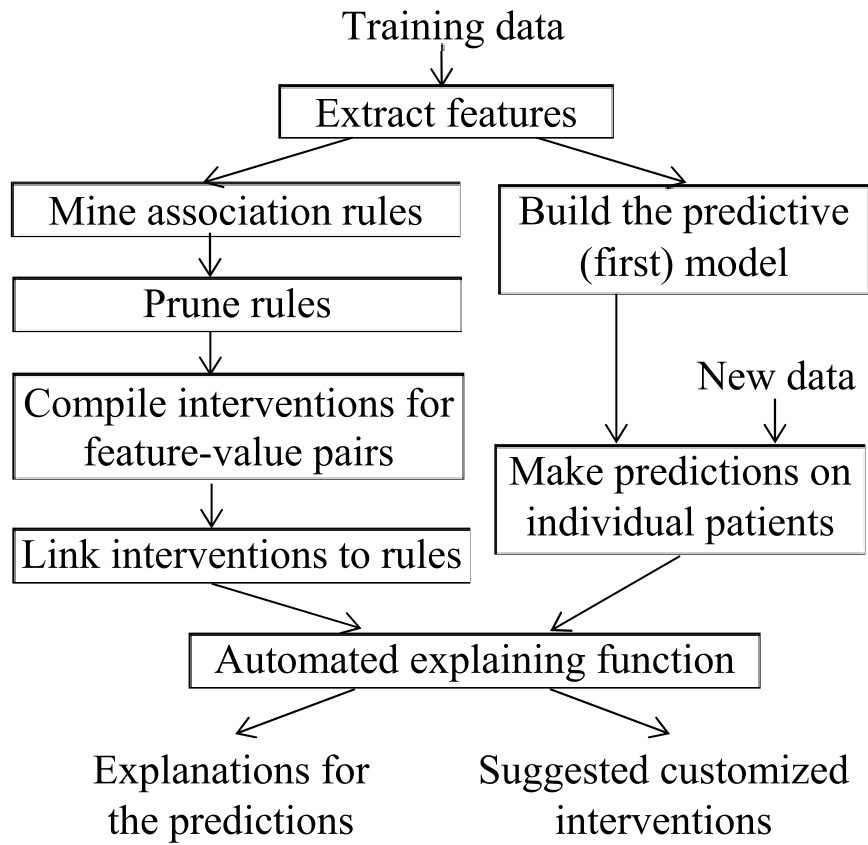 Figure 1: The flow chart of the automated explanation method, showing the separation between prediction and rule-based explanation.
Pruning for Relevance
To prevent a "combinatorial explosion" of rules, the authors introduced several pruning techniques:
- Commonality & Confidence: Rules must meet a minimum frequency and precision.
- Confidence Difference Bound (): Eliminating redundant, overly specific rules that don't significantly improve confidence over a more general rule.
- Clinical Tagging: Ensuring rules only include features positively correlated with poor outcomes.
Results: Solid Performance at UWM
The system was tested on 82,888 data instances from UWM (2011–2018). While academic healthcare systems typically treat "sicker and more complex" patients compared to non-academic systems, the method proved highly generalizable.
- Coverage: The explainer covered 87.6% of accurate high-risk predictions.
- Information Density: While some patients satisfied thousands of rules, the number of unique actionable items was manageable (average of 26.62 per patient).
- Predictive Power: The underlying XGBoost model maintained high performance with an AUROC of 0.902.
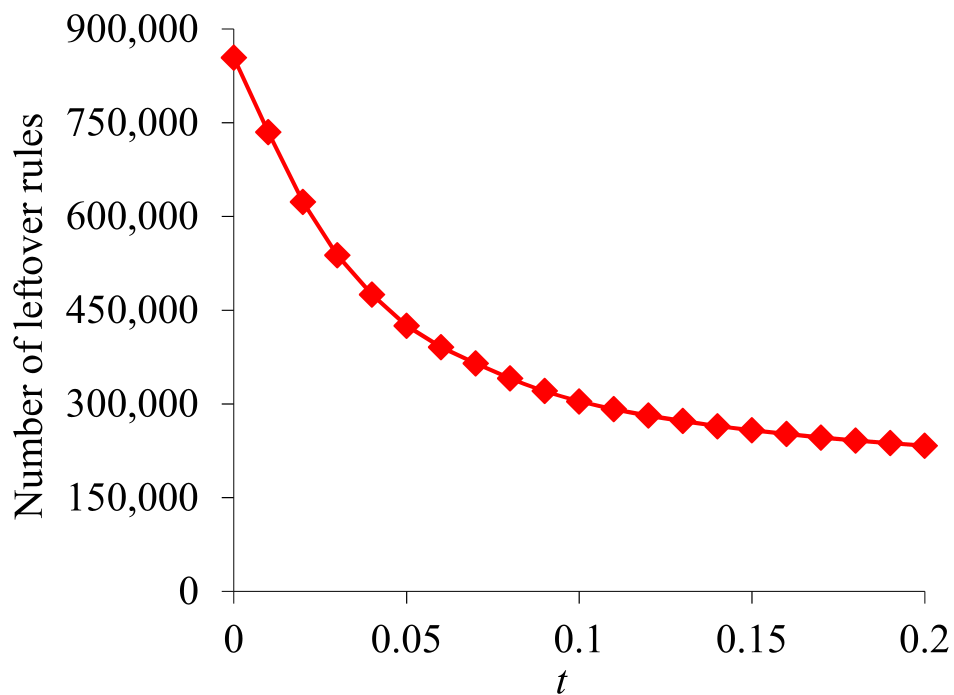 Figure 2: The impact of the confidence difference bound (t) on the number of leftover rules, demonstrating how the system filters for the most impactful insights.
Deep Insight: Why Rule-Style Explanations?
Unlike "Feature Importance" scores (like SHAP or LIME) that tell you which variable mattered globally, Rule-Style Explanations provide a specific "pathway" for an individual patient.
The blog presents examples where the rules capture complex clinical interactions. For example, a patient with zero outpatient visits (suggesting no primary care provider) combined with high asthma diagnoses creates a specific risk profile that leads directly to a social resource intervention. This "Logic-to-Action" pipeline is what makes the work valuable for real-world deployment.
Critical Analysis & Conclusion
Takeaway
The study successfully validates that automated interpretability tools developed on one healthcare system (Intermountain Healthcare) can generalize to another (UWM) despite differences in patient complexity. This is a massive win for the "copy-paste" potential of AI in medicine.
Limitations & Future Work
- Rule Overload: Patients can satisfy thousands of rules. Future work should focus on ranking rules by clinical "impact" rather than just statistical confidence.
- Data Types: The method targets tabular data. Extending this to deep learning models (RNNs/Transformers) dealing with temporal, longitudinal EHR data is the next frontier.
In conclusion, by providing a rational, clinical structure for ML predictions, the authors have created a blueprint for how AI can be integrated into the human-centric workflow of care management.