
Logic Meets Influence: Leveraging GAPs for Social Network Optimization
Using Generalized Annotated Programs to Solve Social Network Diffusion Optimization Problems
This paper introduces Social Network Diffusion Optimization Problems (SNDOPs) and presents a framework for solving them using Generalized Annotated Programs (GAPs). It enables finding an optimal set of nodes to maximize or minimize a diffusion process (e.g., product adoption or disease spread) within a social network.
TL;DR
This research bridges the gap between Generalized Annotated Programs (GAPs) and Social Network Diffusion. It defines the SNDOP (Social Network Diffusion Optimization Problem) to identify the most influential nodes in a network. By proving submodularity for a class of "Linear GAPs," the authors introduce an approximation algorithm that hits the theoretical limit of efficiency.
Background: Navigation the Diffusion Landscape
In the study of social networks, understanding how information, diseases, or products spread is critical. Historically, researchers have used three distinct models:
- Tipping Models: Behavior changes once a threshold of neighbors is met.
- Cascade Models: Probabilistic spread from node to node (common in epidemiology).
- Homophilic Models: Spread based on the similarity between users rather than just their connections.
The authors argue that prior work was too fragmented. Real-world scenarios are often "hybrids" (e.g., Flickr favorites spreading via both similarity and network cascades). We need a unified language—and this paper finds it in Logic Programming.
Methodology: The GAP Framework
The core innovation is using Generalized Annotated Programs (GAPs) to represent the "physics" of the network. In a GAP, atoms are "annotated" with values—usually representing confidence or the degree of infection.
1. Unified Representation
A social network is embedded into a GAP where rules define the logic of spread. For example, a tipping model rule might state that a node's probability of "buying a product" is the weighted average of its neighbors' statuses.
2. The SNDOP Query
The authors define a formal query :
- agg: The objective (e.g., SUM of all influenced nodes).
- VC: Vertex Conditions (e.g., only "Active Users" can be targeted).
- k: The budget of nodes to seed.
3. Submodularity and the Greedy Approach
The "aha!" moment of the paper is proving that if the GAP rules are Linear (annotations are linear combinations of body variables), the objective function becomes submodular. This is a massive win because submodular functions can be optimized greedily with a guaranteed performance of of the global optimum.
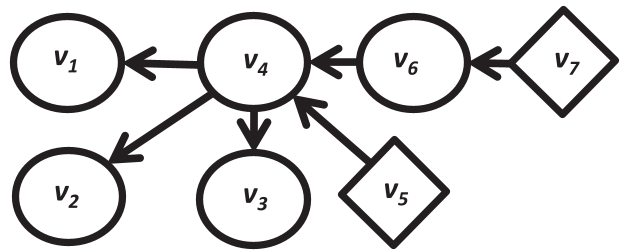 Figure 1: Visualizing disease spread logic within the GAP framework.
Experiments: Scaling to Wikipedia
The authors tested their GREEDY-SNDOP algorithm on a dataset of Wikipedia admin votes, treating "votes" as a proxy for social influence.
Performance Insights
The experiments revealed a stark difference between diffusion types:
- Tipping Models (Jackson-Yariv) were generally faster to compute than Cascade Models (SIR).
- The "Lazy Evaluation" technique (pruning redundant calculations) proved essential for scaling to the 103,000+ edges in the Wikipedia network.
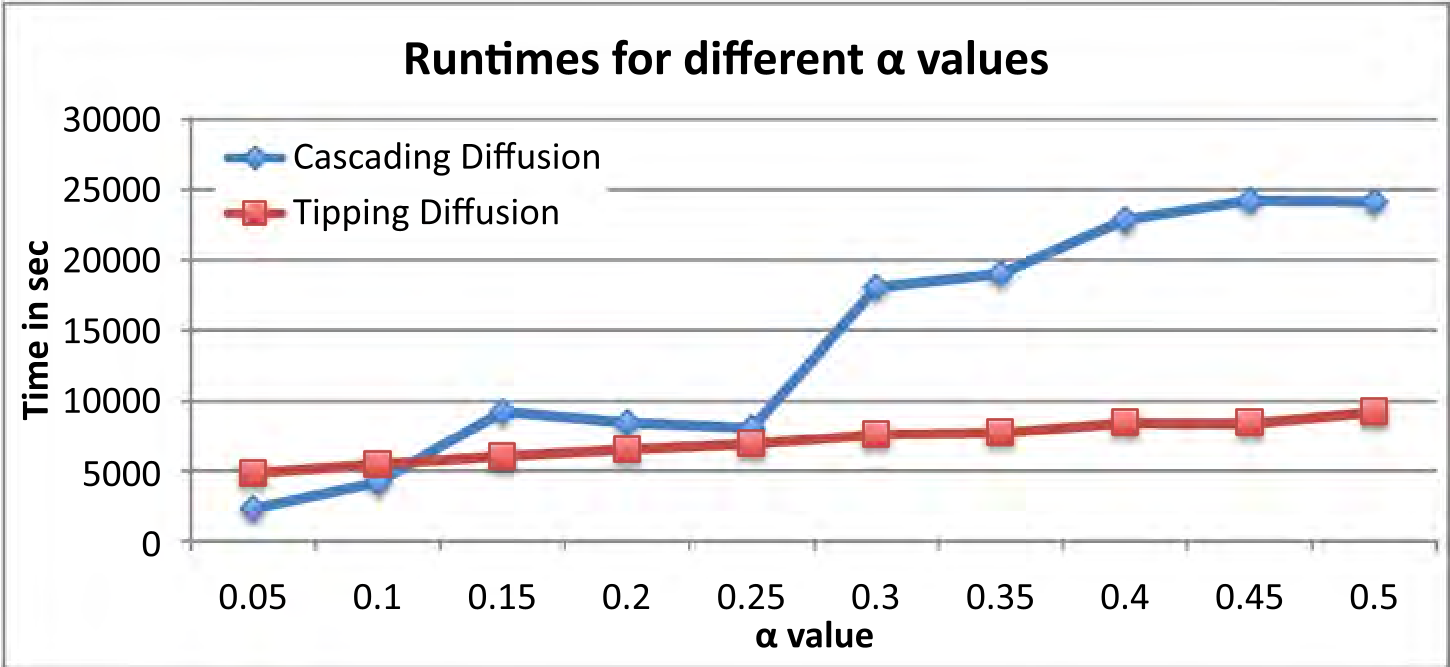 Figure 2: Runtime of GREEDY-SNDOP across different influence strengths ().
Critical Analysis
Why this matters
Most "influence maximization" research (like the seminal work by Kempe et al.) focuses on purely probabilistic graphs. By using GAPs, this paper allows for Logical Constraints. You can now ask: "Find the best 10 people to vaccinate who are over age 65 and have not been previously infected." This level of metadata-aware reasoning is a significant step forward.
Limitations
- Non-Linearity: Many complex social phenomena are non-linear. The authors admit that while GAPs can represent these, the submodularity proof (and thus the greedy guarantee) may not hold.
- Scalability: While 7,000 nodes is a good start, modern social networks (billions of nodes) would require massive distributed computing power to run these logic fixpoint operators.
Future Outlook
The marriage of Deductive Databases and Social Network Science is just beginning. As the industry moves toward "Knowledge Graphs," representing diffusion as a set of logical rules rather than just a black-box probability matrix will be vital for explainability and precision in marketing and public heath.