
The Physics of Fame: Optimizing Social Media Popularity via Fractional Programming
A Generalized Fractional Program for Maximizing Content Popularity in Online Social Networks
The paper proposes a "generalized" fractional programming approach to maximize content popularity in Online Social Networks (OSNs) like Facebook or Twitter. It models popularity primarily as a function of the time a post spends in the top position of a news feed and presents an efficient gradient-based algorithm for optimizing posting rates across different topics.
TL;DR
In the digital attention economy, being "first" is everything. This paper provides a mathematical blueprint for becoming popular on Online Social Networks (OSNs) by viewing posting strategy as a resource extraction problem. By modeling news feed dynamics with Poisson processes and generalized fractional programming, the authors provide a gradient-based algorithm that tells a source exactly what to post and how often to post it to maximize engagement.
Academic Positioning: This work bridges the gap between empirical social media studies and formal optimal control theory, moving beyond simple viral "cascades" toward a "flow control" perspective.
Problem & Motivation: The Battle for the Top Spot
Why do some posts explode while others vanish? The authors identify a crucial observation: in "anti-chronological" feeds (like Twitter or Facebook's "Most Recent"), popularity is almost entirely dictated by the duration a post spends at the first position.
They equate this to the "Oil Producer Problem"—a classic economic model where a producer pumps oil until the return decreases, then moves to a new well. In OSNs, every new post from any user "pushes" your content down, effectively drying up your well of engagement. The core challenge is to balance the cost of posting (spamming/monetary) against the decaying return of being pushed out of sight.
Methodology: Flow Control and Fractional Programming
The authors define a source's strategy as a vector of intensities representing the rates of posting for different topics.
1. The Popularity Model
The evolution of popularity is modeled as a non-homogeneous Poisson process. The total expected popularity is derived from how long a post stays at the top before the next arrival occurs.
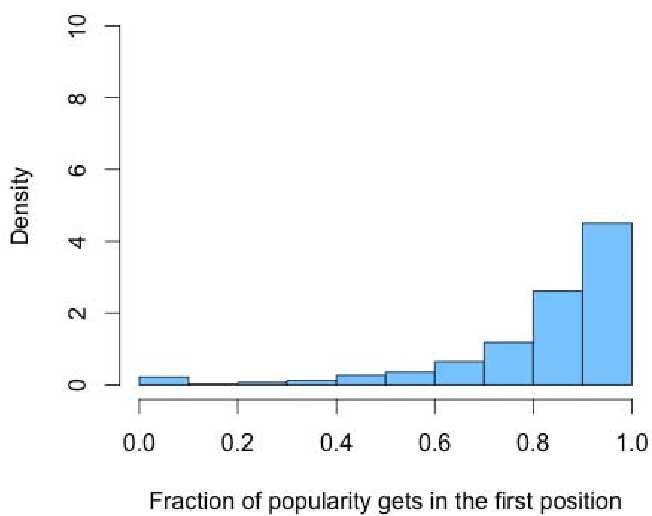 Fig 1: Empirical evidence showing that over 70% of posts get 80% of their popularity in the first position.
2. Standard Popularity Functions
The paper evaluates three types of "Popularity Functions" ():
- Constant: Popularity grows linearly with time.
- Linear: Growth accelerates or decelerates.
- Michaelis-Menten: A biological model representing saturated growth.
The authors proved that under these standard functions, the objective function is pseudo-concave, allowing the use of efficient convex optimization tools.
3. The Algorithm
The "Popularity Optimization Problem" (PoP) is transformed into a Generalized Fractional Program. The source's net utility is: The optimal solution determines that a source should ideally focus on the single topic that offers the best "Popularity-over-Cost" ratio.
Experiments & Results: Proving the Math
Using data from a French political page (Anne Hidalgo), the authors estimated the parameters for their models. The results were striking: the Michaelis-Menten model achieved a correlation level of 0.95 with real-world comment data.
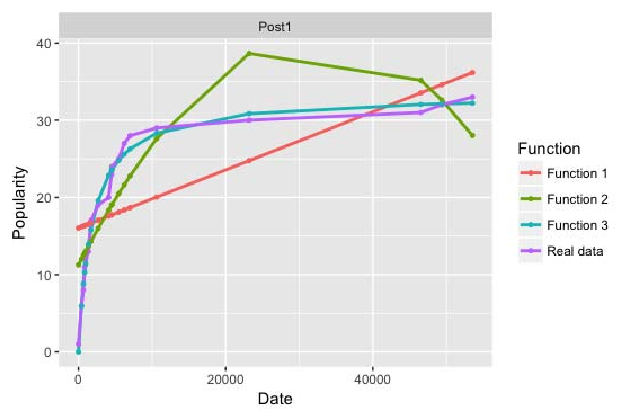 Fig 2: Estimation of Different Popularity Functions against actual post data.
The proposed projected gradient algorithm demonstrates rapid convergence. As shown in the figure below, the algorithm iterates through potential topics to find the specific intensity that maximizes utility before settling on the most profitable topic.
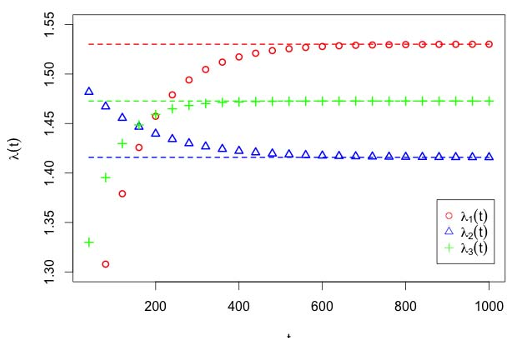 Fig 3: Gradient algorithm converging to the optimal posting rate for various topics.
Critical Insight & Conclusion
Takeaway
The paper mathematically confirms what many social media managers feel: quality/topic selection beats volume. Because the news feed is a zero-sum game for the top spot, increasing your posting rate () eventually increases the "effective noise" for your own previous posts.
Limitations
- Algorithmic Feeds: The model assumes anti-chronological order. Modern "Relevance-based" algorithms (TikTok, Facebook's "Top Stories") introduce black-box variables that Poisson processes might not fully capture.
- Single Source Bias: The model treats other users' posts as a stationary background flow (), ignoring potential strategic reactions from competitors.
Future Outlook
The integration of Convex Constraints (e.g., anti-spamming limits, fairness between topics) makes this framework highly practical for developing automated scheduling tools for social media marketing suites.