
Generalized Lottrees: Balancing the Budget in Crowdsourcing Referral Networks
Generalized Lottery Trees: Budget-Balanced Incentive Tree Mechanisms for Crowdsourcing
2020-03-09
Summary
Problem
Method
Results
Takeaways
Abstract
This paper proposes Generalized Lottrees, the first class of budget-balanced incentive tree mechanisms for crowdsourcing that satisfy essential properties like Sybil resistance and solicitation incentives. By introducing three variants—1-Pachira, K-Pachira, and Sharing-Pachira—the authors provide a framework that ensures the total payout exactly matches the announced budget.
## Executive Summary
**TL;DR**: This paper tackles the "trust gap" in referral-based crowdsourcing by introducing **Generalized Lottrees**. Unlike previous multi-level marketing (MLM) incentives that risk breaking the bank or underpaying promised amounts, this framework guarantees **Budget Balance (BB)** while remaining robust against Sybil attacks.
**Background**: In the landscape of Mobile Crowd Sensing (MCS), we often rely on participants to recruit others via "word-of-mouth." However, designing a fair, budget-capped, and referral-friendly system is notoriously difficult. This work occupies a unique SOTA position by bridging the gap between game-theoretic proofs and the cognitive psychology of human participants.
## The Problem: The Credibility Gap in Incentive Trees
Traditional crowdsourcing mechanisms often assume a "passive" pool of workers. To scale, researchers turned to **Incentive Trees**, where users are rewarded for their contributions *and* their solicitations.
The deal-breaker? **The Budget.**
Most tree mechanisms ignore budget limits. The few that do (like the original Pachira lottree) often fail to pay out the *exact* amount promised. If a platform promises $100 but pays $80 due to technical probabilistic quirks, users lose faith. This lack of "Budget Balance" is what this paper aims to fix.
## Methodology: Redesigning the Lottery
The core of the paper is the **First-is-Root Rescaling**. In a standard lottery tree, the root (the crowdsourcer) might "accidentally" win some of the reward probability. The authors prove that assigning this "lost" probability to the **first participant** (the first-is-root) preserves every desirable property:
1. **CCI/CSI**: Incentives to contribute and solicit remain.
2. **USA (Unprofitable Sybil Attack)**: Users can't game the system by creating fake accounts.
3. **USB (Unprofitable Solicitor Bypassing)**: New users can't gain more by bypassing the person who invited them.
### Mechanism Architecture
The authors provide three variants to suit different "perceived values" of rewards:
* **1-Pachira**: One lucky winner takes all.
* **K-Pachira**: K winners share the pot.
* **Sharing-Pachira**: Everyone gets a slice proportional to their "lottery value."
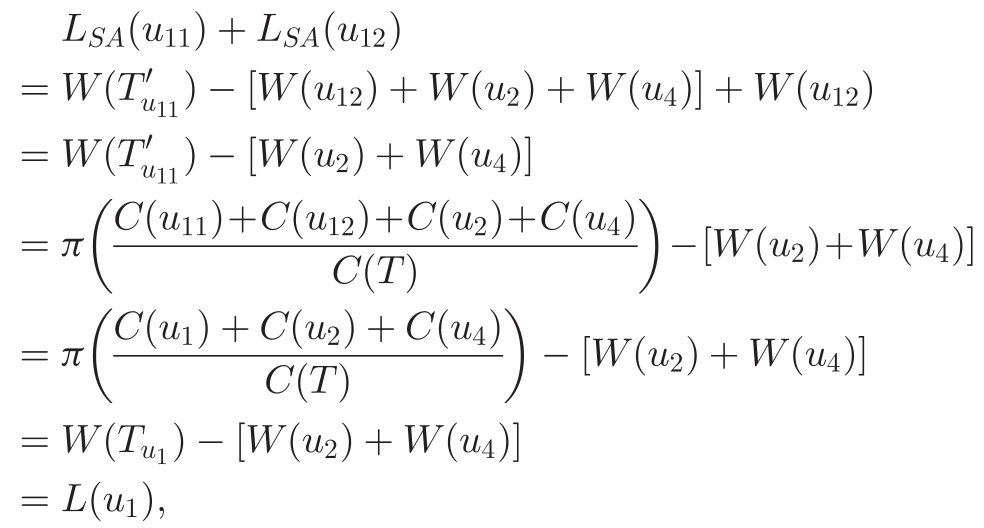
*Illustration of different rescaling strategies to achieve Budget Balance.*
## The Psychological Insight: Why Lottery?
The most profound part of this work is the application of **Cumulative Prospect Theory (CPT)**. Humans don't view a 1% chance at $100 the same way they view a $1 guaranteed payment.
The research identifies a **Critical Lottery Value**:
* **Small Budget / Many People**: Users prefer the **1-Pachira** (Lottery) because the individual share in a linear split would be too tiny to care about.
* **Large Budget / Few People**: Users prefer **Sharing-Pachira** (Deterministic) as the guaranteed reward becomes meaningful.
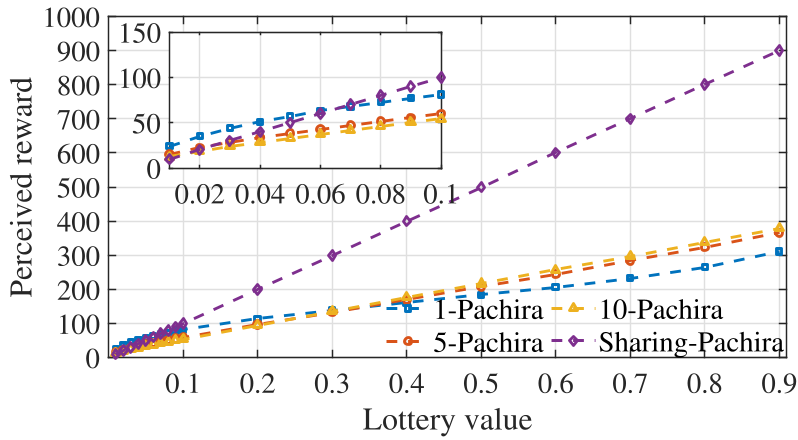
*CPT-based analysis showing how users perceive payout based on their winning probability.*
## Experiments: "Treasure Hunt"
The authors built a mobile game called **Treasure Hunt** to test these theories with 82 real users.
**Key Findings**:
* **RPR (Relative Participation Ratio)**: In low-budget tasks (50 CNY), the lottery (1-Pachira) attracted significantly more active users.
* **Total Contribution**: When many participants were required, the 1-Pachira mechanism outperformed sharing in terms of total data gathered (TCP).
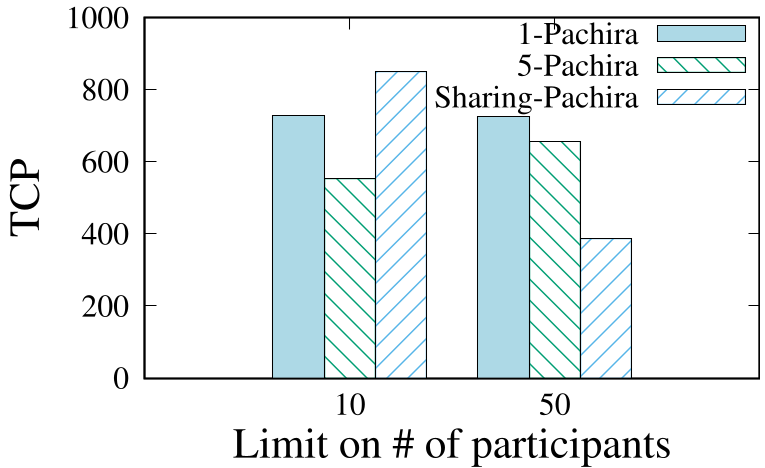
*SOTA comparison of contributions under varying participant limits (N).*
## Critical Analysis & Conclusion
**Takeaway**: This paper is a masterclass in combining rigorous math with human psychology. By solving the "Budget Balance" problem, it makes referral-based crowdsourcing viable for commercial platforms that need strictly predictable financial modeling.
**Limitations**: The "First-is-Root" strategy gives a huge advantage to early adopters. While this solves the "cold start," it might discourage users from joining later if they feel the "extra" probability is already gone. Future work could investigate "Dynamic Rescaling" where the root's value is decayed or distributed over time.
**Outlook**: As we move toward decentralized sensing (DePIN), mechanisms like Generalized Lottrees will be essential in managing token distributions without collapsing under Sybil attacks.