
Generalized Lottery Trees: Mastering the Psychology of Incentive-Based Crowdsourcing
Generalized Lottery Trees: Budget-Balanced Incentive Tree Mechanisms for Crowdsourcing
The paper introduces "Generalized Lottery Trees," a novel family of budget-balanced incentive mechanisms for crowdsourcing that rewards both direct task contributions and social solicitations. It presents three variants—1-Pachira, K-Pachira, and Sharing-Pachira—to address diverse recruitment needs while ensuring theoretical properties like Sybil-proofness and budget balance.
TL;DR
Recruiting participants for mobile crowdsourcing (like finding a lost child or urban sensing) is hard. This paper proposes Generalized Lottery Trees, the first "Budget-Balanced" referral mechanism. By combining recursive social networking incentives with the cognitive psychology of lottery gambling, the authors provide a rigorous guide on when to offer a "Big Prize" vs. "Micro-payments" to maximize crowd contribution.
Background: Beyond the Static User Base
Most academic work in crowdsourcing assumes a captive audience: users are already logged in and waiting for tasks. In reality, the "word-of-mouth" effect is essential. Referring friends via social media (Facebook, WeChat) creates an Incentive Tree. However, existing tree mechanisms suffer from two fatal flaws:
- Unbounded Payouts: The organizer might go broke if the tree grows too large.
- Lack of Budget Balance: If the organizer promises 80 due to complex tree logic, users lose trust and quit.
The Mechanism: Redesigning Pachira
The authors build upon the "Pachira Lottery Tree." In a lottery tree, your contribution and the contributions of everyone you recruited act as "lottery tickets." The more value you add to the tree, the higher your probability of winning the budget.
1. The Challenge of Budget Balance (BB)
To ensure the total payout exactly equals the budget (), the authors introduced the First-is-Root Rescaling. In typical trees, the "root" (the crowdsourcer) often ends up with a leftover probability of winning. By giving this leftover probability to the very first participant, the mechanism ensures is always fully distributed while maintaining protection against Sybil Attacks (creating fake accounts) and Solicitor Bypassing (users trying to jump levels in the tree).
2. The Three Flavors of Pachira
- 1-Pachira: Winner-take-all. One person gets the whole budget.
- K-Pachira: winners share the budget equally.
- Sharing-Pachira: Every participant gets a slice proportional to their "lottery tickets" (deterministic).
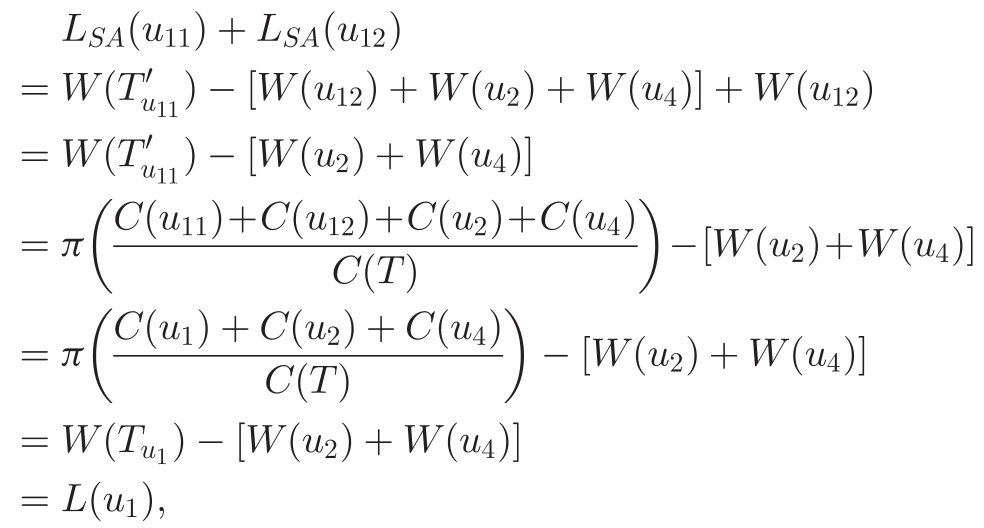 Above: Different strategies to handle the "root" reward to ensure the system remains fair and balanced.
The Insight: Why Cumulative Prospect Theory (CPT) Matters
The most profound contribution of this paper is the application of Cumulative Prospect Theory (CPT) to mechanism selection.
Traditional economics assumes people are rational and care about "Expected Utility." CPT recognizes that human psychology is "warped":
- Low Probability/High Gain: Humans are risk-seeking (we buy lottery tickets because the "dream" feels bigger than the math).
- High Probability/Low Gain: Humans are risk-averse (we prefer a guaranteed 1.20).
The Selection Guideline
Through numerical analysis, the authors prove a Critical Lottery Value:
- Small per-capita reward? Use 1-Pachira. The "gambling" aspect attracts more users than a tiny, guaranteed micro-payment.
- Large per-capita reward? Use Sharing-Pachira. Once the reward is significant, users prefer the safety of a guaranteed payout.
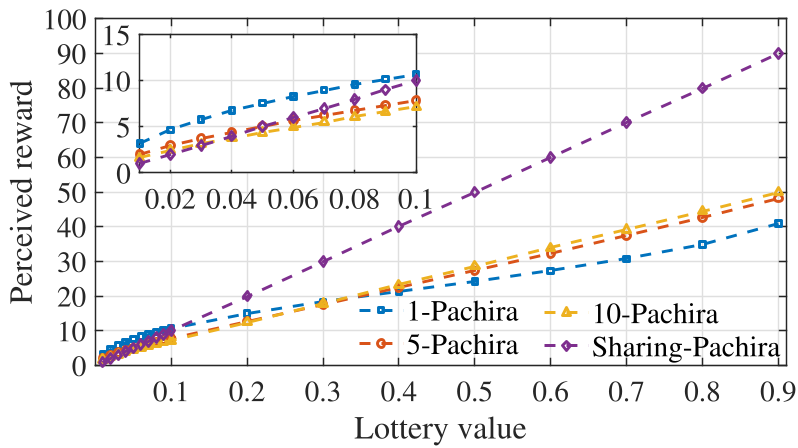 Above: Perceived reward levels showing how users favor the 1-Pachira "lottery" at low winning probabilities.
Real-World Evidence: The Treasure Hunt
To test the theory, the team developed "Treasure Hunt," a mobile game where users scan for Bluetooth beacons (simulating finding a lost object).
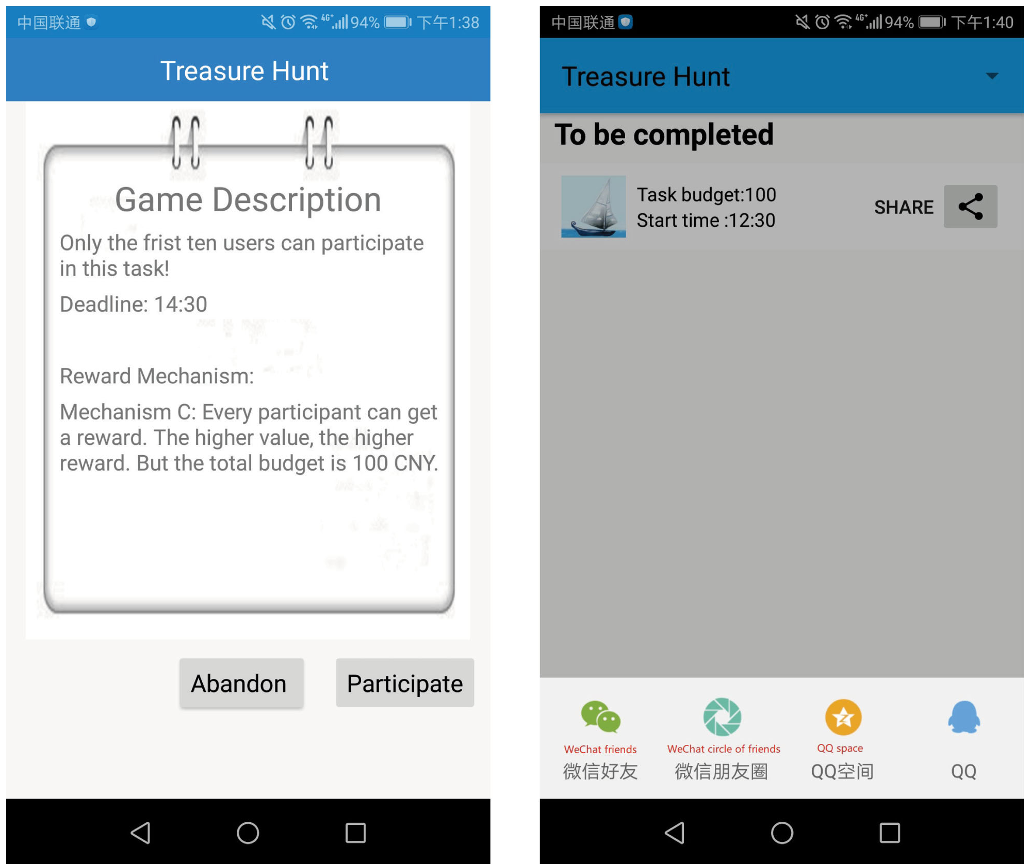
The results across 12 different tasks confirmed the theory:
- Total Contribution (TCP): When the budget was low (50 CNY), the 1-Pachira lottery stimulated the most "hunt" activity. When the budget was high (500 CNY), the Sharing-Pachira model led to the highest total engagement.
- Participation Ratio: Lottery-based models were more effective at maintaining engagement during "dry" periods with small budgets.
Conclusion and Outlook
This work provides a solid theoretical bridge between incentive design and behavioral economics. By proving that a Budget-Balanced lottery tree can be Sybil-proof, it opens the door for high-stakes crowdsourcing (emergency response, environmental monitoring) where recruitment costs are currently a major barrier.
Future Work: The authors suggest exploring more complex "multi-treasure" scenarios and dynamic budgets where the reward might increase as the urgency of the task grows.