
GSBM: Unifying Social Ties and Rating Patterns via Mixed Membership Blockmodels
A generalized stochastic block model for recommendation in social rating networks
This paper introduces the Generalized Stochastic Blockmodel (GSBM), a generative probabilistic framework for Social Rating Networks (SRNs). It extends the Mixed Membership Stochastic Blockmodel (MMB) to jointly model social link creation and user-item rating behavior, achieving competitive performance in both rating prediction and link prediction tasks.
TL;DR
The Generalized Stochastic Blockmodel (GSBM) is a landmark approach to Social Rating Networks (SRNs). Unlike traditional models that treat "who you follow" and "what you like" as separate problems, GSBM treats them as dual manifestations of a single latent reality: your membership in overlapping social communities. By unifying these, it provides a comprehensive tool for rating prediction, link prediction, and community discovery.
Problem & Motivation: The "Silo" Problem in Recommendation
Before GSBM, the recommendation landscape was split. On one side, Collaborative Filtering (CF) and Matrix Factorization (MF) looked strictly at user-item matrices. On the other, Social Recommendation models like TidalTrust or MMB looked at the social graph.
However, sociologists have long argued that two forces shape our digital lives:
- Social Influence: You start liking things because your friends like them.
- Selection (Homophily): You become friends with people because you already share similar tastes.
The authors argue that a model failing to capture both is fundamentally incomplete. Furthermore, they identify that users don't belong to just one group—a professor is a researcher in one context and a father in another. This necessitates a Mixed Membership approach.
Methodology: The Generative Logic
The core of GSBM is its generative process. It assumes latent groups for users and for items.
1. The Membership Vectors
Every user has a distribution and every item has . These represent the "degree" to which a user or item belongs to specific latent categories.
2. The Interaction Matrices
- : A matrix defining the probability of a link between user groups.
- : A tensor defining the probability of a specific rating (1-5) occurring between a user group and an item group.
3. Handling Sparsity
Social networks are notoriously sparse. GSBM introduces two sparsity parameters, (for links) and (for ratings), to account for the fact that a missing interaction doesn't always imply a negative preference—sometimes it's just a "non-observation."
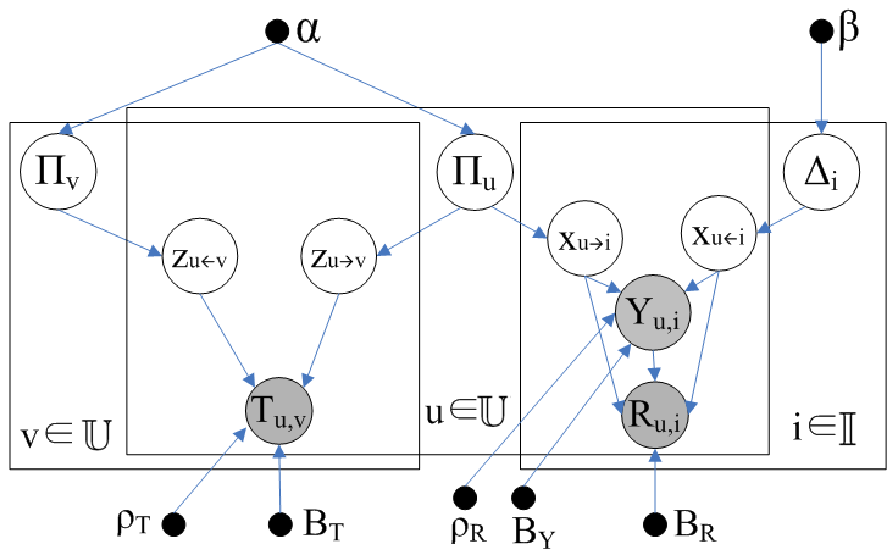 Figure 1: The graphical model showcasing the dependencies between latent memberships and observed ratings/links.
Experiments & Results
The authors tested GSBM on Flixster and Epinions, two datasets that feature both ratings and explicit social links.
Rating Prediction Performance
GSBM achieved significantly lower RMSE than standard CF and MF, proving that social data provides a powerful inductive bias. While specialized social models like SocialMF (which explicitly optimizes for rating RMSE) were slightly better, GSBM remained highly competitive while offering more features.
| Model | Flixster (RMSE) | Epinions (RMSE) |
|---|---|---|
| CF | 0.913 | 1.181 |
| MF | 0.911 | 1.175 |
| GSBM | 0.884 | 1.092 |
Link Prediction: The Selection Effect at Work
In the task of predicting who will follow whom, GSBM outperformed the original Mixed Membership Stochastic Blockmodel (MMB).
Why? Because MMB only looks at existing links. GSBM looks at links and ratings. If two users have never met but both give 5 stars to obscure indie films, GSBM recognizes their latent similarity via the item-group bridge and accurately predicts a future social tie.
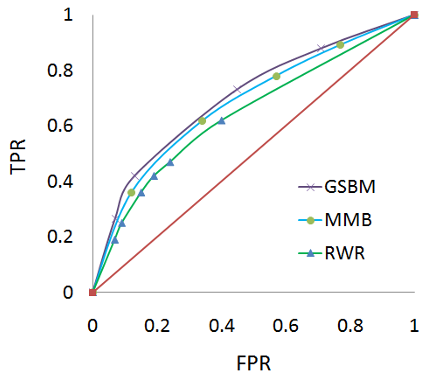 Figure 2: ROC comparison showing GSBM's superior performance in link prediction over MMB and Random Walk with Restart (RWR).
Critical Analysis & Conclusion
Takeaway
GSBM proves that "Relational" and "Attribute" data are two sides of the same coin. By modeling items as having latent memberships just like users, the model creates a "Social-Item Manifold" that captures complex community nuances that simpler matrix factorization misses.
Limitations
The primary bottleneck of GSBM is computational complexity. Because it models interactions at the pair-level for all users and items, the memory and time requirements are significant (). Although the authors implemented a parallel version using Intel Cilk Plus, it still took 24 hours to converge on relatively small samples by today's standards.
Future Outlook
This work laid the foundation for modern Graph Convolutional Networks (GCNs) in recommendation. Future iterations of this logic would likely replace the manual variational inference with Amortized Inference (Variational Autoencoders) or use Graph Embeddings to scale the GSBM intuition to billions of edges.