
DGSH: Bridging the Gap in Social Communities via Spectral Bisection
Generalized Structural Holes Finding Algorithm by Bisection in Social Communities
This paper introduces the concept of "Generalized Structural Holes" (GSH) to describe the clusters of vertices that bridge multiple communities in social networks. The authors propose the DGSH algorithm, a spectral bisection heuristic based on the Laplacian matrix's second smallest eigenvector (Fiedler Vector), achieving SOTA-level efficiency in identifying critical network bottlenecks.
TL;DR
Social networks are more than just clusters (communities); they are defined by the "gaps" between them. This paper introduces Generalized Structural Holes (GSH)—the critical vertices that act as bridges between communities. By utilizing Spectral Graph Theory and the Fiedler Vector, the authors propose the DGSH algorithm, which efficiently identifies these bridges even in massive, sparse networks.
The Missing Link: Why Structural Holes Matter
In sociology, a "structural hole" is the absence of a tie between two parts of a network. While previous research focused on how individuals can exploit these holes for personal gain, this paper shifts the focus to the macro-level: How do we identify the specific group of nodes that hold two massive communities together?
The challenge is twofold:
- Complexity: In large-scale networks (millions of nodes), a single "bridge" node rarely exists. Instead, multiple nodes form a "Generalized" structural hole.
- Computation: Finding the optimal set of nodes to disconnect two communities is an NP-complete problem, similar to the optimal RatioCut or Ncut problems in image segmentation.
Methodology: The Power of the Laplacian Matrix
The authors propose a heuristic approach called DGSH (Discovering Generalized Structural Holes). The core intuition is that the structural "middle" of a graph can be found using the eigenvalues of its Laplacian matrix.
1. Mathematical Foundation
The algorithm constructs a Laplacian matrix , where is the degree matrix and is the adjacency matrix. The "spectral" magic happens with the second smallest eigenvalue () and its corresponding eigenvector (), known as the Fiedler Vector.
2. The Bisection Heuristic
As shown in the paper's visualization, the values in the Fiedler Vector effectively "map" the nodes along a line representing the network's connectivity. Nodes at the extreme ends of the vector belong to separate communities, while nodes with values in the "middle" are the primary candidates for structural holes.
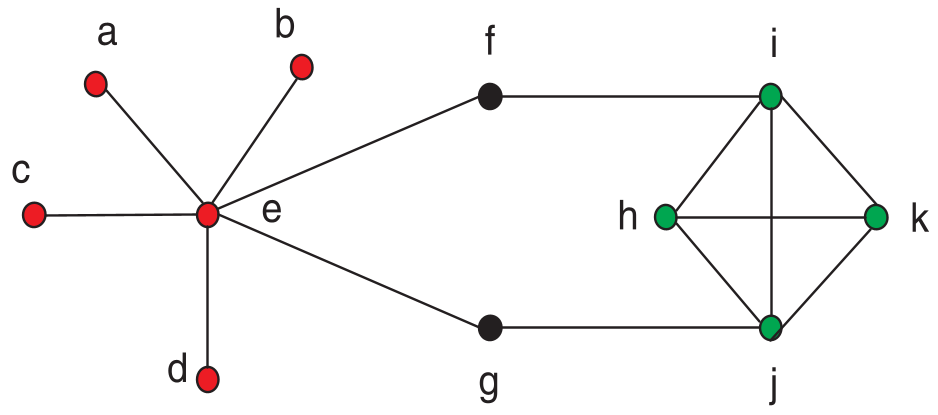 Figure 1: Comparison between a single-vertex structural hole (g) and more complex scenarios.
3. Algorithm Workflow
```markdown
1. Build Laplacian matrix L.
2. Compute the Fiedler Vector (v2) using the Lanczos method (efficient for sparse matrices).
3. Sort nodes based on v2 values.
4. Identify the bisection point that minimizes the tie cost between the two resulting sets.
```
Experiments: Performance on Balanced and Skewed Networks
The authors tested DGSH on both synthetic and real-world data (Wiki datasets).
- Balanced Networks: When two communities are of similar size, the algorithm identifies a clear cut of "green" nodes (structural holes) between them.
- Skewed Networks: Even when one community is significantly larger than the other, DGSH successfully ignores the size imbalance to find the "weakest link" connecting the two groups.
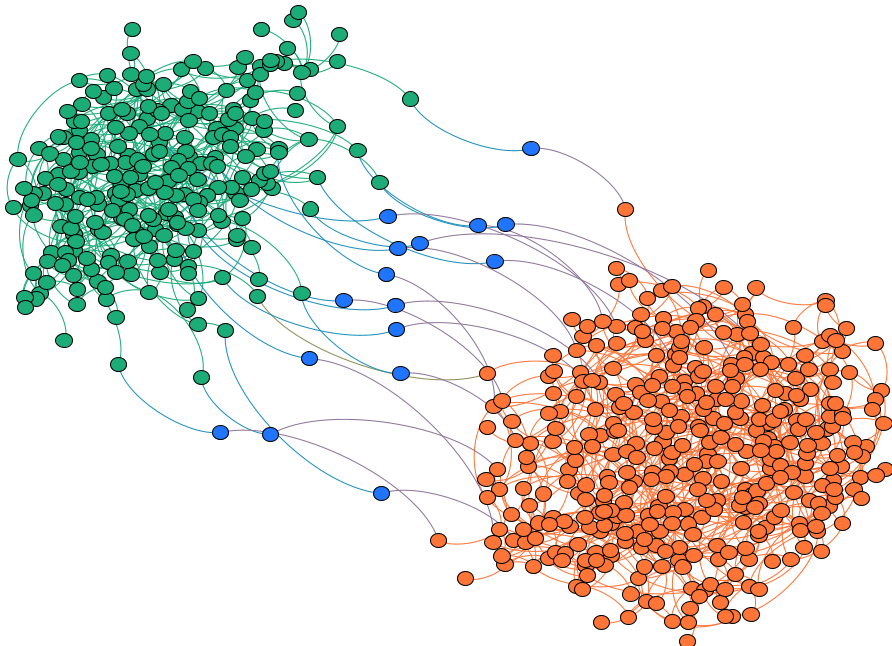 Figure 2: Experimental results showing generalized structural holes (green) between balanced communities.
Critical Insight & Future Outlook
The primary strength of this work is its scalability. By using the Lanczos method, the complexity is reduced from to roughly linear relative to the number of nodes and edges (). This makes the detection of hierarchical community structures feasible for real-world SNS platforms.
Limitations & Future Directions:
- Static vs. Dynamic: Currently, the model assumes a static snapshot of a network. In reality, social ties dissolve and form constantly.
- Weight & Direction: The current DGSH assumes undirected, unweighted graphs. Expanding this to directed "influence" graphs (like Twitter/X) remains a significant challenge.
Conclusion
By reframing sociological "structural holes" as a spectral graph partitioning problem, the authors have provided a robust tool for identifying the gatekeepers of information flow in our digital society.