
Generative AI and the Digital Commons: Escaping the Tragedy of the Data Commons
Generative AI and the digital commons
This paper explores the parasitic yet destructive relationship between Generative Foundation Models (GFMs) and the "digital commons." It proposes a governance framework involving multi-stakeholder consortia, data contribution norms, and shared ownership models to ensure GFMs sustain rather than deplete the public data ecosystems they rely on.
TL;DR
Generative Foundation Models (GFMs) like GPT-4 and Stable Diffusion are built on the backbone of the "digital commons"—the collective pool of human knowledge hosted on Wikipedia, Reddit, and open-source repositories. However, this paper warns of a looming "Tragedy of the Commons": AI is polluting the information sphere with low-quality synthetic data, potentially exhausting high-quality training resources by 2026. The authors argue for a shift from data exploitation to collective governance through monitoring consortia and shared ownership.
The Problem: The Paradox of Reuse
The fundamental tension lies in the fact that GFMs depend on public data but threaten to destroy the incentives for humans to keep producing it. The authors identify several "pollution" vectors:
- Information Poisoning: GFMs generate text and images faster than humans, flooding the internet with subtle falsehoods and "hallucinations."
- The Radiocarbon Effect: Just as nuclear testing made carbon dating difficult, the influx of AI content may make it impossible to find "untainted" human data for future AI training.
- Disincentivization: Why should an artist or coder contribute to the commons if their work is immediately "cannibalized" by a GFM that competes for their livelihood without attribution?
Methodology: A Commons-Based Governance Framework
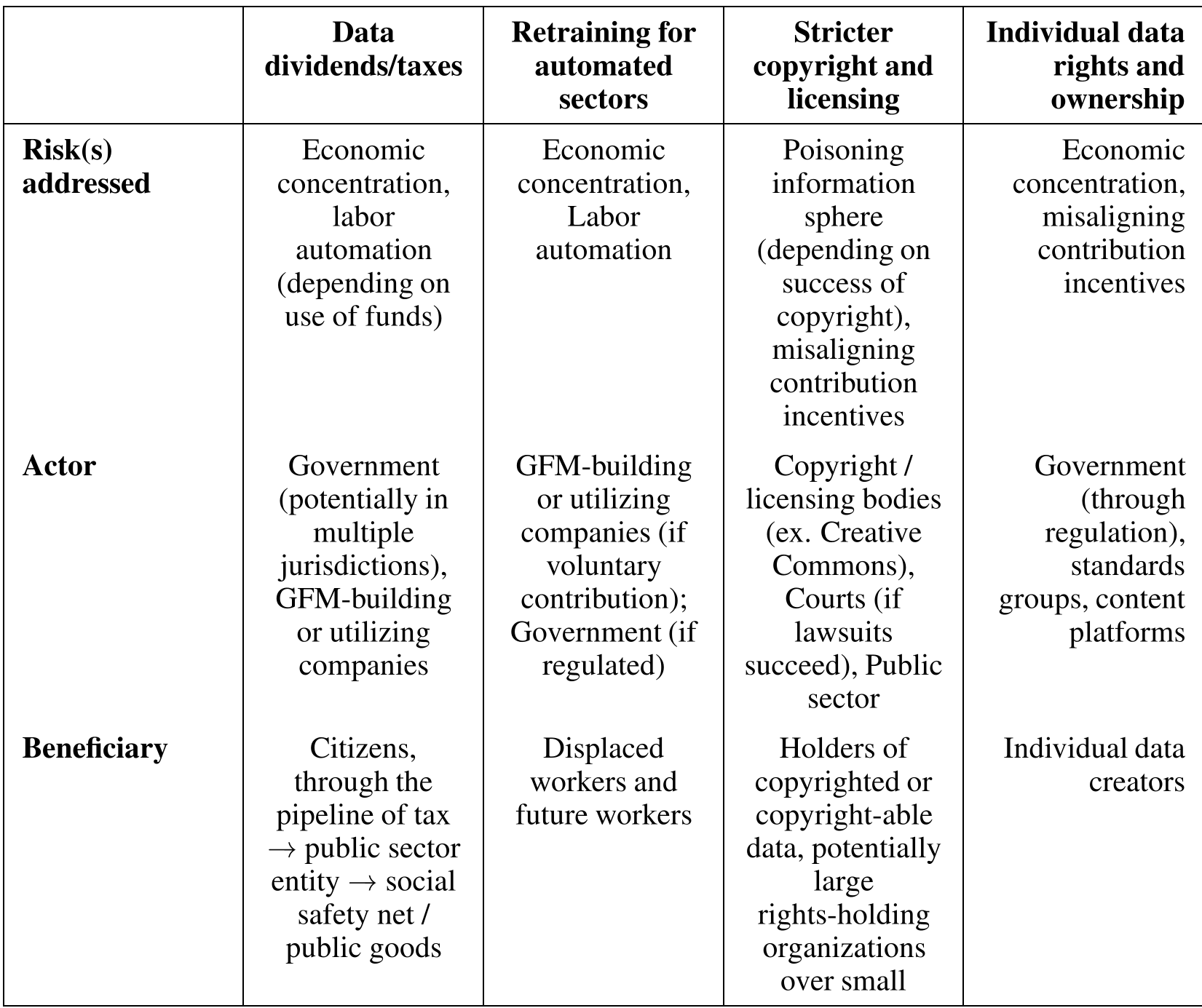
The paper rejects simple "Data Dividends" (taxing companies) or strict Copyright (which favors large incumbents) as sufficient solutions. Instead, it proposes three pillars of governance:
1. Multi-Stakeholder Consortia
Modeled after the W3C (World Wide Web Consortium), these bodies would handle:
- Auditing: Third-party verification of model biases and design choices.
- Provenance: Standards for tagging machine-generated vs. human-generated content (e.g., C2PA).
2. Reciprocal Data Contributions
Currently, GFM companies "scrape and hide." The authors propose a norm where companies must contribute "gold-standard" datasets back to the public domain—sharing their cleaning methods and high-quality labels to maintain the ecosystem's health.
3. Input-Based Governance
Instead of viewing users merely as data points, the authors suggest "Data Trusts." For instance, if a group of artists provides specialized fine-tuning data, they should receive collective ownership stakes or "governance rights" over how that specific model is used and monetized.
Key Evidence: The 2026 Data Wall
The paper cites alarming trends in "Data Exhaustion." Research suggests that the current rate of GFM training will consume the entire stock of high-quality human language data within years.

The evidence is already visible in low-resource languages. On the Scots Wikipedia, bot-generated and poor-quality content led to AI models being trained on "broken" data, resulting in a permanent degradation of model performance for that language. This is a microcosm of what could happen to the entire internet.
Deep Insight: Beyond Individual Privacy
The paper’s most profound insight is that Individual Data Rights are insufficient for AI. While GDPR focuses on my privacy, the risk of GFMs is collective—it’s about the homogenization of culture and the erosion of the "epistemic commons" (our shared ability to agree on facts).
Conclusion & Future Outlook
The authors conclude that if we continue the current "extractive" model of AI development, we risk an information ecosystem collapse. The solution isn't just better algorithms, but better institutions. We need a "Digital New Deal" where GFM creators transition from being data predators to being stewards of the digital commons.
Takeaway for Researchers: The next frontier of AI isn't just scaling parameters; it's scaling Collective Intelligence and building the legal/technical bridges between human creators and machine learners.