
Hybrid Representation Learning: Breathing New Life into Generative Models for Audio Recognition
Generative Model Driven Representation Learning in a Hybrid Framework for Environmental Audio Scene and Sound Event Recognition
This paper introduces a hybrid framework for Environmental Audio Scene Recognition (EASR) and Sound Event Recognition (SER) by utilizing generative model-driven representations (ISAGMM and ISHMM). These compact, instance-specific representations are subsequently classified using Support Vector Machines (SVM), achieving SOTA performance on DCASE and UrbanSound8K datasets.
TL;DR
Researchers have developed a hybrid framework that bridges the gap between classical generative modeling and discriminative classification. By using Instance-Specific Adapted GMMs (ISAGMM) and HMMs (ISHMM) to generate "likelihood-based" feature vectors, they achieved superior results on DCASE and UrbanSound8K datasets, proving that meticulous feature representation can outperform standard Deep Learning when data is scarce.
Background: The Chaos of Environmental Sound
Unlike speech or music, environmental audio has no "grammar." An urban scene—like a busy street—is a chaotic mix of overlapping car horns, footsteps, and wind noise.
Current SOTA methods usually fall into two camps:
- Hand-crafted features: (MFCCs, ZCR) which often struggle with polyphonic noise.
- Deep Learning: (CNNs, i-vectors) which require massive amounts of data to generalize.
The authors identify a "middle way": using generative models not as final classifiers, but as feature extractors that capture the "personality" of specific audio instances.
Methodology: The Power of Adaptation
The core innovation lies in how the models are "adapted." Instead of training one model per class on all data (which washes out instance-specific details), the authors use a two-step process:
1. ISAGMM for Scene Recognition
For scenes (e.g., "Library" vs. "Office"), they first build a class-specific base GMM. Then, for every training instance, they adapt that base model using MAP (Maximum A Posteriori) estimation.
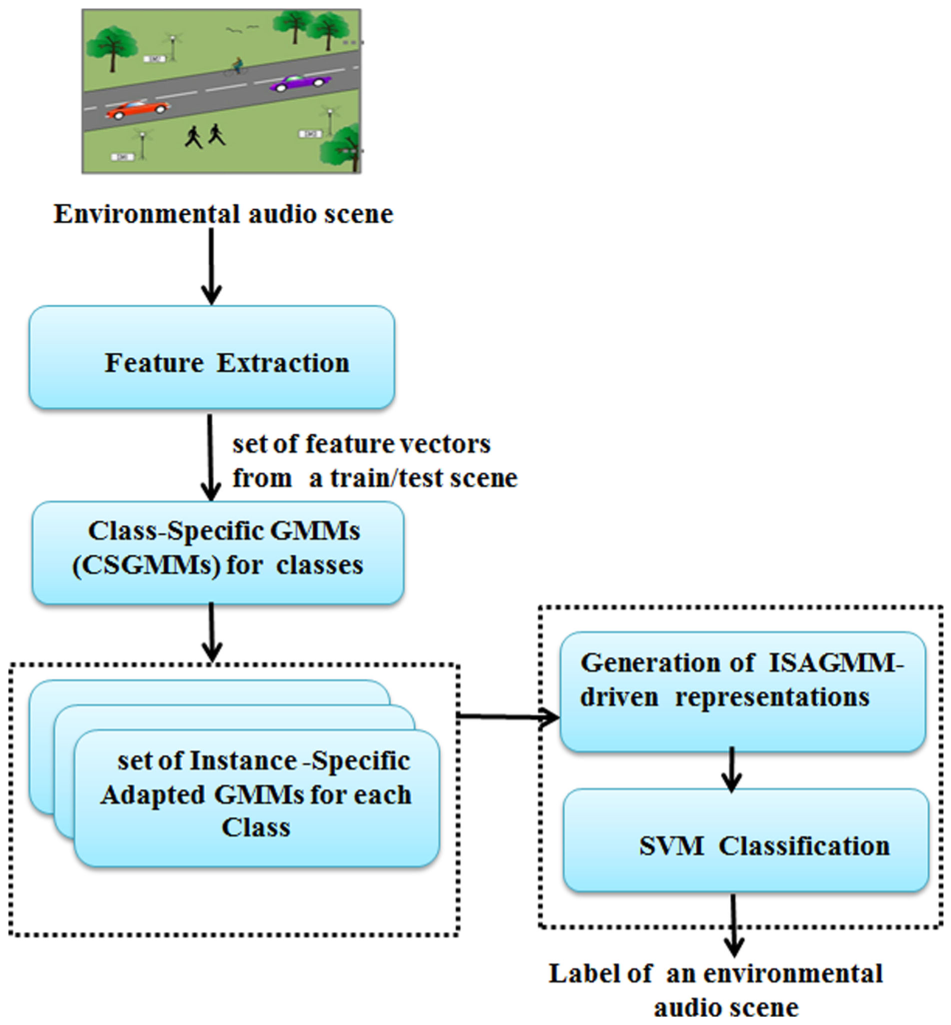
The final representation for an audio clip is a vector of log-likelihood scores across all these adapted models. Because the models are adapted from specific instances, the resulting score vector is extremely sensitive to the unique "texture" of the sound.
2. ISHMM for Event Recognition
For events (e.g., "Gunshot" vs. "Siren"), timing is everything. The authors use Hidden Markov Models (HMM) to capture temporal dynamics. By building multiple HMMs per class (each seeing only a few instances), they create a diverse "committee" of models. The scores from this committee form a discriminative feature vector for the SVM.
Experimental Results: Beating the Big Nets
The hybrid approach was tested against various baselines, including CNNs and SoundNet.
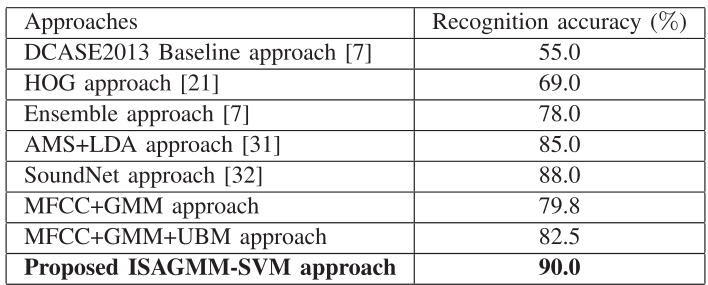
- EASR Results: On the DCASE2013 dataset, the ISAGMM-SVM reached 90.0% accuracy, beating SoundNet (88%) and standard GMMs (79.8%).
- SER Results: On UrbanSound8K, the improvement was even more dramatic. The ISHMM-SVM reached 85.47%, whereas a traditional HMM baseline could only manage 40.03%.
Why does this work? (The Intuition)
Deep Learning tends to "forget" local instance variations in favor of global class traits. By forcing the representation to be a list of "How much do I sound like Instance A? Instance B? Instance C?", the SVM receives a much richer description of the acoustic manifold than raw MFCCs could ever provide.
Critical Analysis & Conclusion
Takeaway
The study highlights that representation learning is not exclusive to neural networks. Generative models like GMMs and HMMs, when used as feature generators through adaptation, provide an efficient inductive bias for audio signals.
Limitations & Future Work
- Computational Complexity: Calculating scores against hundreds of adapted models (L-dimensional vectors) could be slow for real-time edge devices.
- Model Selection: The paper relies on empirical tuning for the number of Gaussian components. Automating this via Bayesian Non-parametrics could be a logical next step.
In conclusion, this hybrid approach is a "smart" alternative for researchers working with limited datasets or seeking more interpretable feature spaces in audio surveillance.